
 866-589-5339






What is a Car Insurance Deductible?

Get quotes from providers in your area


Last updated: August 17, 2026
Key Takeaways: Car Insurance Deductibles
A car insurance deductible is the amount you pay out of pocket before your insurer covers a covered claim.
Deductibles typically range from $0 to $2,000, with $500 and $1,000 the most common amounts.
You typically don’t pay a deductible if another driver is found at fault for the accident.
About 26% of drivers now carry a deductible of $1,000 or higher, per J.D. Power’s 2025 study.
If you bought an insurance policy with comprehensive and collision coverage, you had to set a deductible on that policy. The deductible is the amount you are responsible for paying toward repair if your car sustains damage in a covered incident, like accident or theft. Your insurance company pays for costs over the deductible. Deductibles typically range from $0 to $2,000, with $500 and $1,000 as common amounts.
What is a Car Insurance Deductible?
“Deductible” is a general insurance term for the amount that the policyholder pays before the insurance company starts to pay on a claim. There are two deductibles in an auto insurance policy.
- Collision deductible: The collision deductible applies to at-fault accidents where you need your car repaired.
- Comprehensive deductible: The comprehensive deductible applies to incidents that are not collisions but lead to car damage, like theft theft, vandalism, or a tree falling on the car.
A deductible doesn’t apply when a third party damages your vehicle and is responsible for the repairs. In that case, you’d go file a claim with their insurance company and get your car fixed with their liability coverage. Alternatively, you can file a claim with your own insurer, who will recover the damages through subrogation; in this case, you may get the deductible reimbursed, but it’s not guaranteed.

How Does a Deductible Work?
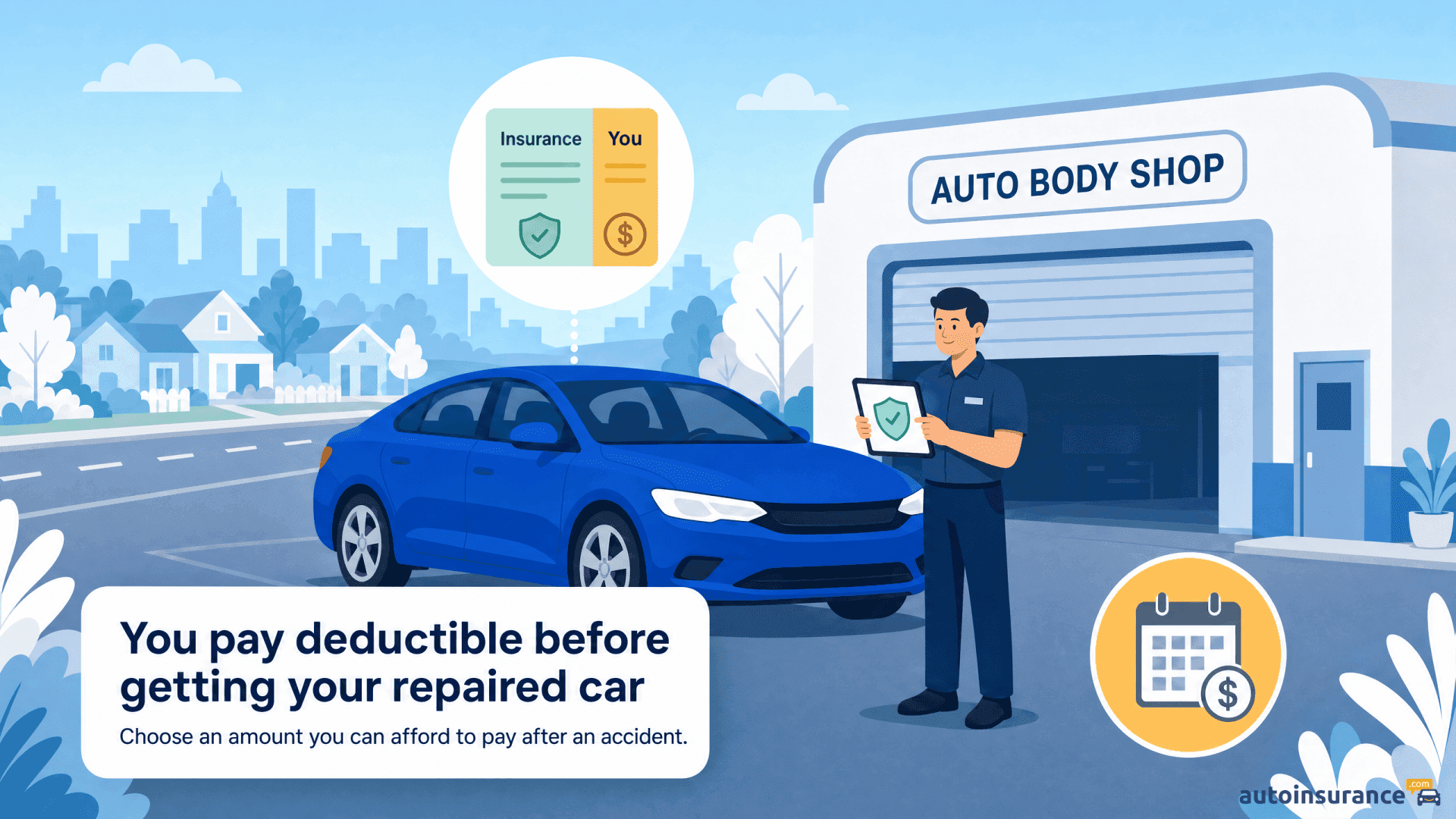
Drivers must pay their insurance deductible out of pocket before they can pick up their repaired vehicle from the shop.
In the auto insurance claims process, the deductible is your portion of the repair bill. You must pay this amount for a covered claim before your provider covers the cost of repairs. When it comes to deductibles, it’s important to choose an amount that you can afford to pay.
Assume that you were in an at-fault car accident. Your insurance policy has a $500 collision deductible, so you’ll be responsible for $500. The insurance company’s claims department will have you schedule repairs with an auto body shop.
The body shop will perform the repairs, and the insurance company will pay for the amount of those repairs, minus the deductible. Before you can pick up your fixed car, you must pay the deductible. If you don’t have $500, you won’t be able to claim your car.
| Example | Cost |
|---|---|
| Total damages | $4,000 |
| Your deductible | $500 |
| Insurance pays | $3,500 |
| You pay | $500 |
The problem could be compounded if the auto body shop has to keep your car once it’s fixed, and it may start charging storage fees.
How Do You Choose a Deductible?
In a nutshell: Choose a high deductible if you drive safely and have a savings cushion. Choose a low deductible if you’re tight on cash or you have risky drivers on your policy.
The higher your deductible, the lower your monthly premiums. However, as the example above shows, it is important to choose the right deductible for your situation.
Most companies offer deductibles between $0 and $2,000. A deductible of $500 or $1,000 tends to strike a good balance, but ultimately it comes down to your personal finances and risk tolerance.
| Deductible amount | Best fit for |
|---|---|
| $0-$250 | Drivers with little savings cushion, newer or financed vehicles, high-risk profiles (teen drivers, high mileage, hail/flood-prone areas) |
| $500 | Most drivers; the default most insurers quote first |
| $1,000 | Drivers with 3+ months of expenses in savings and a clean recent claims record |
| $2,000 | Drivers who could pay $2,000 out of pocket without financial strain and rarely file claims |
When getting a car insurance quote, ask the agent to run the numbers with different deductibles side by side. Don’t rely on rule-of-thumb percentages alone — get the actual dollar figures for your policy, since savings vary widely by insurer and state. Then, you can calculate how much you’ll save.
A quick example:
- If moving from a $500 to a $1,000 deductible saves you $20 a month ($240 a year), and you go three years without a claim, you’ve pocketed $720 — over $200 ahead of the extra $500 you’d owe if you filed a claim in year three.
- But if you have a claim in month two, you’re out the extra $500 minus the $40 you’d saved, a net loss.
- That’s the trade-off in a nutshell: higher deductibles reward drivers who rarely claim, and penalize drivers who claim often or unexpectedly.
FYI
You choose separate deductibles for your comprehensive and collision coverage. Your collision coverage deductible has a greater effect on your rate — raising the collision deductible will save you more than raising just the comprehensive deductible. That’s because collision claims are filed more frequently, with higher average payouts.
Should I Choose a High or Low Deductible? 5-Step Framework
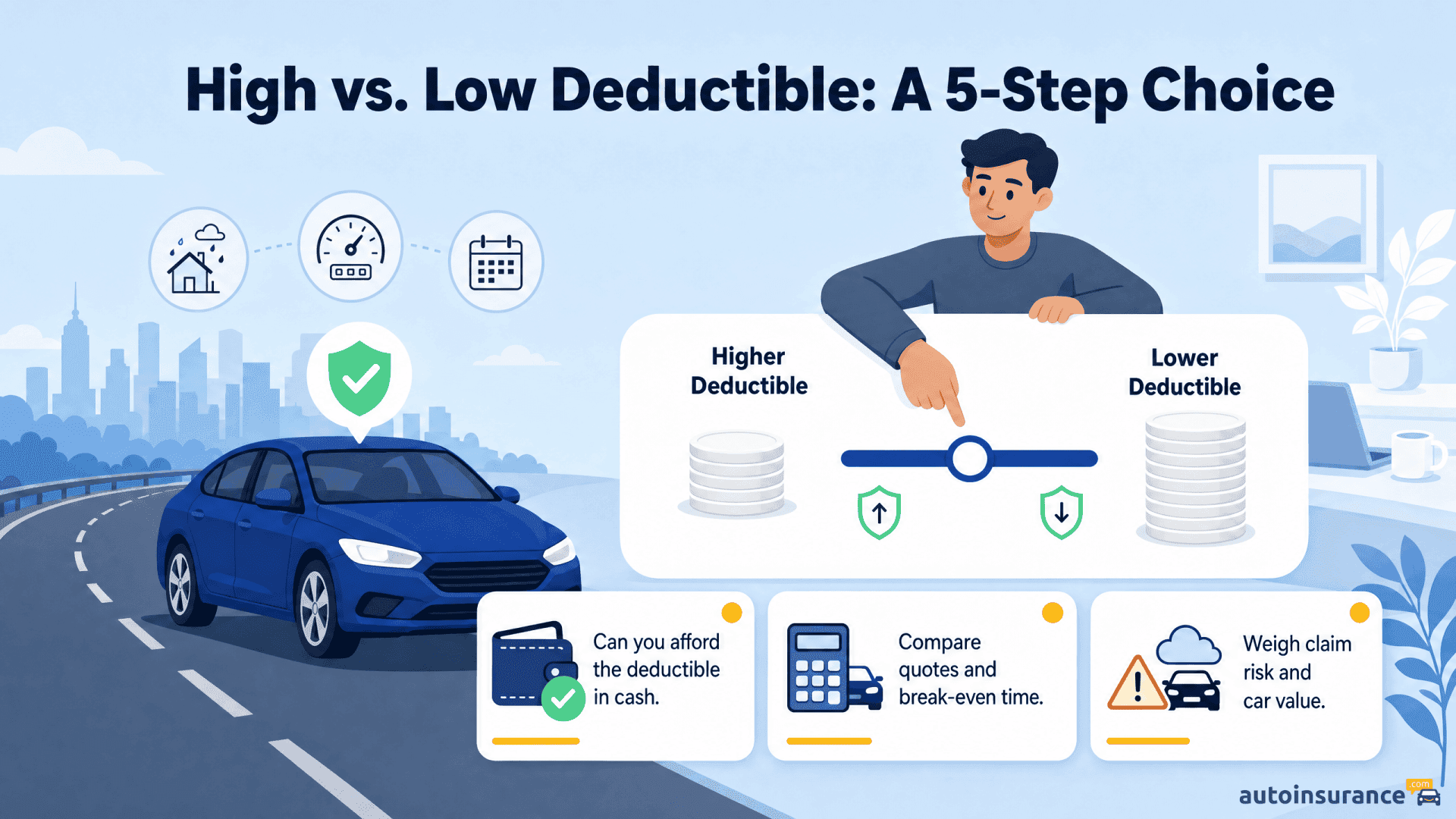
Use this five-step framework to determine whether a high or low deductible is the best financial choice for your car insurance coverage.
There’s no universally “right” deductible — it’s a bet you’re making about whether you’ll file a claim before the premium savings add up. Here’s a step-by-step way to make that decision with numbers instead of guesswork.
Step 1: Check your liquid savings. Could you pay the deductible amount out of pocket, in cash, without borrowing, if your car were damaged tomorrow? If a $1,000 deductible would require a credit card or loan, it’s too high for you right now — regardless of how much it saves on premiums.
Step 2: Get real quotes at each deductible level. Ask your insurer (or agent) to quote your policy at $250, $500, $1,000, and $2,000. Averages and percentage ranges are useful for a ballpark, but your actual savings depend on your car, ZIP code, and driving record — sometimes a $1,000 deductible only saves $60 a year, and sometimes it saves $400.
Step 3: Calculate your break-even period. Use this formula:
(New deductible − Old deductible) ÷ Annual premium savings = Years to break even
For example, moving from $500 to $1,000 is a $500 increase in exposure. If that move saves you $200 a year, your break-even period is 2.5 years. If you expect to go longer than that without a claim, the higher deductible is likely worth it. As a rule of thumb, a break-even period under 3 years generally favors the higher deductible; longer than that, the math gets shakier.
Step 4: Factor in your real-world claim risk. Some situations make a claim more likely regardless of how careful you are:
- Teen or new drivers on the policy
- High annual mileage or a long commute
- Street parking, dense urban driving, or a history of break-ins/vandalism nearby
- Living in a hail, flood, or wildfire-prone area (raises comprehensive claim odds)
- Two or more claims in the past five years
If several of these apply, weight toward the lower deductible even if the break-even math looks favorable on paper — the odds of needing that cushion are higher than the national average.
Step 5: Check your vehicle’s value and any lender requirements. If you lease or finance your car, your lender likely sets a maximum deductible (often $500 or lower) as a condition of the loan.
Separately, run the “10% test”: if your comprehensive-and-collision premium is more than about 10% of your car’s actual cash value, or your deductible is close to what the car is worth, a high deductible (or the coverage itself) may not make financial sense on an older vehicle. If your car is worth $5,000 and you carry a $2,000 deductible, a total-loss payout nets you only $3,000 — worth doing the math on before committing to a high deductible on an aging car.
If you’d rather skip the manual math: run steps 2 and 3 with your actual quotes, and let the break-even number — not the percentage discount — be the deciding factor.
TIP
Some companies offer “vanishing” deductibles for every six to twelve months without a claim.
How Does My Deductible Affect My Premium?
Your deductible and your premium move in opposite directions: the more risk you agree to absorb yourself, the less the insurer charges you to take on that risk.
Raising a collision deductible from $500 to $1,000 saves the typical driver somewhere between $180 and $420 a year, depending on the study and the driver profile. The difference will vary significantly between drivers.
The savings curve tends to flatten as deductibles get higher. The jump from $250 to $500 and $500 to $1,000 often saves proportionally more than the jump from $1,000 to $2,000, so there’s a point of diminishing returns.
FACT
According to J.D. Power’s 2025 U.S. Auto Claims Satisfaction Study, roughly one in four drivers (26%) now carries a deductible of $1,000 or higher.1 The study links the trend to several years of elevated premiums, which have pushed people toward higher deductibles to keep costs down.
Do You Pay a Deductible in Every Claim?
You don’t pay a deductible in every type of claim. It depends on different factors, including whether you’re at fault and the type of claim you need to file.
Deductibles for Not-At-Fault Accidents
When you have an accident that is someone else’s fault, their insurance pays for the damages to your car. In this instance, you won’t pay a deductible as long as they are insured and the insurance company accepts blame. The liability portion of their policy will pay for your repairs without you owing a deductible.
However, if the other party doesn’t have insurance or doesn’t accept blame, you may need to go through your own insurance company. In this case, you most likely will pay your deductible to get your car fixed. Because you are not at fault, your insurance company may try to subrogate, meaning it will reclaim the losses from the other insurance company or party. If the company is successful in subrogation, it can get your deductible back.
Deductibles for At-Fault Accidents
When you have an at-fault accident, you’ll always be responsible for the deductible. There is no one to subrogate the claim to, since you caused the accident. In an at-fault accident, liability will pay for the damages to the other party, which means there is no deductible. However, you’ll need to pay the deductible for collision coverage if you want to fix your car.
Uninsured and Underinsured Motorist Deductibles
Uninsured and underinsured motorist coverage protects you if you get hit by an uninsured motorist. It works like liability insurance and covers bodily injuries. In some places, you can buy uninsured motorist coverage for property damage, in which case you wouldn’t pay a deductible.
However, if you didn’t elect for this coverage, you’d be left using your collision coverage and paying the deductible to get your car fixed. To get your money back, you would need to sue the other party in small claims court, win, and collect the funds.
NOTE
Small claims court may have small fees of around $25 that you must pay. Also, lawsuits tend to take time and energy and have no guarantee of success. Even if you win, you still have to find a way to collect the money, which is not always easy.
Comprehensive Deductibles
In a comprehensive claim, you are not at fault. The only time you wouldn’t pay the deductible is if someone else is at fault for the incident, since it could be subrogated.
For example, if your neighbor’s tree falls and damages your car, the accident could be attributed to your neighbor. In this case, they’ll file a homeowners insurance claim to pay for your car’s damages. If they don’t accept fault, you could file a comprehensive claim with your insurer and ask that they subrogate the claim to get your deductible back.
What Is an Insurance Limit?
A limit is the maximum amount the insurance company will pay for a liability or uninsured/underinsured motorist claim. Limits apply to property damage and bodily injury. If you have a limit of 100/300/50, your insurance will pay for the other party’s bills up to $50,000 of bodily injury per person and $100,000 for all passengers, and $50,000 in property damage.
UIM coverage operates similarly, covering your own injuries and damages caused by a driver without insurance or without enough insurance.
You don’t choose a limit for comprehensive and collision; the limit is really the fair market value of the vehicle. If damages come close to or exceed that fair market value, the policy will likely pay out for a total loss.
Choosing a Deductible for an Older Car
Older cars tend to have lower values, which changes the math on deductibles. A high deductible only makes sense if the potential payout from a claim is meaningfully larger than the deductible itself. On an older car, the gap shrinks.
A simple rule of thumb:
Insurers generally total a car when repair costs exceed 70–80% of its ACV. So a helpful calculation is:
Max Reasonable Deductible ≈ ACV × (1 − Total Loss Threshold)
For example, with a $3,000 ACV and an 80% total-loss threshold:
Max Deductible ≈ $3,000 × (1 − 0.80) = $600
Beyond that point, a higher deductible is wiping out the payout from your insurer. If your car is worth $3,000 and you have a $1,000 deductible, you’re only receiving a $2,000 payout in the event of a total loss. You may be better off dropping collision/comprehensive coverage and putting the premium difference into a savings account.
If annual premiums for comprehensive and collision approach 10% of the car’s ACV, some owners drop those coverages entirely, since the payout is so low.
For example, if your car is worth $3,000, and your annual collision and comprehensive premiums are around $300, plus a deductible, you may decide it’s not worth it to carry the coverage, and put the premiums into savings instead.
Summary of Deductibles
When you buy an insurance policy, you have the option to add comprehensive and collision coverage to your policy. When you do, you choose the deductible that you will pay if you make a claim. The deductible is your financial portion of the claim.
The bottom line is that paying a premium for comprehensive and collision coverage can save you thousands of dollars in repair costs after an at-fault accident. You should choose a deductible that you are financially comfortable with, knowing that you can change it with a phone call to your provider. The best car insurance companies will pay out claims in a fair and timely manner after you pay your deductible.
FAQs
Any amount over $1,000 is generally considered a high deductible, since it’s a large amount to pay for car repairs. A high deductible is a good fit for drivers who can pay it comfortable and don’t anticipate needing to file a claim.
A $500 deductible is better if you’re still building your savings; a $1,000 deductible is better if you have at least 3 months of expenses saved and a clean driving record. Some people opt for a lower deductible because that means they pay less in an accident. Others prefer to absorb the risk themselves and pay lower premiums.
Typically you can’t avoid paying your deductible; you owe the deductible for an at-fault accident or a comprehensive claim, such as theft. You don’t pay a deductible when you are not at fault, since the other party’s insurance kicks in to pay for your damages.
In some cases, you may be able to negotiate with the auto body shop to reduce or waive your deductible, but this is at the shop’s discretion.
A $500 deductible is good and one of the most common deductibles because it helps keep insurance costs down, but is also a realistic amount of money to pay for car repairs. Ultimately, every policyholder has to evaluate whether this is the best deductible for them. Those who can afford the premium may choose a lower deductible.
Comprehensive and collision coverage are necessary if you plan on repairing your car after an accident (unless you can afford to pay a large sum out of pocket, which isn’t the case for most people). If you lease or finance your car, your lender will likely require you to hold these coverages. If you drive an older car that is fully paid off, or you’re confident you will not cause an accident, you might choose to forego collision and comprehensive coverage to save money.
Generally, you don’t pay a deductible in a not-at-fault accident. You would only pay it if the other party doesn’t have insurance or disputes fault.
Sources
Satisfaction with Auto Insurance Claims Strained by Higher Deductibles, More Total Losses, JD Power Finds. JD Power. (2025, Oct 27).
https://www.jdpower.com/business/press-releases/2025-us-auto-claims-satisfaction-study
Related Articles

AssuranceAmerica Car Insurance Review
August 13, 2026
When to Refinance Your Car Loan (And When to Wait)
July 23, 2026