
 866-589-5339






New York Car Insurance Laws
New York state requires PIP coverage due to its no-fault system, which drives up premiums.
Get quotes from providers in your area

Discover rates as low as $24 /month


Last updated: August 18, 2026
Key Takeaways: New York Car Insurance Laws
New York has some of the stricter car insurance requirements in the U.S., including mandatory PIP coverage.
Minimum coverage requires liability, PIP ($50,000/person), and uninsured/underinsured motorist coverage — more than most states.
Full coverage averages $2,882/year in New York, compared to the $2,356 national average.
Driving uninsured can result in fines up to $1,500, a $750 civil penalty, and up to 15 days in jail.
Completing a defensive driving course earns a 10% insurance discount for three years.
When it comes to car insurance, New York has more comprehensive, in-depth requirements than nearly any other state in the U.S. That’s why it’s important to brush up on relevant laws if you’re a New York driver, as oversights like driving without the minimum required insurance can have significant consequences ranging from fines to even jail time.
Below, we’ve compiled a detailed guide to the most important insurance-related laws you need to know as a New York driver.
Important Car Insurance Laws in New York
Here’s a quick primer on key laws, ranging from a breakdown of the minimum required coverage to the intricacies of New York’s no-fault system.
Minimum Car Insurance Requirements
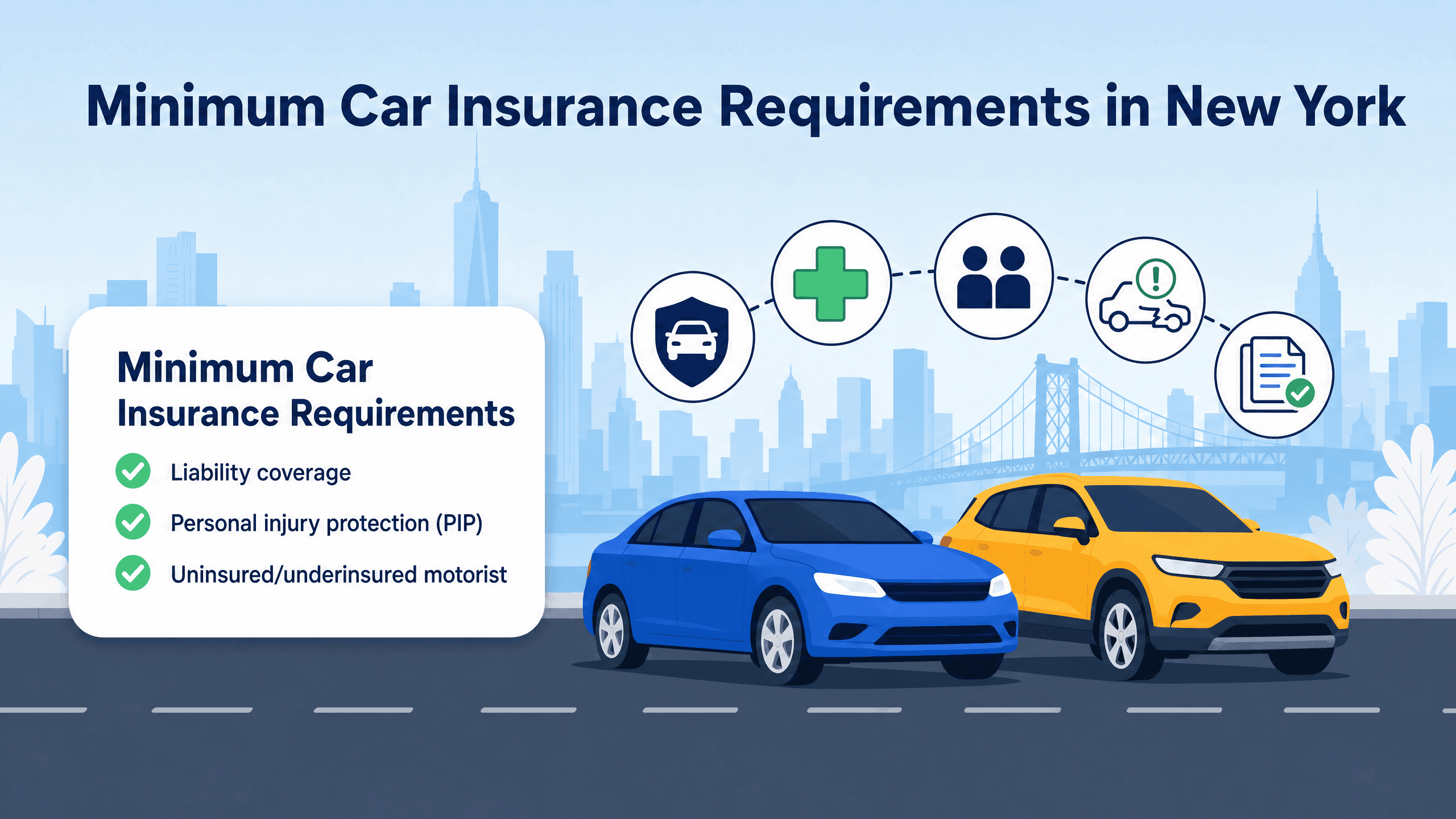
Drivers in New York must maintain specific minimum levels of liability and personal injury coverage.
In New York, the minimum liability coverage for car insurance includes:1
- Property damage: $10,000 per accident
- Bodily injury (one person): $25,000 for injury and $50,000 for death
- Bodily injury (two or more people): $50,000 for injury and $100,000 for death
- Uninsured/underinsured motorist coverage: $25,000 per person and $50,000 per accident
- Personal injury protection: $50,000 per person
Personal injury protection (PIP) includes coverage for:
- All medical expenses
- 80 percent of lost wages, up to $2,000 per month for three years from the accident date
- A maximum of $25 per day for other necessary expenses, like household help or childcare, payable for up to one year
- Death ($2,000 paid to the victim’s estate)
Penalties for Lacking Insurance
If you’re caught driving without insurance in New York, you may face the following penalties:2
- An infraction fine of $150 to $1,500
- Imprisonment for up to 15 days
- License suspension until your hearing
- A civil penalty of $750
NOTE:
Driving uninsured is different from driving without proof of insurance. The former is a more severe offense, while the latter usually results in a citation that can be cleared if you can prove you were insured at the time you were pulled over.
No-Fault System
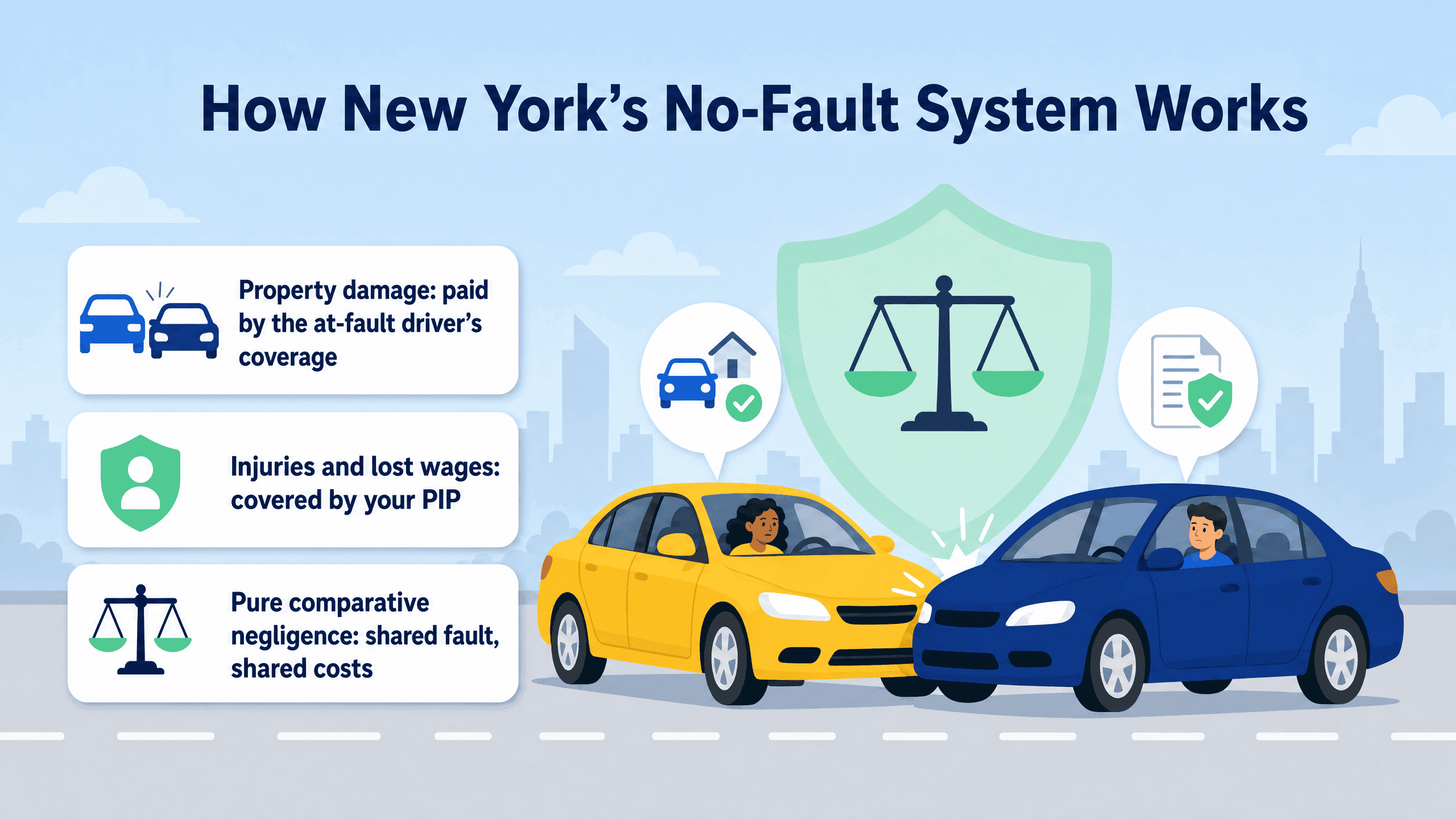
New York law dictates that personal injury protection covers medical costs while the at fault driver pays for property damage.
New York has a no-fault system, which means that if someone hits your car, they will pay for your property damages with their property damage liability coverage. However, you will pay for your and your passengers’ injuries, lost wages, and childcare costs with PIP.
The state also has pure comparative negligence laws that allow accident victims to receive compensation for damages even if they were partially at fault.
Cancellation and Non-Renewals
By law, insurers are required to provide written notice if they are cancelling your auto policy mid-term or declining to renew your policy at the end of term.
- First 60 days of new policy: Insurer can cancel for any reason if they send written notice at least 20 days prior
- Mid-term policy cancellations: Mid-term cancellations are restricted to nonpayment, fraud, or license suspension; insurers must provide notice at least 20 days prior (15 days for nonpayment)
- Nonrenewals: Companies can’t decline to renew your policy during the first three years of your policy without a valid reason; if they do, they must provide notice at least 45-60 days prior to policy expiration
- Insurer must refund unused premiums within 30-60 days of cancellation or nonrenewal
Defensive Driving Course
If you have 11 or more points on your driving record, you can take a defensive driving course to subtract four points and avoid a potential suspension. Completing a course will also earn you a 10 percent discount on your insurance for three years. Find a course at https://dmv.ny.gov/points-and-penalties/pirp-and-ipirp
Supplemental Auto Insurance Coverage in New York
While not mandatory, it’s generally recommended for drivers to add collision and comprehensive coverage to their minimum coverage, as well as raising their liability limits (altogether known as “full coverage”). We cover these optional coverages and a few others below.
Increased Liability Limits
New York requires liability limits of $25,000 per person and $50,000 per accident for bodily injury liability, and $10,000 per accident for property damage. It’s wise to increase these limits to $100,000 per person and $300,000 per accident for bodily injury, and $50,000 or $100,000 for property damage. In particular, property damage liability minimum limits might not cover the full cost of damages in an accident given higher costs of vehicles and repairs.
Collision Coverage
Collision coverage pays for your property damages regardless of fault. While it’s not required, we recommend it for all cars that are relatively new. If you need to use this coverage, you’ll pay a deductible, and then your insurance provider will cover the remainder of your car’s actual cash value or repair cost.
Comprehensive Coverage
Comprehensive coverage similarly pays for your property damages, but for causes other than collisions, such as vandalism, auto theft, and inclement weather (e.g. hail, hurricanes, tornadoes, sinkholes).
If you leased or financed your car, your lender likely requires you to hold comprehensive and collision coverage. If you drive an older, lower-value car that is fully paid off, collision and comprehensive coverage might not be worth it — compare the value of your vehicle to the cost of annual premiums to decide.
Optional Basic Economic Loss
Optional basic economic loss (OBEL) is an add-on to PIP. On top of your $50,000 PIP policy, it would pay for expenses up to $25,000 for you, your passengers, family members in your household, or any pedestrians injured in a car accident. When applicable, you can choose to apply your OBEL payment towards any of the following:
- Basic economic loss (healthcare costs, loss of earnings, or other necessary and reasonable expenses)
- Loss of earnings
- Physical or occupational therapy and rehabilitation or psychiatric care
- A combination of two and three
Supplemental Spousal Liability Coverage
Insurers are required to include supplemental spousal liability (SSL) coverage in all personal auto policies by default. SSL covers bodily injury coverage for your insured spouse and protects you if they sue for damages from a serious injury incurred in an accident you’re at fault for.
Rental Car Reimbursement
If you rely on your car for daily transportation, you’ll likely need a replacement vehicle if yours is being repaired under a covered claim. With rental car reimbursement, your insurance company covers the cost of a rental during the repair.
Roadside Assistance
Many insurance companies offer roadside assistance if you’re stuck on the side of the road and need lockout services, a tow, fuel delivery, or other services.
TIP:
We’ve all heard of AAA, but check out the best roadside assistance you’ve never heard of.
New York Car Insurance Cost
New York has some of the highest rates in the country due to factors like population density and theft and vandalism rates in urban areas. Here are some figures on New York rates across different coverage types or driver profiles, based on our data:
| Coverage type or driver profile | New York annual average rate | National average rate |
|---|---|---|
| Full coverage | $2,882 | $2,356 |
| Minimum coverage | $1,249 | $722 |
| Low credit | $5,759 | $4,126 |
| Speeding ticket | $3,052 | $2,730 |
| Accident | $3,246 | $3,156 |
| DUI | $3,851 | $4,461 |
| Teen driver | $5,725 | $6,054 |
FYI:
Looking for the best car insurance in New York? Check out our guide here.
Are Vehicle Inspections Required in New York?
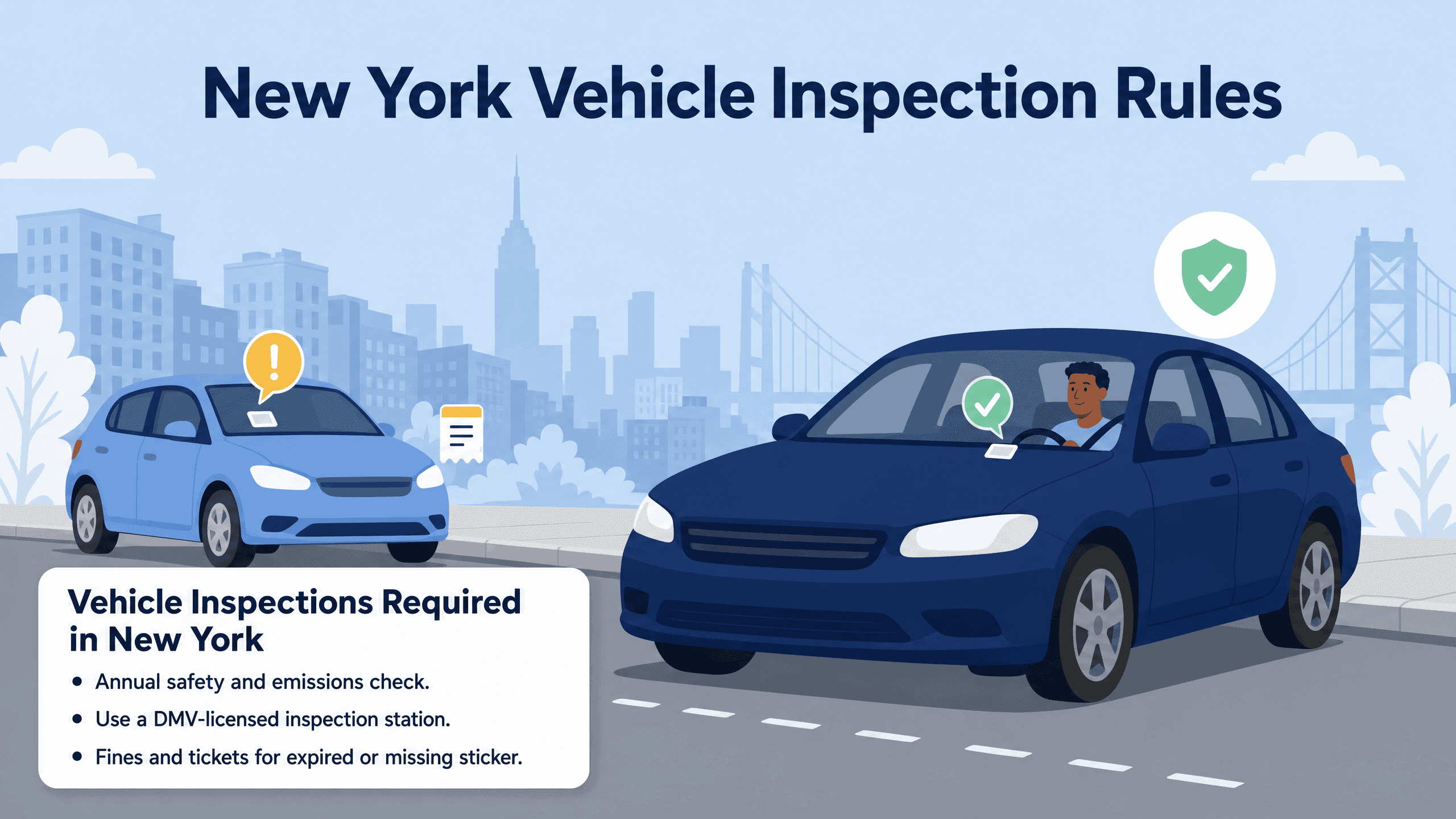
Vehicles in New York must undergo annual safety and emissions inspections to avoid costly fines.
If you’re the owner of a vehicle registered in New York, you may already know you’re required to do a safety inspection every 12 months or whenever you transfer ownership. This safety inspection also includes an emissions inspection or diesel emissions inspection.
Here are a few need-to-knows:
- You must go to a DMV-licensed inspection station; find a station near you at https://process.dmv.ny.gov/FacilityLookup/
- Fees range from $6 to $27 per inspection3, depending on your vehicle
- If your vehicle has an expired inspection sticker or no sticker at all, you may be fined between $25-100, plus a state surcharge of $88-93
- A parked vehicle without a valid inspection sticker can also receive a parking ticket
| Group | Vehicle type | Exceptions | Inspection cost |
|---|---|---|---|
| 1 – Light vehicles | Vehicles with capacity of under 15 passengers and under 10,001 lbs | Trailers, motorcycles | $10 |
| Vehicles over 10,000 lbs and under 18,001 lbs | Trailers, motorcycles | $15 | |
| Trailers under 18,001 lbs | Semi-trailers | $6 | |
| 2 – Heavy vehicles | Vehicles with capacity of over 14 passengers; vehicles over 18,000 lbs | Trailers | $20 |
| Trailers over 18,000 lbs | Non-trailers | $12 | |
| All semi-trailers | Non semi-trailers | $12 | |
| 3 – Motorcycles | All motorcycles | Non-motorcycles | $6 |
| Emissions inspections | OBD II emissions inspection for vehicles from 1996 and newer under 8,501 lbs | Vehicles from 1995 and earlier | Within the New York metropolitan area: $27
Outside the New York metropolitan area: $11 |
| Low-enhanced emissions inspection for vehicles from 1995 and older and vehicles over 8,500 lbs | Vehicles from after 1994 | $11 | |
| Diesel emissions inspection for diesel-powered vehicles over 8,500 lbs | Diesel-powered vehicles | $25 |
Texting and Driving Laws in New York
New York bans all drivers from using handheld electronic devices while driving. The fines for texting and driving in New York, plus other penalties for breaking this rule, are as follows.
| Offense number | Minimum fine | Maximum fine |
|---|---|---|
| First offense | $50 | $200 |
| Second offense within 1.5 years of first conviction | $50 | $250 |
| Third or more offense within 1.5 years of first conviction | $50 | $450 |
If you’re convicted of cell phone use, electronic device use, or a texting violation, you also get five points added to your driving record. If you get 11 points in a 24-month period, you may have your driver’s license suspended.
If you’re a junior driver with a Class MJ or DJ license, or you have a learner’s permit, your license or permit will be suspended for 120 days following the first conviction of cell phone use or texting violation.
DID YOU KNOW?
Distracted driving is the most common cause of collisions in New York, accounting for about 20 percent of crashes.4
Conclusion
New York has some of the most thorough auto insurance laws in the country, so if you’re a driver in the state, it’s important to brush up on them to avoid penalties. In addition to basic liability coverage, New York drivers are also required to purchase personal injury protection (PIP) and uninsured/underinsured motorist coverage (UI/UIM).
New York is also home to some of the highest insurance premiums of all states due to its no-fault system, plus factors like population density and vandalism and theft rates. Penalties for driving uninsured can be severe, including jail time, fines up to $1,500, civil penalty fees of $750, and license and registration suspension.
Learn more about affordable options in our guide to the cheapest New York insurance.
Frequently Asked Questions
The minimum required liability limits for New York state is as follows: $10,000 per accident for property damage; $25,000 for injury and $50,000 for death for bodily injury to one person; $50,000 for injury and $100,000 for death for bodily injury to two or more people; $25,000 per person and $50,000 per accident for uninsured/underinsured motorist coverage; and $50,000 per person for personal injury protection.
Yes, New York is a no-fault insurance state. This means your own Personal Injury Protection (PIP) coverage — required at a minimum of $50,000 — pays for your medical expenses and a portion of lost wages after an accident, regardless of who was at fault.
In New York, Progressive has the lowest average rate for full coverage at $1,848 annually, while NYCM has the lowest average rate for minimum coverage at $592 annually. Progressive also has some of the cheapest average rates for certain high-risk drivers, such as those with a speeding ticket, accident, or DUI on record.
If you drive without insurance in New York, you may be subject to any of the following penalties: a fine up to $1,500, mandatory court surcharges between $88 to $93, up to 15 days’ jail time, a civil penalty of $750, revocation of vehicle registration and plates, driver’s license suspension, a fee of $50 to reinstate your license, and vehicle impoundment.
New York has some of the highest car insurance rates in the country, partly due to its no-fault insurance laws. It has a full coverage average rate of $2,882 annually and a minimum coverage average rate of $1,249 annually. In comparison, the national average rate is significantly lower at $2,356 annually for full coverage and $722 annually for minimum coverage.
If you complete a certified defensive driving course and you’re a New York driver, you can earn a 10 percent discount on your premium for three years. You’ll have to retake the course once every three years to maintain the discount. Find a course at https://dmv.ny.gov/points-and-penalties/pirp-and-ipirp
Sources
New York State Insurance Requirements. Department of Motor Vehicles. (2026).
https://dmv.ny.gov/insurance/insurance-requirementsPay a Driver Civil Penalty. New York State Department of Motor Vehicles. (2026).
https://dmv.ny.gov/points-and-penalties/pay-a-driver-civil-penaltyInspection Group and Fee Chart. New York State Department of Motor Vehicles. (2011, Jan 01).
https://dmv.ny.gov/forms/vs77.pdfGovernor’s Traffic Safety Committee Announces Statewide Distracted Driving Enforcement and Education Campaign. New York State Department of Motor Vehicles. (2025, Mar 27).
https://dmv.ny.gov/news/governors-traffic-safety-committee-announces-statewide-distracted-driving-enforcement-and-2
Related Articles

Virginia Car Insurance Laws and Requirements
May 22, 2026
Oregon Car Insurance Laws
March 31, 2026
Guide to New Jersey Car Insurance Laws
May 14, 2026