866-589-5339






Leading Michigan Insurance Providers
Compare the best car insurance companies in Michigan.

Michigan’s average car insurance costs are some of the most expensive in the U.S.
Get quotes from providers in your area

Discover rates as low as $24 /month

Michigan has some of the most expensive car insurance rates in the U.S., driven by its no-fault system and high minimum coverage requirements.
Full coverage averages $3,013/year in Michigan — over $650 above the national average of $2,356/year.
Minimum coverage averages $1,085/year, also well above the national average of $722/year.
An estimated 22.3% of Michigan drivers are uninsured, the fourth-highest rate in the country.
Drivers may reduce costs by opting out of PIP coverage, shopping around, or exploring usage-based insurance.
According to Michigan’s Department of Insurance and Financial Services, these are the state’s minimum car insurance requirements and coverage limits:
*Drivers can opt for lower PIP coverage or opt out entirely if specific eligibility requirements are met, including health insurance requirements.
Michigan is one of the most expensive states for car insurance in the entire country. There are a number of reasons for this, including its no-fault system, high minimum coverage requirements, and high rate of uninsured drivers.
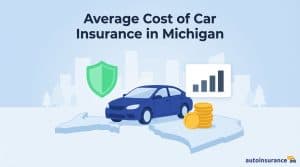
The average cost of full coverage in the state is $3,013 annually, compared to the national average of $2,356. Minimum coverage costs an average of $1,085 annually, which is higher than the national average of $722.
| Category | Annual average | Monthly average |
|---|---|---|
| Full coverage (clean record) | $3,013 | $251 |
| Minimum coverage (clean record) | $1,085 | $90 |
| Speeding ticket | $3,852 | $321 |
| At-fault accident | $4,060 | $338 |
| DUI | $4,716 | $393 |
| Teen driver | $6,203 | $517 |
| Seniors | $2,301 | $192 |
An estimated 22.3 percent of drivers in Michigan are uninsured, the fourth-highest rate in the country after New Mexico, Mississippi, and D.C.
Here are some ways to cut down on your car insurance costs in Michigan:
In Michigan, it’s not only necessary to have insurance, but also proof of insurance, be it physical or digital. If you’re caught driving without insurance, you could face:
Let’s dive deeper into the car insurance and driving laws in the Great Lakes state.
Michigan is a no-fault state, and a unique one at that. While in all no-fault states, each party pays for its own medical expenses, in Michigan, the state covers them entirely, along with lost wages and $20 daily in replacement services, in some cases. That means that if you get into a car accident and have bodily injuries, the state will always pay for them, even if the accident was your fault.
That being said, the at-fault party will still be responsible for the other party’s property damage, and the accident victim can still sue the perpetrator for a recovery (given they meet the serious injury threshold, detailed below). The state of Michigan has modified comparative negligence laws. In English, that means that the victim can only recover money if they’re less than 50 percent at fault2.
Michigan takes DUIs seriously, as they’ll stay on your record for seven years. For the first offense, you’ll get a 30 to 180-day license suspension, with limited driving privileges after 45 days. If your blood alcohol concentration is 0.17 or higher or if you have repeat convictions, you’ll need to install a DUI interlock device for a year.
Michigan has a mandatory seat belt law for those over the age of 16 and in the front seat. The law is under primary enforcement, so the police can pull you over for not wearing a seat belt solely.
In Michigan, you can make calls on a handheld electronic device unless you’re a:
However, texting and driving is illegal for all drivers, as it’s one of the most dangerous forms of distracted driving. These laws, like the seat belt laws, are under primary enforcement. The fines for illegal cell phone usage include:
There’s a reason that car insurance costs for teens are so high. With little driving experience, teens are more likely to get into accidents and thus, have covered claims. Michigan takes a cautionary stance when it comes to teen drivers. All first-time, licensed drivers enter their driving experience on probation for the first three years.
If they get into any crashes or receive any tickets, they’ll have to face a driver assessment reexamination, which could lead to a license suspension and/or restriction. And if those tickets or at-fault accidents fall into the last 10 months of probation, the probation will be extended for another 10 months, which must be violation-free.
Fines for teens caught using phones while driving are higher than the rest of the population. If you’re caught using a phone while driving, you could pay up to $295 in fines. However, there are a few exceptions to take note of:
In the same vein, teens have stricter DUI penalties, as well. Michigan has a zero tolerance law when it comes to consuming alcohol and drinking. For the first offense, you could receive:
Penalties only get more severe for the second and subsequent offenses. Even possessing alcoholic beverages in your car could land you in trouble, even if they’re not opened.
| Penalties for having alcohol in your car for teens in Michigan | First | Second | Third |
|---|---|---|---|
| Maximum fine | $100 | $200 | $500 |
| License suspension in days | 0 | 30 | 60 |
| License restriction in days | 0 | 60 | 305 |
| Community service | Sometimes | Sometimes | Sometimes |
| Alcohol screening | Sometimes | Sometimes | Sometimes |
If you have a personal injury or property damage claim, you must file it in three years, the statute of limitations for claims in Michigan.
Companies can’t end your coverage without notifying you first, whether it’s a cancellation or a nonrenewal.
| Cancellation vs. nonrenewal notification law in Michigan | Cancellations due to fraud, misrepresentation, driver’s license suspension, or driver’s license revocation | Cancellations due to nonpayment | Nonrenewals |
|---|---|---|---|
| Number of days the company has to notify you before your policy expires | 30 | 10 | 20 |
Make sure you get a new policy before your old policy ends to avoid a lapse in coverage.
Do you have more than 25 vehicles? If so, you may be able to self-insure your cars, but it’s at the discretion of the insurance commissioner, according to the Michigan Legislature.
Unless you’re insuring a salvage vehicle, Michigan doesn’t require annual inspections or emissions tests. That being said, to get your salvage vehicle inspected, use the below contact information:
What happens if you don’t have insurance and you get into an at-fault accident? Michigan doesn’t require SR-22s or FR-44s, but rather, you’ll have to get a special license that demonstrates financial responsibility. Here’s everything you need to know about the Financial-Responsibility Restricted Drivers License, straight from the Office of the Secretary of the State:
Michigan Department of State Driver Record Activity Unit
7064 Crowner Drive
Lansing, Michigan 48918-0001
Or, call 517-636-6406.
Have you been ordered to take a defensive driving course in Michigan? You can find one here: https://www.michigan.gov/msp/0,4643,7-123-72297_30536-230768–,00.html. Just note that it has to be four hours at a minimum.
No-fault accident victims have the right to sue, but in Michigan, only if they have either a serious impairment of a bodily function or a serious and permanent disfigurement.
In Michigan, there’s no monetary threshold for personal injury lawsuits.
While you don’t technically need a police report to file a claim, if you got into an accident that involved an injury, death, or property damage worth over $1,000, you need to file a police report immediately. If you don’t, you could face a maximum of 90 days in jail, a maximum $100 fine, or both.
In any accident, we recommend filing a police report, regardless of if it’s legally necessary. Police reports provide great evidence of the accident, so make sure to get a copy for your records.
Did you know that in 43 states, men pay more for car insurance than women? How about the fact that 46 states give higher rates to those with bad credit? Fortunately, Michigan is one of the four states that bans auto insurance companies from determining price on the basis of gender or credit scores along with Massachusetts, California, and Hawaii. If you’re a male with bad credit living in Michigan, this information should come as a pleasant surprise.
Most people think of a “total loss” as a situation in which a car’s repairs cost more than its actual market value (AMV). However, each state has a different total loss threshold, and it’s not always 100 percent of the AMV. In Michigan, it’s only 75 percent. So if you have a $10,000 car with $8,500 worth of covered damages, it would be declared a total loss and you could be reimbursed for your car’s AMV.
See below for the state’s car and insurance-related contact information.
Here’s how to contact the Michigan DMV:
Before you register your car in Michigan, you’ll need to have proof of in-state insurance.
To get another copy of your car’s ownership papers by mail:
To get a duplicate car title online:
Note that you won’t need a notary to get a duplicate car title unless you’re filling out the form for someone else, i.e you are not the owner of said car.
Finally, here’s how to contact Michigan’s Insurance Department:
Surprisingly given Michigan’s high car insurance costs, car repairs cost nine percent less than the national average at $350.77 for parts and labor. That divides into $202.30 for parts and $148.47 for labor, if you were wondering.
Rates of car theft and the number of traffic fatalities are two of the many factors that impact insurance costs. While Michigan has fewer car thefts than the national average, traffic fatalities were higher, unfortunately.
According to 2020 FBI data, Michigan had 185 motor vehicle thefts per 100,000 inhabitants, 33 percent less than the rest of the U.S. This number isn’t surprising, as the Midwest in general is the safest area for car theft. Compared to the rest of the U.S., the Midwest region has 54 percent fewer car thefts.
That being said, cities like Kalamazoo and South Bend have more car thefts compared to the rest of the state. Cities have more car thefts than rural and suburban areas in general, so these increased crime rates aren’t surprising.
| Name of Metropolitan Statistical Area | Rate of motor vehicle theft by 100,000 inhabitants in 2020 |
|---|---|
| Kalamazoo-Portage, MI | 371 |
| South Bend-Mishawaka, IN-MI | 337 |
| Detroit-Warren-Dearborn, MI | 252 |
| Battle Creek, MI | 240 |
| Lansing-East Lansing, MI | 199 |
| Niles, MI | 191 |
| Flint, MI | 184 |
| Grand Rapids-Kentwood, MI | 177 |
| Jackson, MI | 175 |
| Bay City, MI | 135 |
| Muskegon, MI | 132 |
| Monroe, MI | 120 |
| Ann Arbor, MI | 95 |
| Saginaw, MI | 92 |
| Midland, MI | 46 |
While as a whole, Michigan has few car thefts, it didn’t fare as well when it came to traffic fatalities, with 985 per 100 million vehicle miles traveled in 2019. These rates are 28 percent higher than the rest of the nation.
Michigan drivers face some of the highest car insurance rates in the country, largely due to the state’s no-fault insurance system, high minimum coverage requirements, and a significant share of uninsured motorists.
Full coverage averages $3,013 per year, while minimum coverage runs $1,085 annually — both well above national averages. Costs vary widely by city, driving history, and driver profile, with Detroit drivers paying nearly double the state average.
By shopping around, maintaining a clean record, and exploring options like PIP waivers or usage-based insurance, Michigan drivers can work to bring their premiums down.
We’ve answered all of your questions about Michigan car insurance below.
Yes. Michigan operates under a no-fault insurance system, meaning your own insurance covers your medical expenses after an accident regardless of who was at fault.
Michigan requires bodily injury liability ($50,000 per person/$100,000 per accident), property damage liability ($10,000 per accident outside Michigan, $1 million per accident within Michigan), and $250,000 in Personal Injury Protection (PIP), though some drivers may qualify for reduced or waived PIP coverage.
Michigan’s high rates stem from its no-fault system, high minimum coverage requirements, and a high percentage of uninsured drivers.
USAA (for those eligible), GEICO, Auto-Owners, and Westfield tend to have the cheapest car insurance rates in Michigan, depending on your driver profile.
Yes. The Michigan Automobile Insurance Placement Facility (MAIPF) ensures all Michigan residents can access auto insurance, even if they’ve been unable to find coverage through the standard market.
2019/2020 Auto Insurance Database Report. NAIC. (2023, Jan).
https://content.naic.org/sites/default/files/publication-aut-pb-auto-insurance-database.pdf
Michigan’s Auto Insurance Law Has Changed. DIFS.
https://www.michigan.gov/documents/difs/Auto_Insurance_Guide_448003_7.pdf
One in Eight Drivers Uninsured. The Institutes. (2021, Mar 22).
https://www.insurance-research.org/sites/default/files/downloads/UM%20NR%20032221.pdf