
 866-589-5339






What happens if my car is declared a total loss?
The value of a total loss settlement will typically be the car's actual cash value, but it depends on your policy and several other factors.
Get quotes from providers in your area

Discover rates as low as $24 /month


Last updated: July 14, 2026
Key Takeaways: What Happens if Your Car Is Totaled
Your insurer will deem your car a total loss if it doesn't make financial sense to repair it after it's been damaged.
An insurance payout for a totaled car is generally based on the vehicle’s actual cash value.
Total loss payouts are most commonly made under collision or comprehensive coverage, but it depends on the cause of the loss.
If you have new car replacement coverage, your settlement will be the amount of a new car of the same make and model as the totaled vehicle.
You can review and negotiate the settlement offer if you disagree with the valuation.

Most people haven't compared rates in over a year.
Rates change constantly. A quick comparison takes 2 minutes and could put hundreds of dollars back in your pocket.
A car is declared a total loss if the cost to repair it exceeds a certain percentage of its value, whether due to an accident, theft, or other covered event. A car may be totaled even if it’s technically still drivable. Understanding how insurers determine a total loss and what happens next can help you make informed decisions.
What Is a Total Loss?
When your car is declared a total loss, also known as being totaled, it means the cost to repair it exceeds its pre-accident actual cash value (ACV). Essentially, it’s the threshold at which it’s not worth it for the insurer to pay for repairs when it would cost less to simply pay out the ACV. A car may also be deemed a total loss if the insurance company determines that it can’t be driven safely even after being repaired.
GOOD TO KNOW:
If you have new car replacement coverage, your insurance company will pay out the cost of a new car instead of your current vehicle’s ACV.
How Insurance Companies Determine a Total Loss
In practice, the total loss threshold varies by state and by insurer. States have different regulations around what percentage of a car’s ACV the repair estimates must meet or exceed in order to be deemed a total loss.
In some states, a vehicle may be declared a total loss when repair costs reach only 50% to 60% of its value. Even in states with higher legal thresholds, insurers may still total a vehicle if the cost of repairs, the vehicle’s salvage value, and other factors make repairing it uneconomical.
Coverages That May Cover a Total Loss
Several different coverages may come into play if your car is damaged — it depends on the cause of the damage.
- Comprehensive: In general, your car insurance provider will only pay for repairs to your vehicle if you have comprehensive and/or collision coverage on your policy. These would also apply for total loss determination, since this takes the place of repairs. Comprehensive, specifically, kicks in for damage caused by non-collision events, such as vandalism or weather, as well as theft.
- Collision: If you get into an accident — regardless of fault — and your car is totaled, a payout would be covered under collision coverage.
- Property damage liability: If you’re in an accident caused by their insurance policy, property damage liability coverage would cover damage to your car, up to their coverage limits. If their policy is insufficient or the claims process is delayed, you can file a claim under your own collision coverage (if you have it) and let your insurer seek reimbursement from the at-fault driver’s insurer.
- Uninsured motorist property damage (UMPD): There are two types of uninsured motorist coverages: bodily injury and property damage. UMPD is not available in all states, but if you have it on your policy, it may kick in if your car is totaled by a driver without insurance.
What Happens When Your Car Is Declared a Total Loss
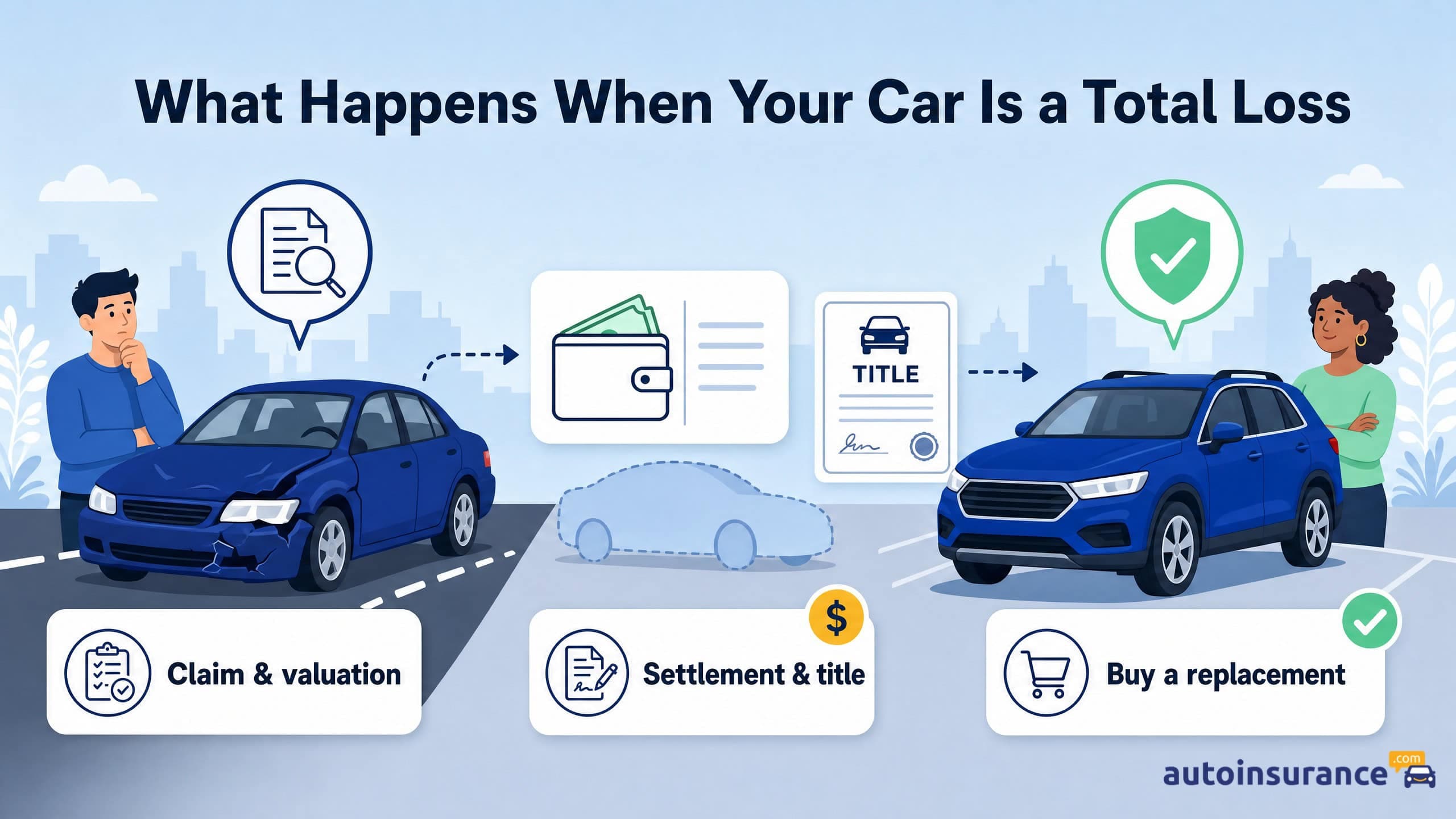
The total loss process involves assessment of damage, financial settlement, and the purchase of a replacement vehicle.
A total loss claim begins the same way as any other insurance claim: You file a claim with your insurance company, which sends an adjuster to assess the damage and estimate repair costs. Based on the inspection and repair estimate, the insurer will then determine whether the vehicle qualifies as a total loss.
If your insurance company deems that your vehicle is a total loss, you can expect to go through the following general steps:
1. Settlement
You can expect a payout for the car’s value instead of repair costs. Your insurer will calculate a settlement based on its actual cash value, which considers factors such as the vehicle’s age, mileage, condition, options, and local market values.
If you have new car replacement coverage, you’ll get a payment for the cost of a new model instead of its depreciated value. If you filed the claim under your own collision or comprehensive coverage, you can expect your deductible to be subtracted from the payout.
What Happens if You Have a Loan or Lease?
If your vehicle is financed or leased, the insurance company will usually issue the payment directly to the lender or leasing company. If the settlement exceeds your remaining loan balance, you’ll receive the difference. If you owe more than the vehicle’s actual cash value, you’ll usually be responsible for paying the remaining balance, unless you have gap insurance.
2. Transfer Ownership
After accepting the settlement, you can expect to sign over the vehicle’s title to the insurance company. The insurer then takes ownership of the totaled vehicle and usually sells it to a salvage auction. Depending on your state, you may have the option to keep the vehicle, though your settlement will usually be reduced by its salvage value.
3. Purchase a Replacement Vehicle
Once the claim is finalized and payment is issued, you can use the settlement toward purchasing another vehicle. If you had new car replacement coverage, the settlement should cover the full amount of a new car of the same make and model as the one totaled. If you’re financing a replacement, you’ll need to get a new insurance policy before driving it. Comparing quotes from multiple insurers can help you find the best coverage and rate for your new vehicle.
What if You Disagree With the Settlement Offer?
If you believe that your insurer’s settlement offer is too low, you don’t have to accept it immediately. Carefully review the offer and gather information to support a higher valuation.
- Review the insurer’s valuation. Ask your insurer for a copy of the total loss valuation report. Check that it accurately reflects your vehicle’s features, including year, make, model, trim level, mileage, and condition.
- Gather supporting evidence. If you think your vehicle is worth more than the insurer’s estimate, you’ll need convincing evidence. This may include getting a valuation by an independent appraiser if you feel it’s worth the cost, as well as recent maintenance records, receipts for upgrades, and multiple listings for similar vehicles currently for sale in your area.
- Negotiate. If you notice any errors or have solid evidence that your vehicle was worth more than the insurer’s estimate, contact your claims adjuster and submit a formal counteroffer. Providing clear documentation will be more likely to lead to productive discussion than simply disputing the amount.
- File a complaint. While your claim hopefully won’t come to this, you can file a complaint with your state’s insurance department or regulator if you believe your insurer has handled your claim unfairly. Before taking this step, make sure you’ve documented your communications with the insurer and attempted to resolve the dispute directly.
Can You Keep a Totaled Vehicle?
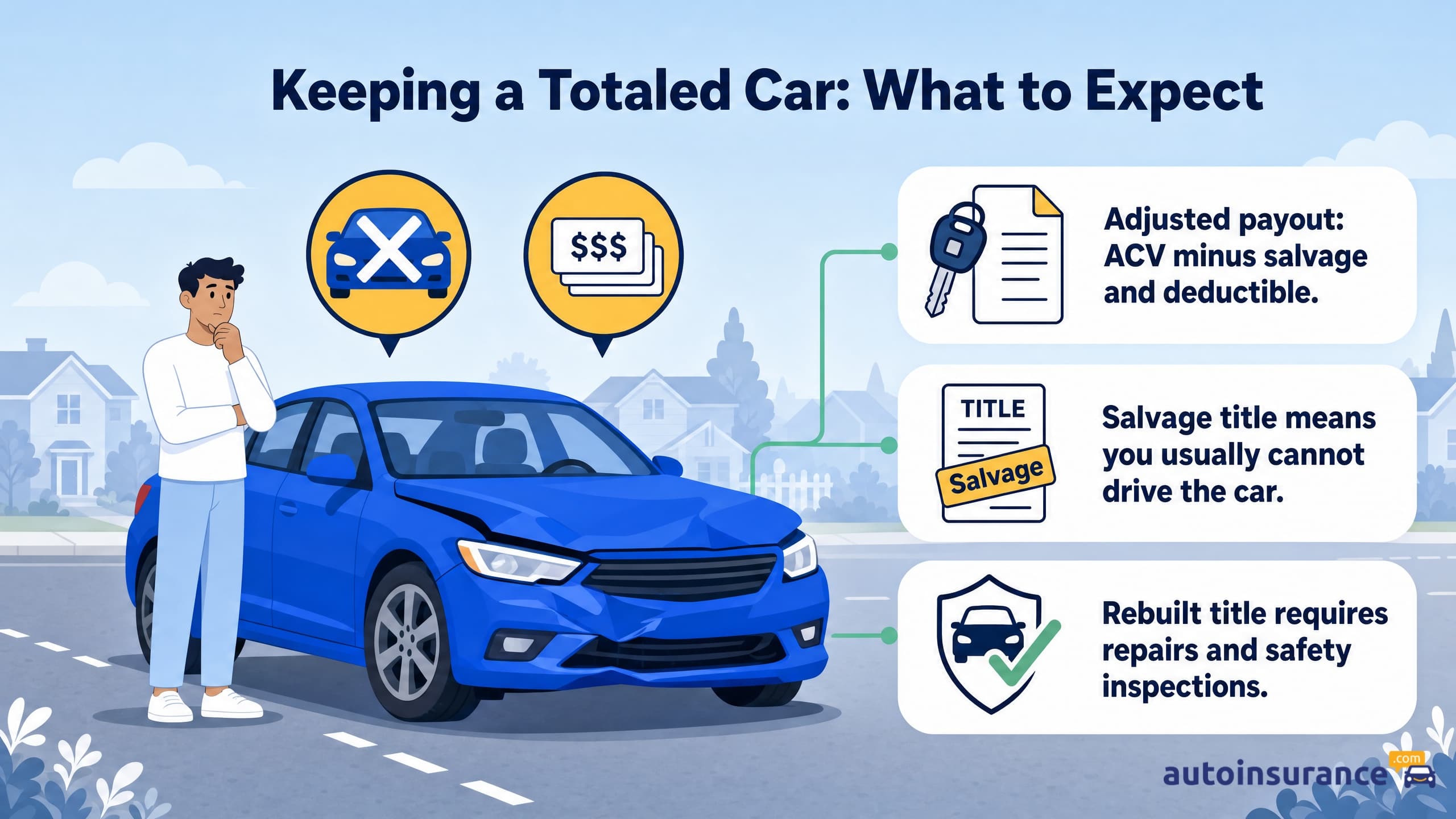
While you can keep a totaled car, you will face an adjusted insurance payout and complex titling requirements.
You can typically choose to keep your vehicle after it’s been totaled if you wish to, but in most cases, it doesn’t make financial sense. You’ll need to inform your insurer that you want to keep the car, and it will adjust the amount of the payout. You can expect to get the car’s ACV minus the salvage value (which is what the insurer would have made selling it for scrap parts) and your deductible.
You’ll need to get a salvage title for your car, which indicates that it’s been deemed a total loss by the insurance company. Generally, you will not be able to drive the car with a salvage title, so keep that in mind. If you get the car repaired, it will then need a new title, typically referred to as a rebuilt or prior salvage title. States have their own requirements for what this entails, but it usually means your car will have to pass various safety tests. These titles can be difficult to obtain.
How a Total Loss Affects Your Insurance
Having your vehicle declared a total loss doesn’t automatically mean your insurance premium will increase — what matters more is the cause of the loss, as violations like at-fault accidents can result in a rate increase regardless of whether your car was totaled.
If your vehicle was totaled in an accident that you caused, your insurer may increase your premium at renewal because you’ve filed an at-fault claim. The amount of the increase varies by insurer and factors such as the severity of the accident, your driving record, and any previous claims.
FYI:
Drivers with an at-fault accident on their record pay around 34 percent more than drivers with clean records.
If another driver was responsible for the accident, your rates are less likely to increase, but this depends on your insurer and state laws. In some states, including California, insurers are not allowed to increase premiums for certain not-at-fault claims.
Your car may also be totaled to another covered event such as theft, fire, or a falling tree, which would be covered under comprehensive insurance. These claims usually don’t impact your rates as much as at-fault collision claims.
Getting a New Policy
Assuming you get a new car after a total loss, you’ll need to add it to your insurance policy. You can expect your premium to change simply because it’s a different car, and because newer cars tend to cost more to insure. Shopping around for coverage can help ensure you’re getting the best rate for your replacement car.
Recap
A total loss is never a fun experience, but understanding your insurance policy and how the claims process works can make it easier to navigate. Always do your due diligence to be able to evaluate whether your insurer’s settlement offer is fair, and be prepared to propose a counteroffer if you believe your payout should be higher. Including new car replacement coverage on your policy can also provide additional financial protection if your vehicle is ever declared a total loss.
Frequently Asked Questions
You should accept a total loss offer if it seems like a fair deal after doing some research. If you feel that your insurer is giving you a lowball offer, you have the option to submit a counteroffer along with evidence supporting your valuation.
You should always pay your insurance as long as your claim is still pending to avoid a lapse in insurance, which can cause future premiums to increase. Once your claim is settled, you can remove the totaled vehicle from your policy or transfer your coverage to a replacement vehicle.
The best option is usually to accept the insurance settlement and let the insurer take possession of the vehicle. However, if the damage is minor, the vehicle has sentimental value, or you believe it can be repaired cost-effectively, you may be able to accept a reduced settlement and keep the vehicle by. Keep in mind that a totaled vehicle will need to receive a salvage title, and you’ll likely need to repair it, pass any required inspections, and obtain a rebuilt title before it can be legally driven again.
There is no required waiting time to get a new car after a total loss. You can technically purchase a new vehicle as soon as you’re ready, even before your total loss claim is finalized. However, it can be a good idea to wait until you receive the insurance settlement so you know how much you’ll have to put towards another car. If your old vehicle was financed or leased, your insurer will typically pay the lender first, and you’ll receive any remaining settlement. You’ll also receive a total loss letter, which you can bring to dealerships to prove your previous loan is being taken care of and avoid issues getting new financing.
Related Articles
Can You Insure a Salvage Vehicle?
August 17, 2026
Does Car Insurance Cover Flood Damage?
December 19, 2024
How Long Does an Auto Insurance Claim Take?
July 30, 2026