
 866-589-5339




Do I need full coverage on an older car?
Whether you should keep full coverage on an older car depends on your car's value, your budget, and other factors.
Get quotes from providers in your area

Discover rates as low as $24 /month


Last updated: August 5, 2026
Key Takeaways: Full Coverage for Older Cars
Full coverage is not required unless your car is leased or financed.
Drivers who own their car outright may consider dropping full coverage if their premium is high compared to the car’s value.
Insurers will consider the car’s actual cash value, not the purchase price, when determining total loss settlements.
A common rule cited by experts is to keep full coverage as long as your premium is less than 10% of your car’s value.
Consider your car’s actual cash value, your premium, and your deductible when weighing whether full coverage is worth it.

Most people haven't compared rates in over a year.
Rates change constantly. A quick comparison takes 2 minutes and could put hundreds of dollars back in your pocket.
What Is Full Coverage Insurance?
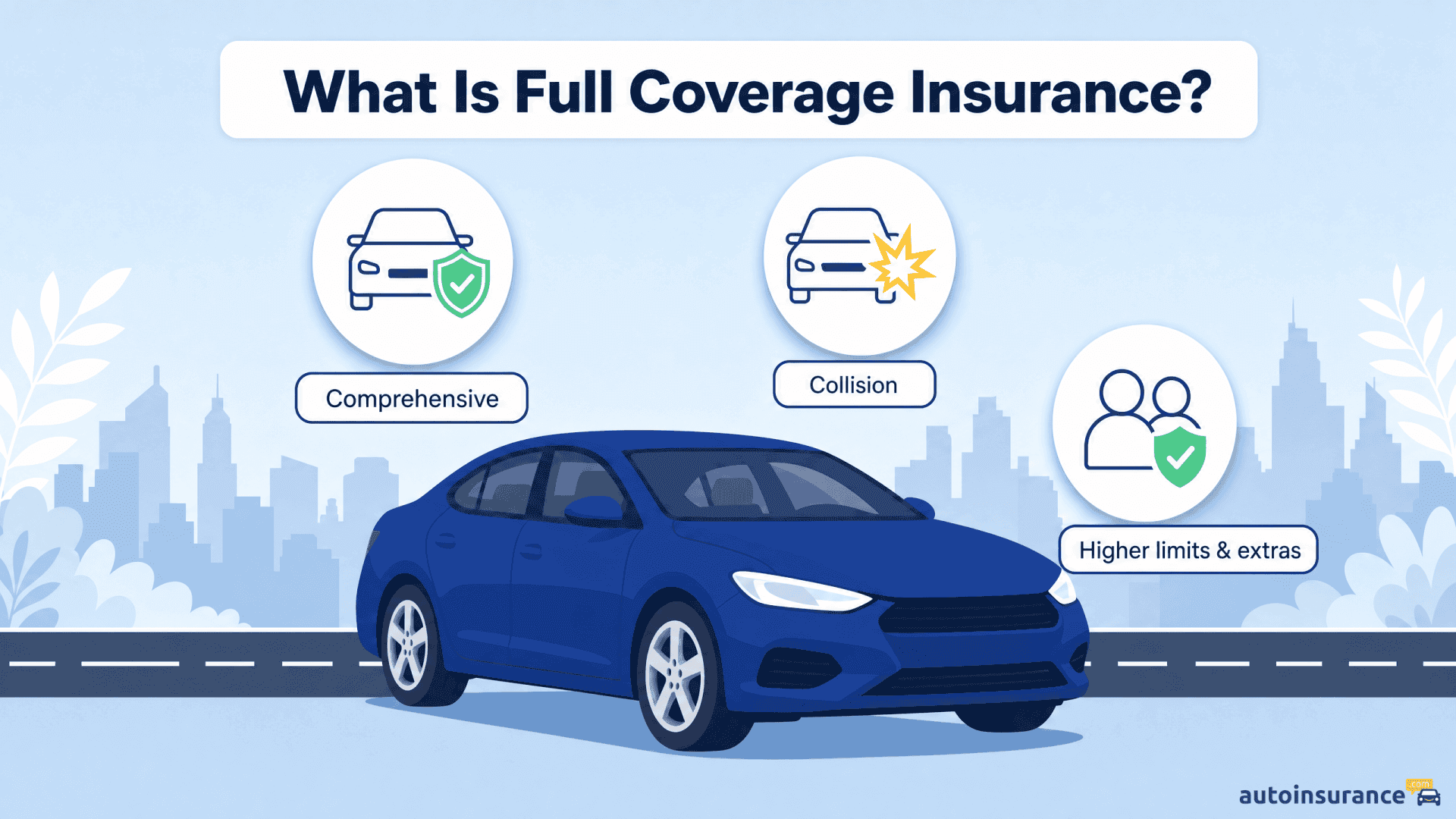
Full coverage insurance typically combines comprehensive, collision, and higher liability limits to provide robust vehicle protection.
Full coverage is not a regulated term or an official policy type, so it may refer to slightly different things. Most commonly, it refers to a policy with comprehensive and collision coverage in addition to liability coverage with limits higher than the minimum. In some contexts, full coverage may also include certain additional coverages, such as uninsured motorist and medical payments coverage.
Is Full Coverage Required on an Older Car?
Full coverage is not mandated by any state — comprehensive and collision coverages are not included in any minimum coverage requirements.
However, they are generally required by lenders for leased and financed vehicles to ensure that the vehicle will be repaired or replaced while they still have a stake in it.
Once a car is paid off, you can choose to keep or drop full coverage.
FYI
Most lenders will not finance a car more than 10 years old or with more than 125,000 miles.
When to Keep Full Coverage
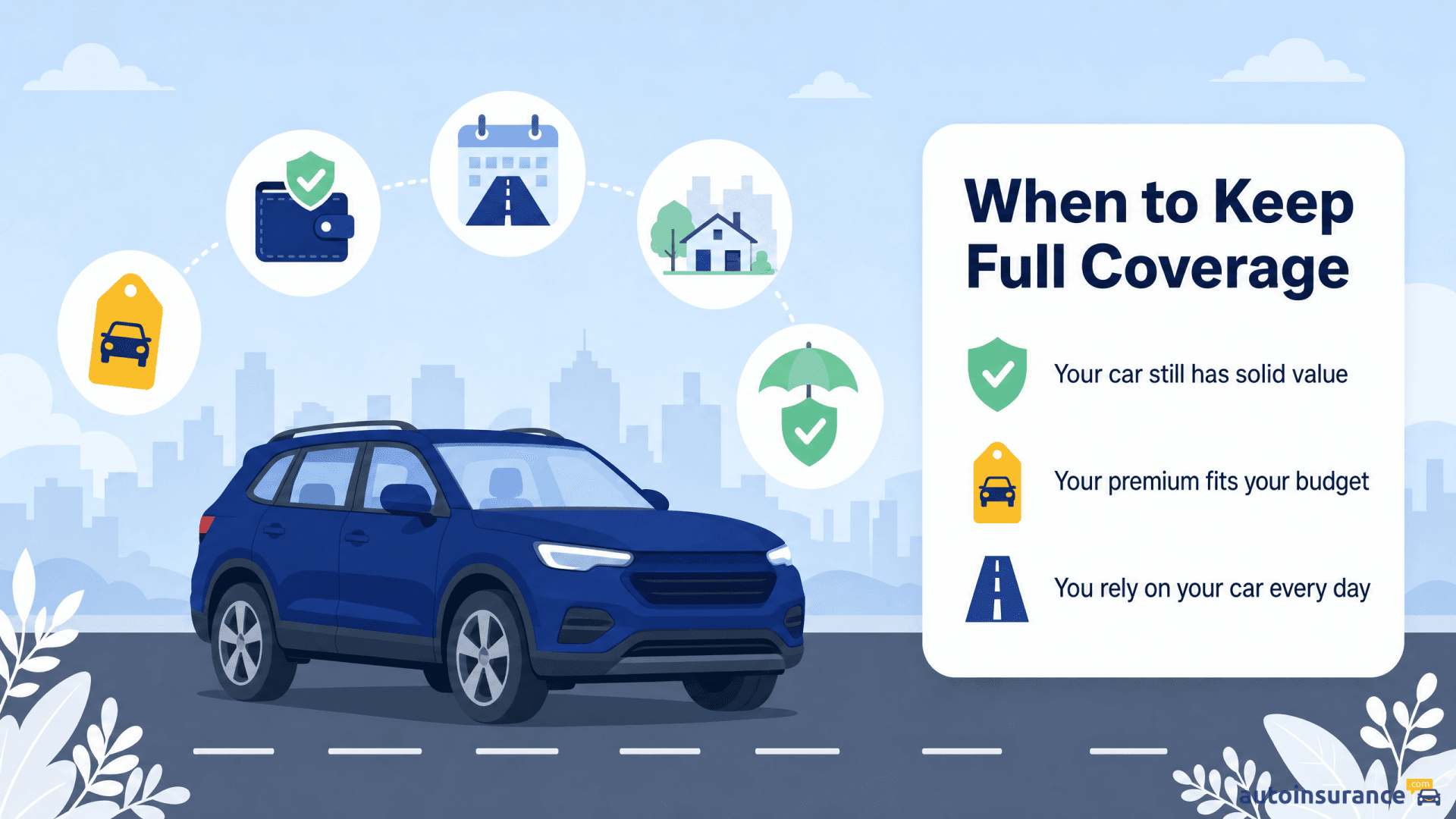
Evaluate your vehicle value and driving habits to determine if keeping full insurance coverage is the right financial choice.
While removing full coverage can lower your insurance premium, consider whether it makes sense financially, even if your car is older. Collision and comprehensive coverages can be valuable, especially if repairing or replacing your vehicle would be a significant expense.
The following are some situations where it may make sense to keep full coverage, assuming you own your car outright.
Your Car Still Has Significant Value
If your car is totaled or otherwise damaged in a covered incident, collision and comprehensive coverage will either help pay for repairs or pay out your car’s actual cash value. If your vehicle is worth several thousand dollars, full coverage may still be worthwhile. Generally speaking, the more your car is worth, the more beneficial it is to keep full coverage.
Your Premium Is Reasonable
A common rule cited by experts is to keep full coverage as long as your premium is less than 10 percent of your car’s value.
You don’t necessarily need to follow that exactly, but if the annual cost is relatively low compared with your vehicle’s actual cash value, full coverage may still be a good value. Your deductible factors in here too, as your payout will be reduced by the amount of the deductible.
You Couldn’t Easily Afford to Replace Your Car
Depending on your car’s value, a total loss payout can provide a significant chunk towards the down payment on a new car. If you don’t have enough savings to comfortably purchase another vehicle after a total loss and your current car still has decent value, maintaining full coverage can provide you with a bit of a cushion and added peace of mind.
You Drive Frequently
If you drive frequently, you’re more likely to be involved in an accident. Drivers who have long commutes, take frequent road trips, or do daily errands may benefit from the added protection that collision coverage provides.
You Live in a High-Risk Area
Comprehensive insurance covers damage from non-collision incidents, as well as from hitting an animal. If you live in an area with severe weather, a high theft and/or vandalism rate, or a high risk of hitting deer or other animals, comprehensive coverage can help protect your vehicle from costly non-collision damage.
GOOD TO KNOW
While full coverage is often referred to as a package, you can drop either comprehensive coverage or collision coverage while keeping the other. For an older car, it may make sense to only keep one or the other depending on your driving and garaging habits, while not necessarily dropping both.
When to Consider Dropping Full Coverage
While full coverage is always recommended for newer vehicles if you can afford it, there’s more leeway when it comes to deciding whether it’s a good financial decision to keep on an older car. As your vehicle depreciates, the maximum payout you could receive after a covered loss decreases, but your premiums may remain relatively high. Here are some situations where you may want to consider dropping full coverage.
Your Car Has a Low Market Value
If your vehicle is only worth a few thousand dollars or less, the potential insurance payout after a total loss may not justify the ongoing cost of full coverage. Look at your car’s actual cash value, your deductible, and your premium to determine whether these additional coverages are still worth the expense.
Your Premiums Are High Relative to Your Car’s Value
Even if your car still has relatively high value, if your premiums are also very high, you may decide that it doesn’t make financial sense to keep full coverage. On the flip side of the rule mentioned earlier, you may consider dropping it if your annual premium exceeds 10 percent of the car’s value.
You Can Afford to Replace or Repair the Vehicle
If you have enough savings to repair your vehicle or purchase a replacement after an accident or total loss, you may prefer to rely on those savings instead of paying for full coverage, and carry only the liability coverage required by your state.
Your Deductible Is Close to the Vehicle’s Value
If your vehicle isn’t worth much more than your collision or comprehensive deductible, your insurer would pay very little after a covered claim. In this situation, paying for full coverage may not be worth it.
You Rarely Drive the Car
If you don’t use your car often, you have a lower risk of being involved in an accident. While comprehensive coverage can still protect against theft, vandalism, and weather-related damage, some low-mileage drivers may decide that their risk is low enough to justify dropping collision coverage.
How to Decide if Full Coverage Is Worth It
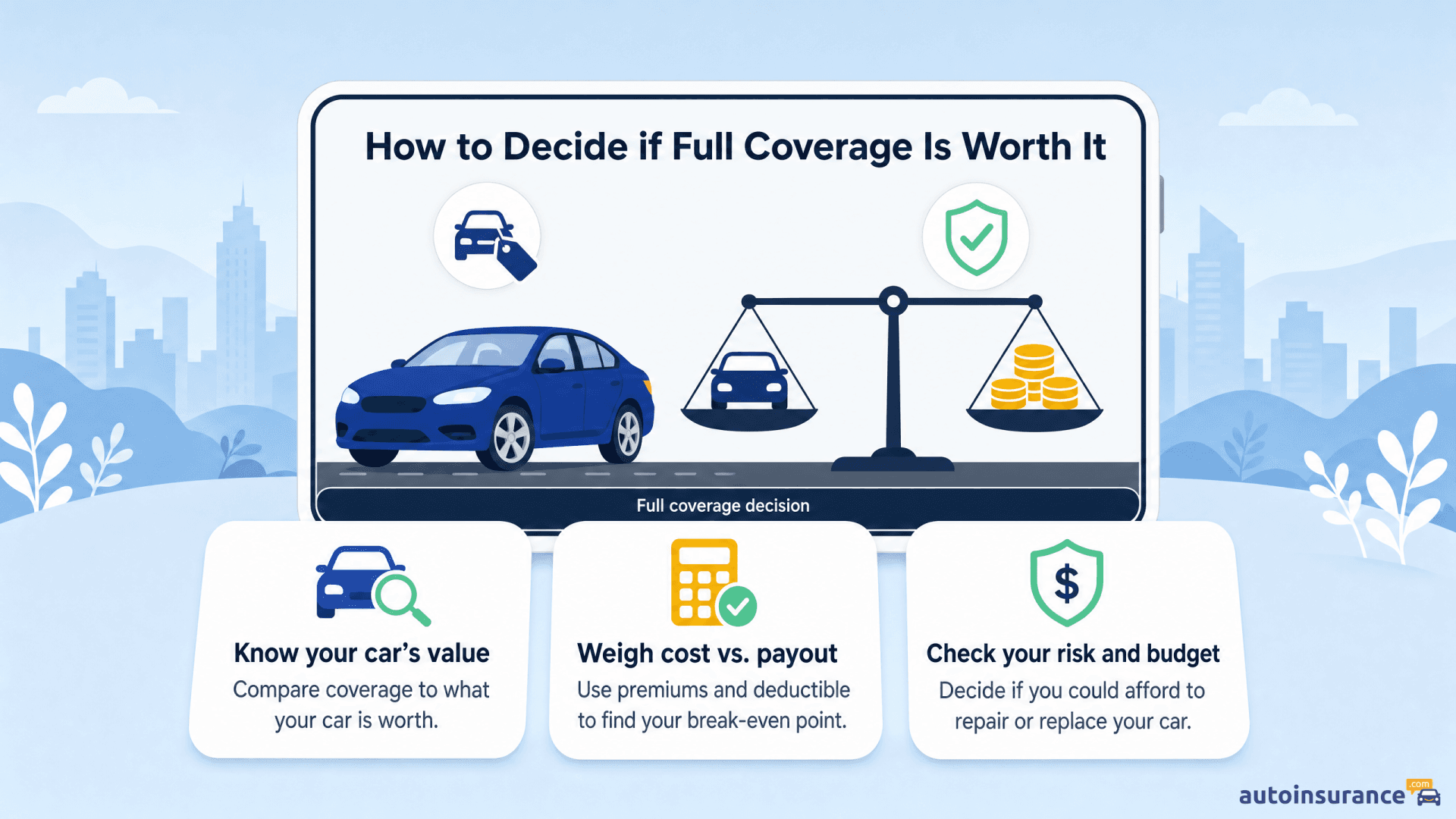
Evaluate your vehicle value, costs, and risk tolerance to determine if full insurance coverage is right for you.
When deciding whether it makes financial sense to keep or drop full coverage, you’ll need to weigh the cost of your premiums against the financial protection the coverage provides. Before making changes to your policy, consider the following factors.
Determine Your Car’s Value
Look up your vehicle’s current market value using pricing guides or online valuation tools like Kelley Blue Book. In the event of a total loss, you can expect your insurer to base the settlement on your car’s actual cash value before the damage occurred, which accounts for depreciation. You will not get back what you originally paid or the price of a new car.
Compare Your Premiums to the Potential Payout
Look at how much you pay each year for just collision and comprehensive coverage, not your total insurance premium. If those costs represent a large percentage of your vehicle’s value, keeping full coverage may no longer make sense.
You can calculate how long it would take to break even on your saved premiums.
The Break-Even Formula is:
(Value of Car – Deductible) / Annual Premium = Years to Break Even
Here’s an example:
| Value of car | $2,000 |
|---|---|
| Collision & comprehensive premium | $250 every six months, or $500 per year |
| Deductible | $1,000 |
In this example, if you go two years without a claim, you’ve broken even:
($2,000 – $1,000) / $500 = 2 Years
You pocketed $500 each year — $1,000 total — which is the equivalent of what your payout would be minus a deductible.
Factor in Your Deductible
Your deductible is the amount you’ll pay out of pocket before your insurance kicks in. A higher deductible lowers your premium, but it also means you’ll get a lower payout after a covered loss. If your deductible is close to your car’s value, full coverage may provide limited financial benefit. For example, if your collision deductible is $1,000 and your car’s value is $2,000, you would only get $1,000 in the event of a total loss.
Consider Your Financial Situation
Consider whether you could comfortably afford to repair or replace your vehicle if it were stolen or totaled. If replacing your car would create financial hardship, maintaining collision and comprehensive coverage may be worthwhile even if your vehicle is older.
Evaluate Your Risk
Think about how and where you drive. Drivers with long commutes or those who live in areas with high accident rates, severe weather, theft, or frequent animal collisions may benefit more from keeping full coverage than someone who drives only occasionally.
Ultimately, there isn’t a one-size-fits-all answer. Full coverage is generally worth keeping when the cost of replacing your vehicle would be difficult to absorb, but it may make sense to drop it if your car has depreciated significantly and you can comfortably cover the loss yourself.
Recap
When deciding whether to keep full coverage on an older car, consider its value, your financial situation, and your risk tolerance. Dropping collision and comprehensive coverage can lower your premium, but it also means you’ll have to pay out of pocket to repair or replace your vehicle after a covered loss. Before making a decision, compare the cost of full coverage with your car’s current value and consider whether you could comfortably afford to replace it if it were totaled.
Frequently Asked Questions
Keeping full coverage on a 15-year-old car depends on your car’s value and your financial situation. If it’s only worth a few thousand dollars, paying for collision and comprehensive coverage may not make sense because the maximum insurance payout after a covered loss could be relatively small. Compare the annual cost of collision and comprehensive coverage with your car’s current market value and consider how much financial risk you’re comfortable with before making a decision.
Yes, it’s usually cheaper to insure a 20-year-old car than a new vehicle because it likely has a low value, unless it’s a classic car. Because older cars tend to have low value and are cheaper to repair, insurance premiums are lower. They can be particularly cheap to insure if you only carry liability coverage.
A $1,000 deductible is usually better for with at least 3 months of expenses in savings and a clean recent claims record; $500 is usually better for newer drivers with fewer savings. That said, neither is inherently better — choosing between a $500 and a $1,000 deductible depends on your budget and preference. A higher deductible will lower your premium, but it also means you’ll need to pay more out of pocket if you need to file a claim.
Neither comprehensive nor collision is necessarily better than the other. They cover different risks, and it often makes sense to have both. If you need to choose just one, the right choice depends on the risks you face and the value of your vehicle. Comprehensive often costs less than collision and covers a wide range of non-collision losses, including theft, vandalism, and weather. Collision coverage pays to repair or replace your car after an accident involving another vehicle or object, regardless of who is at fault.
Related Articles


How Do I Know If I Need Umbrella Insurance?
November 6, 2025
What happens if my car is declared a total loss?
July 14, 2026