




Last updated: April 1, 2026
Most EV-friendly cities in the U.S.
Boston, Los Angeles, San Diego, and Kansas City are some of the most EV-friendly cities in the country.
Get quotes from providers in your area

Key Takeaways
- The number of Level 3 chargers in the U.S. increased by 30 percent in 2025, but distribution remains uneven, and some cities are much better suited to EV ownership than others.
- The most EV-friendly cities include Boston, Los Angeles, Kansas City, and Denver.
- The top three cities with the most EV chargers are all in California: Los Angeles, San Diego, and San Jose. On the flip side, New York, Chicago, and Philadelphia all have a surprisingly low number of chargers compared to their populations.
- Although federal EV incentives have expired, many states still offer tax credits for the purchase or lease of an EV.
While they’re still nowhere near as common as gas-powered cars, EVs are becoming increasingly popular across the country. The number of electric vehicles on the road in the U.S, grew from fewer than 3 million to around 4 million between 2022 and 20241. Currently, there are approximately 16 registered EVs per charger nationwide.
As EV adoption continues nationwide — in 2025, the number of Level 3 chargers grew by 30 percent2 — certain cities are far better equipped to support electric driving than others. In some U.S. cities, EV drivers have access to broad charging networks, local incentives, and electricity costs that make going electric more convenient and affordable. In others, limited infrastructure and higher costs can make it a less appealing option.
We examined the latest national data to determine the most EV-friendly cities in the U.S. and highlight where drivers can get the most out of going electric.
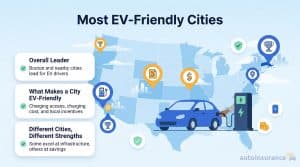
Most EV-Friendly Cities
A city’s EV-friendliness comes down to several factors. Here are the most EV-friendly cities in the U.S., as well as our top picks for specific categories, based on our analysis.
How We Defined the Most EV-Friendly Cities
To determine the most EV-friendly cities in the U.S., we prioritized the city’s total number of public Level 2 and Level 3 chargers, and we also considered its respective state’s average charging costs and EV-related tax incentives.
Most EV-Friendly City Overall: Boston, MA
Number of public chargers: 1,846 (7th nationwide)
Average annual public charging cost in MA: $1,843
Relevant statewide EV tax incentives: Rebate between $3,500 and $6,000, depending on income and whether you can trade in a qualifying vehicle
The overall most EV-friendly city in our analysis is Boston, MA, thanks to its high rankings for various factors. It has the seventh-highest number of public chargers in the country, moderate charging costs, and some of the most generous statewide incentives available.
NOTE
The average annual public charging cost is based on the average U.S. mileage of 13,500 miles per year and an average EV efficiency of 0.35 kWh per mile. Keep in mind that the annual charging cost would be lower for drivers charging primarily at home.
Top 10 Overall Most EV-Friendly Cities
- Boston, MA
- Los Angeles, CA
- San Diego, CA
- Seattle, WA
- Atlanta, GA
- San Francisco/San Jose, CA
- Sacramento, CA
- Austin, TX
- Denver, CO
- Kansas City, MO
Best for Infrastructure: Los Angeles, CA
Number of public chargers: 7,875 (1st nationwide)
Average annual public charging cost: $2,174
Relevant statewide EV tax incentives: Up to $12,000 available for low-income households who have a vehicle to scrap
When looking purely at EV charging infrastructure, Los Angeles is far and away the winner. It has almost 2,000 public Level 2 and Level 3 chargers, which is more than twice as many as the runner-up, San Diego.
Category Runner Up: San Diego, CA
San Diego has over 3,000 public EV chargers, making it the city with the second-most robust charging network in the U.S.
Best for Day-to-Day Affordability: Kansas City, MO
Number of public chargers: 914 (21st nationwide)
Average annual public charging cost in KS: $1,370
Relevant statewide EV tax incentives: N/A
If affordability is the priority, Kansas City, MO, comes out on top. Missouri has the second-lowest average public charging cost of any state (only $0.03 behind Kansas), and Kansas City ranks 21st on the list of cities with the most available public chargers.
Category Runner Up: Salt Lake City, UT
Utah ranks third for cheapest public charging costs, and all Level 2 chargers in Salt Lake City that are operated by the city are free to use.
Top Cities for Public EV Charging Access
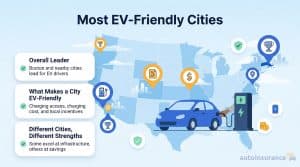
One of the key data points when evaluating the most EV-friendly cities is the availability of public chargers. We looked specifically at Level 2 and Level 3 charging access, as these are the most convenient and commonly used public charging options by EV owners.
According to the most recent records from the Department of Energy, the city of Los Angeles has the most public Level 2 and Level 3 chargers in the country, by far, with nearly 8,000. The next city on the list is San Diego, which has 3,035.
The top three cities with the most public chargers are in California, and six California cities are in the top 20. This makes sense given that California also has the largest number of EV registrations of any state, making up about 35 percent of EV registrations nationwide3.
FYI
This data refers to the number of chargers, not the number of charging stations. Many charging locations have multiple chargers, so for any given city, the total number of chargers is higher than the number of charging stations.
| City | State | Number of public EV chargers (Level 2 and 3) |
|---|---|---|
| Los Angeles | California | 7,875 |
| San Diego | California | 3,035 |
| San Jose | California | 2,325 |
| Atlanta | Georgia | 2,303 |
| New York | New York | 1,928 |
| Sacramento | California | 1,859 |
| Boston | Massachusetts | 1,846 |
| Seattle | Washington | 1,843 |
| Austin | Texas | 1,791 |
| Irvine | California | 1,703 |
| Las Vegas | Nevada | 1,495 |
| San Francisco | California | 1,493 |
| Houston | Texas | 1,483 |
| Denver | Colorado | 1,420 |
| Orlando | Florida | 1,322 |
| Washington, D.C. | N/A | 1,262 |
| Miami | Florida | 1,219 |
| Chicago | Illinois | 1,140 |
| Columbus | Ohio | 1,091 |
| Portland | Oregon | 970 |
States With the Fewest Registered EVs per Charger
While California has the most chargers overall, it also has the largest number of registered EVs. To get a better sense of where EV drivers experience the least amount of competition for public chargers, we looked at which states have fewest registered EVs per charger.
It’s important to look at this data with a couple of things in mind. Wyoming and North Dakota technically have the lowest number of registered EVs per charger because they have very low numbers of both. The location of the chargers also matters — both of these states are quite rural and have large stretches of roadway without any charging stations.
| State | Number of EVs per charger |
|---|---|
| Wyoming | 3.37 |
| North Dakota | 3.43 |
| Maine | 4.55 |
| South Dakota | 4.75 |
| West Virginia | 4.83 |
| Mississippi | 5.20 |
| Vermont | 5.62 |
| Arkansas | 6.38 |
| New York | 6.65 |
| Connecticut | 6.68 |
States With the Most Registered EVs per Charger
On the other end of the spectrum, the following states have the most registered EVs per public charger, making it more likely that drivers will have competition when looking to charge.
Again, some discretion is needed because states like California have a robust charging network that still makes it overall more convenient for EV drivers than somewhere like Wyoming.
| State | Number of EVs per charger |
|---|---|
| Hawaii | 24.39 |
| New Jersey | 22.15 |
| California | 19.40 |
| Arizona | 19.32 |
| Texas | 18.89 |
| Washington | 18.56 |
| Illinois | 18.06 |
| Nevada | 17.73 |
| Florida | 17.59 |
| Virginia | 15.64 |
Overall, the data suggest that charging infrastructure is lagging a little behind EV adoption — the states with some of the highest rates of EV ownership also have the greatest competition for existing chargers.
State-Level EV Incentives
Up until September 30, 2025, the U.S. offered tax credits at the federal level of up to $7,500 for new and $4,000 for used electric vehicles. However, even though these have now expired, several states still offer tax incentives that can make EV ownership more affordable.
Beyond statewide tax credits, many utility companies across the country offer incentives for customers who purchase or lease an electric vehicle, install an at-home charger, or charge at specific times of day. Be sure to check with your utility company to see if you may be eligible for a rebate or discount.
GOOD TO KNOW
A tax credit is not the same as a tax rebate. A credit reduces your tax bill dollar-for-dollar, while a rebate typically functions as a direct refund or reimbursement.
For example, if you owe $2,000 in taxes and receive a $1,000 tax credit, your bill drops to $1,000—but a $1,000 rebate would be paid to you directly, regardless of how much you owe.
The following states currently offer statewide tax incentives for the purchase of a new EV. Some also include rebates for used EVs.
| State | EV Incentive |
| California | Eligible low-income households with a car to scrap can qualify for up to $12,000 to purchase or lease a new EV under the Clean Cars 4 All Scrap and Replace Program.4 |
| Colorado | Colorado taxpayers are eligible for a state tax credit of $750 for the purchase or lease of a new EV with an MSRP up to $80,000, and an additional tax credit of $2,500 for the purchase or lease of a new EV with an MSRP up to $35,000.5 |
| Connecticut | CT residents qualify for a $1,000 tax rebate for the purchase or lease of a new EV. Prequalified low- and moderate-income families can receive an additional $3,000 credit.6 |
| Delaware | Delaware residents receive a rebate of up to $2,500 with a purchase or lease of a new or used electric vehicle.7 |
| Illinois | Illinois residents can receive a credit of up to $4,000, depending on income, for the purchase of a new or used all-electric vehicle with a maximum MSRP of $80,000.8 |
| Maine | Rebates are income-dependent and are available up to $7,000 are available for new EVs and $3,000 for used EVs.9 |
| Massachusetts | MA offers a $3,500 rebate for the purchase or lease of an electric vehicle. Income-qualifying residents can also apply this rebate to the purchase of a used EV and may apply for an additional rebate of $1,500. Those trading in a qualifying vehicle can receive an additional $1,000 rebate.10 |
| New Jersey | Receive an incentive of up to $1,500 (or $4,000 for income-qualifying residents) when you purchase or lease a new EV.11 |
| New York | The Drive Clean Rebate provides a credit of up to $2,000 for residents who buy or lease a new EV.12 |
| Pennsylvania | $3,000 rebates for the purchase of new EVs are available until June 30, 2026.13 |
| Rhode Island | Rebates of up to $3,000 are available for new EVs, and lower rebates are available for used EVs.14 |
| Washington, D.C. | Eligible taxpayers who convert vehicles to operate on qualified alternative fuels may claim an income tax credit of 50% of the associated equipment and labor costs, up to $19,000 per vehicle, through the Alternative Fuel Conversion Tax Credit. |
States With Cheapest Public Charging Costs
Part of whether a state is EV-friendly depends on its energy/charging costs, which directly impact the cost of EV ownership. At-home charging will almost always be cheaper than using a public charger. For the sake of this analysis, we looked at charging costs at public charging stations across the U.S.
At the time of this writing, Kansas had the cheapest charging costs at $0.29/kWh, followed by Missouri and Utah.15
| State | Cost/kWh |
|---|---|
| Kansas | $0.29 |
| Missouri | $0.32 |
| Utah | $0.33 |
| Nebraska | $0.34 |
| Maryland | $0.34 |
| Iowa | $0.34 |
| Vermont | $0.35 |
| South Dakota | $0.35 |
| Delaware | $0.36 |
| New Mexico | $0.37 |
States With the Most Expensive Public Charging Costs
The state with the highest average public EV charging cost is West Virginia, which may come as a surprise given its overall low cost of living. Other states on the list, such as Hawaii and California, are more expected.
| State | Cost/kWh |
|---|---|
| West Virginia | $0.53 |
| Hawaii | $0.52 |
| Alaska | $0.50 |
| New Hampshire | $0.48 |
| Louisiana | $0.48 |
| South Carolina | $0.47 |
| California | $0.46 |
| New Jersey | $0.45 |
| Arkansas | $0.45 |
| Idaho | $0.44 |
Recap
Determining how EV-friendly a city is comes down to how well infrastructure, policy, and cost align to support everyday electric driving. Cities with dense charging networks, strong incentives, and affordable charging rates make EV ownership significantly more convenient and affordable. Cities lagging in these areas present barriers for drivers considering the switch.
Metrics like total charging ports and EVs per charger highlight how uneven charging access can be across regions. As investment continues and adoption grows — even if growth has slowed somewhat — the gap between leading and lagging cities may narrow. For now, living in certain areas over others can make a big difference in the practicality of going electric.
Methodology
We evaluated data from the following third parties to compile this report:
- AAA
- Department of Energy
- Experian
- Paren
Citations
Electric Vehicles: 2024 Year in Review. Experian Automotive. (2025).
https://www.experian.com/content/dam/marketing/na/automotive/infrographic/EV-Infographic/electric-vehicles-2024-year-in-review.pdf
US EV Fast Charging — Full Year 2025. Paren. (2026, January 28).
https://www.paren.app/reports/state-of-the-industry-report-us-ev-fast-charging-full-year-2025
Electric Vehicle Registrations by State. U.S. Department of Energy, Alternative Fuels Data Center (AFDC). (n.d.).
https://afdc.energy.gov/data/10962
Driving Clean Assistance Program (DCAP). Community Housing Development Corporation (CHDC). (n.d.).
https://drivingcleanca.org/
Electric Vehicle Tax Credits. Colorado Energy Office. (n.d.).
https://energyoffice.colorado.gov/transportation/grants-incentives/electric-vehicle-tax-credits
Connecticut Hydrogen and Electric Automobile Purchase Rebate (CHEAPR). Connecticut Department of Energy & Environmental Protection (DEEP). (n.d.).
https://portal.ct.gov/DEEP/Air/Mobile-Sources/CHEAPR/CHEAPR—Home
Delaware Clean Vehicle Rebate Program. Delaware Department of Natural Resources and Environmental Control (DNREC). (n.d.).
https://driveelectricdelaware.org/
Electric Vehicle Rebate Program. Illinois Environmental Protection Agency (IEPA). (n.d.).
https://epa.illinois.gov/topics/ceja/electric-vehicle-rebates.html
Electric Vehicle Incentives for Low- and Moderate-Income Mainers. Efficiency Maine Trust. (n.d.).
https://www.efficiencymaine.com/electric-vehicle-incentives-for-low-and-moderate-income/
Massachusetts Offers Rebates for Electric Vehicles (MOR-EV). Massachusetts Department of Energy Resources (DOER). (n.d.).
https://mor-ev.org/
Drive Green New Jersey — Affordability Incentives. New Jersey Department of Environmental Protection (NJDEP). (n.d.).
https://dep.nj.gov/drivegreen/affordability-incentives/
Drive Clean Rebate for Electric Cars Program. New York State Energy Research and Development Authority (NYSERDA). (n.d.).
https://www.nyserda.ny.gov/All-Programs/Drive-Clean-Rebate-For-Electric-Cars-Program
Alternative Fuel Vehicle Rebates for Consumers. Pennsylvania Department of Environmental Protection (DEP). (n.d.).
https://www.pa.gov/agencies/dep/programs-and-services/grants-loans-rebates/alternative-fuel-vehicle-rebates-for-consumers
DRIVE EV — Electric Vehicle Rebate Project. Rhode Island Office of Energy Resources (OER). (n.d.).
https://drive.ri.gov/drive-ev-project
EV Charging Prices. American Automobile Association (AAA). (n.d.).
https://gasprices.aaa.com/ev-charging-prices/
Related Articles
Farm Bureau Car Insurance Review 2026
March 31, 2026Best Cheap Car Insurance in St. Petersburg
March 31, 2026