866-589-5339





How a Speeding Ticket Impacts Insurance in Colorado
Drivers with a speeding ticket in Colorado can expect their auto insurance to increase by 24 percent on average.
Get quotes from providers in your area

Discover rates as low as $24 /month

Last updated: July 12, 2026
Key Takeaways: Speeding Ticket & Car Insurance in Colorado
In Colorado, car insurance premiums increase by an average of 24 percent following a speeding ticket.
Drivers in Colorado with a speeding ticket pay an average of $3,984/year, compared to $3,215/year with a clean record.
American National offers the cheapest rates for drivers with a speeding ticket at $1,853/year.
Most speeding violations in Colorado are considered traffic infractions and carry a fine, but severe offenses are misdemeanors that may result in jail time.
In 2025, over 200 people were killed in car accidents due to speeding in Colorado, which is more than were killed due to impaired driving and lack of restraint use.1 A speeding ticket in the Centennial State may result in a fine and even jail time, depending on the severity of the offense. You can also expect your insurance premium to increase as a result.
How a Speeding Ticket Impacts Your Insurance in Colorado
In Colorado, a speeding ticket increases annual premiums by an average of 24 percent, the equivalent of over $750 per year. American National’s rates increase the least, on average — only by 11 percent — and it also offers the lowest rates for drivers with a speeding ticket in the Centennial State.
By contrast, Farm Bureau has the largest rate increase after a speeding ticket, but it still offers lower rates for this category than Progressive.
| Company | Clean record | Speeding ticket | Percentage increase |
|---|---|---|---|
| American National | $1,671 | $1,853 | 11% |
| Farm Bureau | $2,064 | $3,382 | 64% |
| USAA | $2,210 | $2,800 | 27% |
| GEICO | $2,380 | $3,316 | 39% |
| Progressive | $3,147 | $4,360 | 39% |
| Colorado average | $3,215 | $3,984 | 24% |
How to Lower Your Premium After a Speeding Ticket
A speeding ticket can lead to higher car insurance rates, but there are steps you can take to minimize the impact and reduce your premium over time.
- Shop around for quotes. Different insurance companies have different ways of weighing driving violations, so comparing rates from multiple insurers can help you find the most affordable policy.
- Drive safely. Your rate can increase with each violation, so avoiding additional tickets or accidents will keep your rate as low as possible and ensure the points are removed from your license as soon as possible.
- Take a defensive driving course. Some insurers offer discounts for completing an approved driver safety course, and certain Colorado municipalities allow drivers to take an approved defensive driving course to help reduce the impact of a speeding ticket and other violations.
- Look for available discounts. Ask your insurer about savings opportunities, such as bundling policies, enrolling in paperless billing, or participating in a telematics program.
- Increase your deductibles. Choosing higher deductibles for comprehensive and collision coverages can lower your premium, though you’ll pay more out of pocket if you file a claim.
- Review your coverage needs. While reducing coverage is generally not recommended, it can be a smart move in certain situations. For example, if you drive an older vehicle, it may be worth reassessing optional coverages like collision and comprehensive to ensure you’re not paying for protection you no longer need.
Colorado Speeding Ticket Fines
Colorado categorizes speeding violations according to several tiers, with each incurring a different fine.2 Traffic infractions refer to the lesser violations and are subdivided into Class A and Class B infractions. More severe violations are considered misdemeanor traffic offenses, which are subdivided into Class 1 and Class 2. Misdemeanor traffic offenses may carry jail time in addition to or instead of a fine.
Most speeding violations are either Class A traffic infractions or Class 1 misdemeanor traffic offenses. Drivers required to pay a fine for traffic infractions will also be charged a surcharge, which goes towards the Crime Victim Compensation Fund and the Victims and Witness Assistance and Law Enforcement Fund.
| Violation | Fine | Surcharge | Jail Time |
|---|---|---|---|
| 1 to 4 mph over the speed limit (Class A traffic infraction) | $30 | $6 | None |
| 5 to 9 mph over the speed limit (Class A traffic infraction) | $70 | $10 | None |
| 10 to 19 mph over the speed limit (Class A traffic infraction) | $135 | $16 | None |
| 20 to 24 mph over the speed limit (Class A traffic infraction) | $200 | $32 | None |
| 25 or more over the speed limit (Class 2 misdemeanor traffic offense) | Minimum $150
Maximum $300 | N/A | Minimum 10 days
Maximum 90 days |
| 25 or more over the speed limit in a construction zone (Class 1 misdemeanor traffic offense) | Minimum $300
Maximum $1,000 | N/A | Minimum 10 days
Maximum 1 year |
| Driving at a speed that is not reasonable given road conditions (Class A traffic infraction) | $100 | $10 | None |
| Driving so slowly that reasonable forward movement of traffic is impeded (Class A traffic infraction) | $50 | $6 | None |
| Exceeding a safe speed on a bridge or elevated structure (Class A traffic infraction) | $30 | $6 | None |
Other Consequences of a Speeding Ticket in Colorado
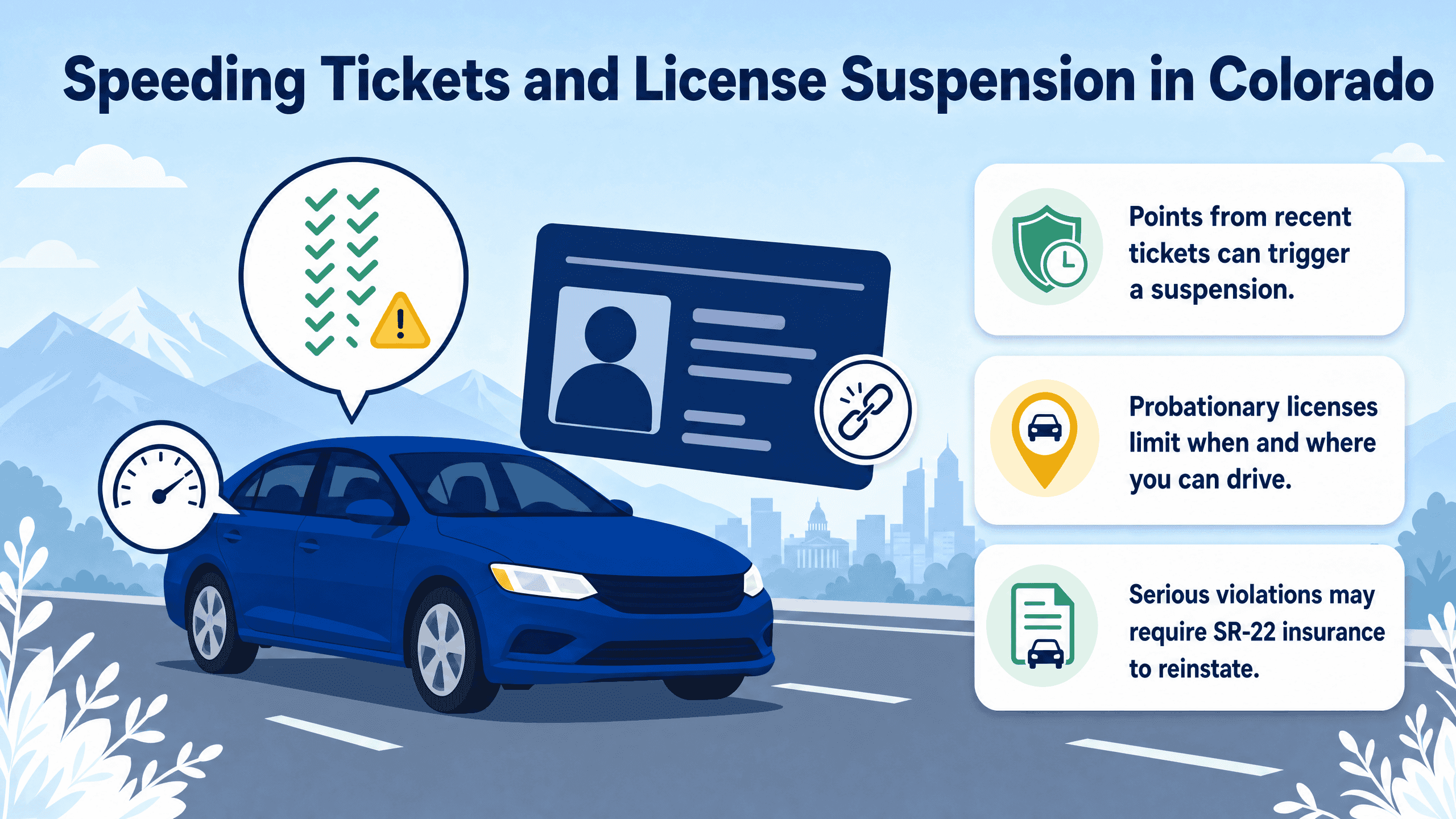
Accumulating too many points on your driving record in Colorado can lead to license suspension and restricted driving options.
Like many states, Colorado uses a point system to keep track of violations on your driving record. In addition to being fined or even facing possible jail time, you may have your license suspended if you accrue a certain number of points on your license.
Points for speeding infractions are as follows:
| MPH over the speed limit | Points |
|---|---|
| 1 to 4 | 0 |
| 5 to 9 | 1 |
| 10 to 19 | 4 |
| 20 to 39 | 6 |
| 40 and over | 12 |
The number of points you can have added to your license before a suspension depends on your age — there is less leeway for younger drivers:
- Minors 17 and under: six points or more within a 12-month period; seven points or more at any point
- Minors 18 to 21: nine points or more within a 12-month period; 12 points or more within a 24-month period; 14 points or more at any point
- Adults 21 and over: 12 points or more within a 12-month period; 18 points or more within a 24-month period
Once you reach these point thresholds, your license will be suspended.3 You may have your license suspended after a single speeding ticket if you’re 40 or more miles over the speed limit. There is no flexibility regarding these thresholds, but Hearing Officers do have flexibility in determining the length of the suspension.
The default suspension is six months, and the maximum is one year. If it’s your first offense, chances are you’ll be suspended for less than six months. However, if you have aggravating factors like repeat violations or prior points on your record, you may be looking at the maximum suspension.
FYI:
In Colorado, all violations, including speeding tickets, remain on your driving record for seven years. However, only points from the past 24 months are used for license suspension decisions.
Probationary licenses
Hearing Officers may also consider whether to grant a probationary license. It is up to their discretion, and a past probationary license on your record will make it more difficult to obtain a second one. Probationary licenses are only valid within the state of Colorado and only allow driving for specific reasons, like school or work.
Once the point suspension expires, even if you were on a probationary license, you will need to reinstate your driver’s license. If you receive a ticket for any type of moving violation, including speeding, while on a probationary license, it will be revoked immediately. If this happens, you will need to carry SR-22 insurance for three years once your driving privileges are reinstated.
What to Do After a Speeding Ticket in Colorado
If you receive a speeding ticket in Colorado, taking the right steps can help you avoid additional penalties and limit the impact on your driving record and insurance rates.
- Review the ticket carefully. Make sure that your personal information, the recorded violation, and the court or payment deadlines are accurate.
- Decide whether to pay or contest the ticket. Paying the ticket is considered an admission of guilt and may result in points being added to your driving record. If you believe the ticket is a mistake or you want to try to get a point reduction, you have the option to contest it in court by appearing in court on the date shown on the citation.4
- Pay the fine on time. For citations payable to the Department of Revenue, payment made online or postmarked within 20 days of the violation date will get you a point reduction. After 20 days, there will be no point reduction, and after 40 days, it will become a Summons and require a court appearance. Certain citations are designated as a Summons or a Municipal citation, which must be paid through the appropriate court.
- Understand the points system. Colorado uses a driver’s license point system, and accumulating too many points within a certain period can result in a license suspension. Knowing how many points your violation carries will help you understand the potential consequences.
- Check with your insurance company. A speeding ticket may increase your premium at your next renewal, so it’s a good idea to check on the impact and potentially shop around before renewal to see if you may get a better rate elsewhere.
- Drive safely going forward. Maintaining a clean driving record after a ticket is one of the best ways to keep future insurance costs down and reduce the long-term impact of the violation.
A single speeding ticket will affect your driving record and will likely lead to an increase in your insurance premium, but the impact ultimately depends on how far over the speed limit you were driving. If you’re caught speeding, you will receive an automatic point reduction for paying the fine promptly. Choosing to fight the ticket, while more inconvenient, may lead to a judge knocking some more points off. A fine reduction is less likely, but also possible in some cases.
Recap
In many cases, a speeding ticket in Colorado will result in higher car insurance premiums, but the impact depends on several factors, including the severity of the violation, your driving history, and your insurance provider. On average, rates increase by around 24 percent after a speeding ticket in Colorado.
A single, minor speeding ticket is unlikely to significantly impact your insurance or your driving record, but depending on how much you speed, it can be considered a more severe violation. Maintaining a clean driving record following a speeding violation and regularly comparing quotes from multiple providers can help you find more affordable coverage over time.
Frequently Asked Questions
One speeding ticket may increase your insurance premium, but it depends on a few factors. If you were only going a few miles over the speed limit, you will have very few points (or even no points) added to your record, which is unlikely to affect your premium. However, if you were going significantly over the speed limit, even if it was only one ticket, you should expect your insurance rates to increase at renewal.
Yes, your insurance will generally increase with three points on your driving record. However, if this was your first offense, the impact may be minimal. If these three points are adding to existing points, the impact will be more significant.
Whether it’s worth fighting a speeding ticket in Colorado depends on your citation and your willingness to show up in court. If you believe you were issued a citation in error, it’s absolutely worth fighting it and pleading your case to a judge. Even if the citation is correct, you may be able to get some points reduced by showing up in court. For a minor violation, it may be less hassle to pay the fine and get an automatic point reduction. The decision is up to each driver’s discretion.
Yes, your car insurance company will know if you got a speeding ticket. Citations that you’re convicted of are added to your driving record with the state DMV, which insurers have access to. Your rates won’t change immediately, but when your insurer checks your record at renewal time, you can expect them to rise.
Sources
Speeding claimed 237 lives on Colorado roads last year. Colorado Department of Transportation. (2025, Aug 26).
https://www.codot.gov/news/2025/august/speeding-claimed-237-lives-colorado-last-yearPenalties for Speeding Violations. Colorado General Assembly. (2016, Dec 23).
https://content.leg.colorado.gov/content/penalties-speeding-violationsPoint Suspensions. Colorado Department of Revenue. (2026).
https://cdor.colorado.gov/hearings-homepage/motor-vehicle-hearings/point-suspensionsTickets and Penalty Assessments. Colorado Department of Revenue. (2026).
https://dmv.colorado.gov/tickets-and-penalty-assessments
Related Articles
How a Speeding Ticket Impacts Insurance in Illinois
July 23, 2026
How a Speeding Ticket Impacts Insurance in Maryland
July 22, 2026