866-589-5339





What Is the Minimum Car Insurance in Louisiana?
Car insurance is a legal requirement in the Pelican State.
Get quotes from providers in your area

Discover rates as low as $24 /month


Last updated: May 13, 2026
In Louisiana, drivers must carry the minimum car insurance or face strict penalties, including fines starting at $500, vehicle impoundment, and license/registration suspension. Read on to learn more about Louisiana’s minimum coverage requirements, plus important state laws related to being an insured driver.
What are Louisiana’s Minimum Coverage Requirements?
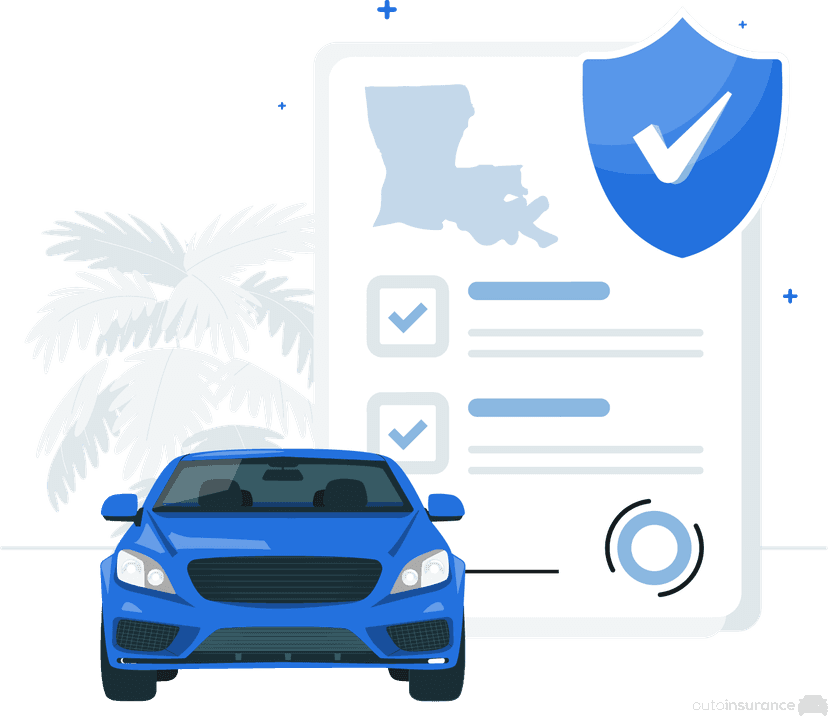
Like most states, Louisiana requires drivers to carry insurance.1 Here are the minimum liability limits required by law:
- Bodily injury to one person: $15,000 per accident
- Bodily injury to two or more people: $30,000 per accident
- Property damage: $25,000 per accident
Is the Minimum Coverage Enough in Louisiana?
We recommend increasing your liability limits above the state minimum (regardless of where you live), as accident damages can often exceed what’s covered if you’ve opted for the minimum. Experts recommend bodily injury liability limits of $100,000 per person/$300,000 per accident and $100,000 of property damage liability per accident, often abbreviated to 100/300/100.
Liability coverage only includes bodily injury and property damage coverage. Consider including these additional coverage types in your policy for more comprehensive protection:
- Collision coverage: Keeps you covered when your vehicle is damaged in a collision with another. Your collision limit is your vehicle’s actual cash value (ACV, also referred to as actual market value or AMV). In the event of a total loss, you’ll be paid out the ACV minus your chosen deductible.
- Comprehensive coverage: Covers expenses stemming from non-collision-related damages to your car, like hail, theft, vandalism, and more. As with collision coverage, your comprehensive coverage limit is your vehicle’s ACV minus your deductible.
- Uninsured/underinsured motorist coverage: Protects you if you’re in an accident with an uninsured or underinsured driver, and pays the expenses related to medical bills or vehicle repair costs. Here, your coverage limit should match your liability limit.
- Personal injury protection (PIP): Covers your medical bills if you’re in an accident you caused, along with lost wages and childcare costs you incurred from the accident.
FYI:
Nearly 12 percent of drivers in Louisiana are uninsured.2 If you get into an accident, the risk that the other driver lacks adequate insurance is high, so uninsured motorist coverage is particularly helpful if you’re a Louisiana driver.
Is Proof of Insurance Required in Louisiana?
You need proof of insurance when driving, as well as transactions like vehicle registration, title transfers, and other transactions.3 Keep in mind that driving without proof of insurance is different from driving completely uninsured.
Penalties for Driving Without Proof of Insurance in Louisiana
If you’re pulled over and cited for driving without proof of insurance, your license plate will be confiscated, and you’ll have three business days to prove you were insured at the time of your citation. Once you do, you’ll get your license plate back and any fines will be waived.
Penalties for Driving Uninsured in Louisiana
On the other hand, if you were uninsured when you were cited, you’ll be subject to a number of penalties. These escalate in severity with each offense and span the following:
- Fine of $500-$1,000 per offense
- A reinstatement fee ($100 for first offense, $250 for second offense, $500 for third or subsequent offenses)
- Driving privileges suspended: vehicle impounded and license plate confiscated
- Registration revoked for 180 days
- License revoked for 12 to 18 months
- SR-22 on file for three years, which can lead to higher premiums
- Inability to recover damages from the other driver, per Louisiana’s No Pay, No Play law
What Are Car Insurance Premiums in Louisiana Like?
Louisiana has some of the highest car insurance premiums in the country, with an average minimum coverage premium of $1,252 annually or $104 monthly. For the cheapest Louisiana car insurance, look to Southern Farm Bureau, GEICO, and USAA (military-only). These providers offer rates that are at least several hundred dollars below the state average.
Again, we recommend getting full coverage if possible. For instance, with Southern Farm Bureau you’ll pay $2,372 annually for full coverage, versus $735 for minimum coverage – a difference of $1,637 more per year. That amount may save you thousands more in accident repair and medical bills. That said, if full coverage is out of your price range, getting minimum coverage is better than having no coverage at all.
| Insurer | Minimum coverage (annual average) | Full coverage (annual average) | Difference between full and minimum coverage (annual average) |
|---|---|---|---|
| Southern Farm Bureau | $735 | $2,372 | +$1,637 |
| GEICO | $874 | $3,478 | +$2,604 |
| USAA | $883 | $2,725 | +$1,842 |
| Progressive | $1,037 | $3,555 | +$2,518 |
| State Farm | $1,081 | $3,971 | +$2,890 |
| Allstate | $1,309 | $4,339 | +$3,030 |
| Safeway | $1,480 | $3,530 | +$2,050 |
| State Average | $1,252 | $3,651 | +$2,399 |
Tip:
When shopping for insurers, price is just one factor. You may prefer working with an agent or a self-service online system. Other factors include coverage types and discounts available. Keep in mind that how much you pay depends on factors like your location, age, driving history, vehicle, and more.
What are Important Auto Insurance Laws in Louisiana?
Cancellation and Non-Renewal Laws
In Louisiana, insurers must provide notice prior to cancelling a policy or declining to renew it.4 Some key facets of Louisiana’s cancellation and non-renewal laws:
- First 60 days of new policy: Can cancel for any reason, if they send notice
- After 60 days of new policy: Can only cancel for nonpayment, fraud, or license/ registration suspension
- Must provide notice for nonrenewal, usually 20-30 days before policy expiration; if driver does not pay premium, shorter periods (~10 days) may apply
- Insurer must refund unused premiums within 30 days of cancellation
- If insurance is cancelled, the insurer can notify the state, leading to a “no insurance” block on driver’s registration/license (prevents renewal, requires reinstatement fees)
At-Fault and Comparative Fault Laws
Louisiana is an at-fault state, so you’re responsible for damages if you’re at fault for an accident. You’ll have to pay your deductible before your insurance will kick in, and if the costs exceed your limits, you’ll have to pay out of pocket.
The state does have a comparative fault rule that can reduce the amount of payment you’re liable to pay if the other party is partially at fault.
Diminished Value Claims
Louisiana law recognizes a vehicle’s “diminished value,” or a car’s loss in market value in an accident. If you can prove the collision reduced your car’s value, even after repairs, you can pursue a diminished value claim against the at-fault party for reimbursement.5
Insurance Law Reforms of 2026
The Louisiana legislature passed a suite of laws effective January 1, 2026 to lower insurance rates and instill consumer protections. Some key laws:
- Act 15: If drivers are over 51% at fault for an accident, they can no longer receive any compensation for injuries, no matter how severe the injuries.6
- Act 466: Revises the process by which medical costs are considered in accident-related personal injury lawsuits. It’s intended to ensure recoverable medical expenses don’t surpass the amount paid to the medical provider.7
- Act 476: If a policyholder has a first lapse in auto coverage that lasts 90 days or fewer, their insurer can’t increase their premium. Subsequent lapses within a five year period can still lead to higher premiums.8
Recap
Louisiana requires drivers to have minimum liability coverage, but this may not be enough to cover you if you get into an at-fault accident. Opt for full coverage if possible; if not, having minimum coverage is better than none due to the penalties of driving uninsured, which include fines and vehicle impoundment. Stay apprised of important auto insurance-related laws so you can properly navigate the insurance process, whether you’re starting a new policy or filing a claim.
Sources
Consumer’s Guide to Auto Insurance. Louisiana Department of Insurance. (2025, March).
https://www.ldi.la.gov/docs/default-source/documents/publicaffairs/consumerpublications/consumer%27s-guide-to-auto-insurance.pdfFacts + Statistics: Uninsured motorists. Insurance Information Institute. (2026).
https://www.iii.org/fact-statistic/facts-statistics-uninsured-motoristsRS 32:898. Louisiana State Legislature (2026).
https://www.legis.la.gov/legis/Law.aspx?d=88630RS 22:1267. Louisiana State Legislature. (2026).
https://legis.la.gov/Legis/Law.aspx?d=508140RS 9:2800.17. Louisiana State Legislature. (2026).
https://legis.la.gov/Legis/Law.aspx?d=4083802023 Regular Session HOUSE BILL NO. 171. Louisiana State Legislature. (2026).
https://legis.la.gov/legis/ViewDocument.aspx?d=13281282025 Regular Session SENATE BILL NO. 231. Louisiana State Legislature. (2026).
https://www.legis.la.gov/legis/ViewDocument.aspx?d=14268542025 Regular Session HOUSE BILL NO. 496. Louisiana State Legislature. (2026).
https://www.legis.la.gov/Legis/ViewDocument.aspx?d=1427662
Related Articles
Average Cost of Car Insurance in Louisiana
March 6, 2026
What Is the Minimum Car Insurance in Florida?
June 16, 2026