
 866-589-5339





When to Refinance Your Car Loan (And When to Wait)
Get quotes from providers in your area

Discover rates as low as $24 /month


Last updated: July 23, 2026
Key Takeaways: When to Refinance Your Car Loan
Refinancing can lower your payment or interest, but timing depends on your credit, income, and current rates.
Wait 6 months to a year after buying before refinancing, so your title transfers and credit history builds.
Rates vary widely by credit tier — from 4.55% for super-prime to 16.01% for deep-subprime new-loan borrowers, as of Q1 2026.
Refinance if your credit score rose, rates dropped, or you want to remove a cosigner.
Wait if you’re upside-down on the loan, near payoff, or facing a prepayment penalty.
See if refinancing your auto loan with RefiJet could lower your monthly payment and save you money.
Refinancing an auto loan can lower your monthly payment or cut the total interest you pay, but timing matters. Refinance too soon and you may not qualify for meaningfully better terms; wait too long and you could pay unnecessary interest. Here’s how to tell which camp you’re in.
Not sure how the refinancing process itself works? Start with our step-by-step guide to refinancing a car loan. Still shopping for your original loan? See our guide to car loans instead.
How Soon Can You Refinance a Car Loan?
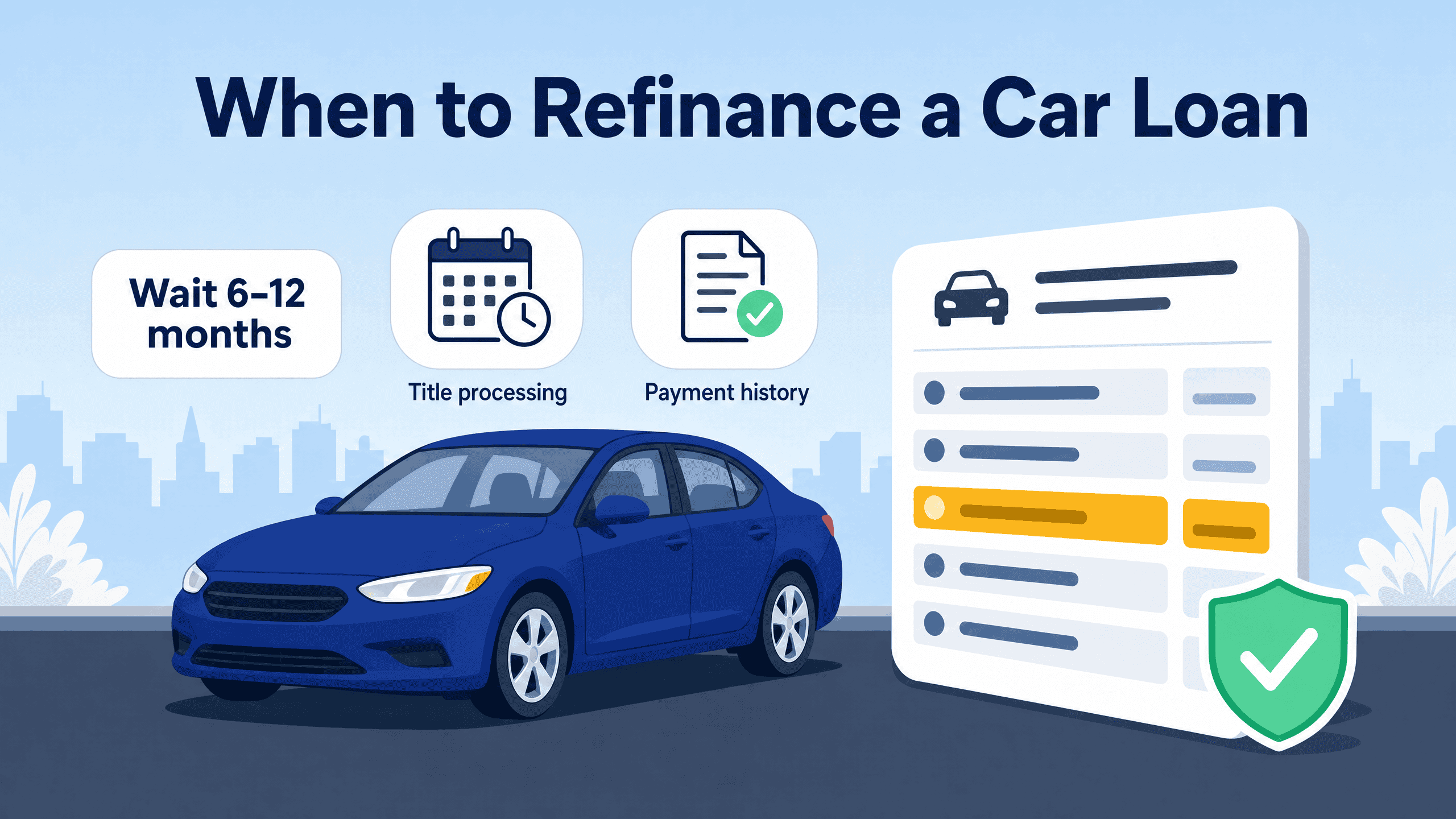
It is best to wait six to twelve months after buying a car to refinance so the title can be processed and your credit history can improve.
Experts recommend waiting at least six months to a year after buying a car before refinancing. There are two reasons for this. First, your original lender typically needs to receive and process the vehicle’s title before a new lender can step in, which can take a few months depending on your state. Second, waiting gives your credit report time to reflect a positive payment history, which can improve the rate you’re offered.
Signs It's a Good Time to Refinance
Your credit score has improved
If your score has climbed into a higher tier since you took out your loan, you may qualify for a meaningfully lower rate. The gap between tiers is substantial — in Experian’s Q1 2026 data, average new-loan rates ranged from 4.55% for super-prime borrowers up to 16.01% for deep-subprime borrowers, with used-loan rates running even higher at every tier.1 Moving up even one tier can save hundreds of dollars a year.
| Credit score tier | Avg. new-loan rate (Q1 2026) | Avg. used-loan rate (Q1 2026) |
|---|---|---|
| 781–850 (Super Prime) | 4.55% | 6.30% |
| 661–780 (Prime) | 6.23% | 8.77% |
| 601–660 (Near Prime) | 9.67% | 14.03% |
| 501–600 (Subprime) | 13.44% | 19.42% |
| 300–500 (Deep Subprime) | 16.01% | 21.77% |
Interest rates have dropped since you financed
Auto loan rates move with broader market conditions. If average rates have fallen since you signed your original loan — for example, following a Federal Reserve rate cut — refinancing can let you capture the lower rate without waiting for your loan to mature.
Your income has changed
A raise might mean you want to shorten your term and pay off the car faster. A reduced income might mean you need a lower monthly payment, even if it means paying more interest over a longer term. Either way, refinancing lets you re-shape the loan around your current budget rather than the one you had when you bought the car.
You want to remove a cosigner
If someone cosigned your original loan and your credit has since improved enough to qualify on your own, refinancing is typically the only way to take their name off the loan.
You’re unhappy with your current lender
Poor customer service, limited payment options, or a lender that’s difficult to reach are all valid reasons to refinance with a company that better fits how you want to manage your loan.
OTHER WAYS TO SAVE:
Compare quotes from at least three companies to find the cheapest car insurance rates.
Signs You Should Wait to Refinance
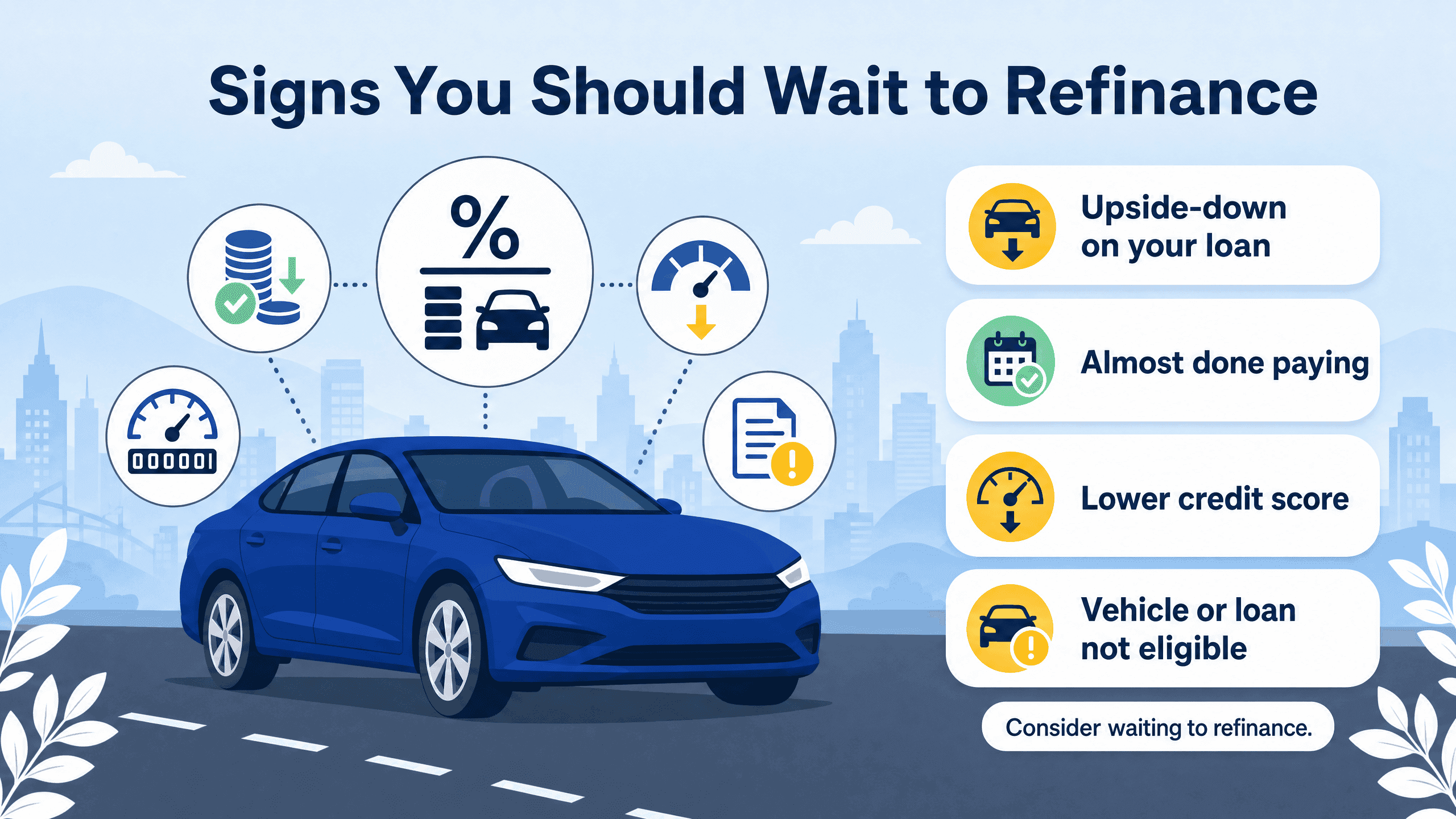
Several financial and vehicle factors can indicate that waiting to refinance is the better choice.
You’re upside-down on your loan
If you owe more than the car is currently worth, refinancing can be difficult, and some lenders won’t approve a new loan until your loan-to-value ratio improves. Paying down principal first, or waiting for depreciation to level out, may put you in a better position. If you’re upside-down and worried about what happens in a total loss, it’s also worth considering gap insurance to cover the difference between what you owe and what your car is worth.
You’re close to paying off your current loan
If you only have a handful of payments left, the fees and hassle of refinancing usually outweigh any savings. You usually need at least two years remaining on your loan to see a real benefit.
Your credit score recently dropped
Refinancing when your credit has gotten worse, not better, will likely lock you into a higher rate than you currently have.
Your vehicle doesn’t meet lender eligibility requirements
Most lenders cap eligibility by vehicle age and mileage. RefiJet, for example, generally works with vehicles under 10 years old, and many other lenders set similar or stricter limits. If your car is older or has high mileage, your options — and your rate — may be more limited.
Your current loan has a prepayment penalty
Some loans charge a fee for paying off the balance early. Check your loan agreement; if the penalty is steep, it can offset some or all of your refinancing savings.
How Often Can You Refinance a Car Loan?
There’s no legal limit on how many times you can refinance, but each application typically involves a hard credit inquiry and, in some cases, fees. Most borrowers refinance once, occasionally twice, over the life of a loan — usually when a clear trigger (a credit score jump, a rate drop, a change in income) makes it worthwhile.
Best Time of Year to Refinance
There’s no single “best month” that applies to every borrower, but a few patterns are worth knowing:
- After tax season, many borrowers use a refund to pay down principal before refinancing, which can improve their loan-to-value ratio.
- Following a Federal Reserve rate decision, average auto loan rates often shift within a month or two, so it’s worth checking rates after any announced rate cut.
- End of quarter, some lenders and aggregators run promotions or waive fees to meet quarterly targets, though this varies by company and isn’t guaranteed.
The more reliable approach is to base timing on your own credit and rate situation rather than the calendar.
Is Refinancing Worth It? How to Tell
Run a simple breakeven check before you commit:
- Add up any fees associated with the new loan (application fees, title transfer fees, prepayment penalties on your old loan).
- Calculate your monthly savings using a car loan calculator.
- Divide total fees by monthly savings to see how many months it takes to break even.
If you plan to keep the car well beyond that breakeven point, refinancing is generally worth it. Getting prequalified with a few lenders — including aggregators like RefiJet, which typically use a soft credit pull — costs nothing and gives you real numbers to run through this math instead of estimates. Our comparison of the best auto loans for refinancing is a good starting point for seeing current rates side by side.
Frequently Asked Questions
It depends on your specific situation more than the broader market. If your credit has improved, your income has changed, or rates have dropped since you financed, it’s worth getting prequalified to see what you’d actually save.
There’s no fixed threshold — it depends on your loan balance, remaining term, and any fees involved. Even a 1–2 percentage point drop can produce meaningful savings on a larger balance or longer remaining term, so it’s worth running the numbers rather than relying on a rule of thumb.
It’s harder, but not always impossible. Some lenders allow it with a larger down payment or a cosigner. In many cases, waiting until your loan-to-value ratio improves leads to better offers.
It can, depending on the term you choose. If you select a new full-length term, you may end up paying interest for longer overall, even if your monthly payment or rate improves. Choosing a shorter term, or one that matches your remaining payoff timeline, avoids this.
Applying typically triggers a hard credit inquiry, which can cause a small, temporary dip. This is usually outweighed over time by the benefit of lower payments or interest, assuming you keep up with the new loan.
Sources
State of the Automotive Finance Market. Experian. (2026).
https://www.experian.com/automotive/auto-credit-webinar-form
Related Articles


The Best Auto Loans for Refinancing of 2026
June 9, 2026
The Best 72-Month Auto Loans of 2026
June 5, 2026