
 866-589-5339






How to Refinance a Car Loan: A Step-by-Step Guide
Get quotes from providers in your area

Discover rates as low as $24 /month


Last updated: July 15, 2026
Key Takeaways: How to Refinance a Car Loan 2026
Refinancing replaces your current auto loan with a new one, ideally at a lower rate or payment.
New-car refinance rates average 6.39% APR; used-car rates average 11.43% APR as of Q1 2026.
Getting prequalified with multiple lenders lets you compare real offers without hurting your credit score.
Rate-shopping within a 14–45 day window counts as a single credit inquiry, not several.
Extending your loan term can lower payments but increase total interest paid over time.
AUTO REFINANCING
See If You Can Save on Your Auto LoanWant to Save on Your Auto Loan
RefiJet could help lower your monthly payment and save you money
RefiJet could help lower payments
Auto loan rates have eased slightly from their recent peak, but they’re still elevated: new-car loans averaged 6.39% and used-car loans averaged 11.43% APR in Experian’s Q1 2026 data.1 If you financed your vehicle when rates were even higher, or your credit has improved since you signed your original loan, refinancing could lower your monthly payment or save you thousands in interest over the life of the loan.
Refinancing means replacing your current auto loan with a new one, usually with better terms. Here’s how to do it from start to finish. (If you’re still shopping for your first loan rather than refinancing an existing one, our guide to car loans covers how to get a low rate from the start.)
What Is Auto Loan Refinancing?
Auto loan refinancing replaces your existing car loan with a new loan, usually from a different lender. The new loan pays off your old balance, and you begin making payments to the new lender instead — ideally at a lower interest rate, a lower monthly payment, or a shorter payoff timeline.
How to Refinance a Car Loan in 6 Steps
1. Check Your Credit Score
Your credit score is the single biggest factor in the rate you’ll qualify for. Lenders use tiers, and the difference between them is significant. Pull your free credit report before you apply so you know roughly where you stand and whether refinancing makes sense right now.
| Credit score tier | Avg. new-loan rate (Q1 2026) | Avg. used-loan rate (Q1 2026) |
|---|---|---|
| 781–850 (Super Prime) | 4.55% | 6.30% |
| 661–780 (Prime) | 6.23% | 8.77% |
| 601–660 (Near Prime) | 9.67% | 14.03% |
| 501–600 (Subprime) | 13.44% | 19.42% |
| 300–500 (Deep Subprime) | 16.01% | 21.77% |
Source: Experian, State of the Automotive Finance Market, Q1 2026. Rates shown are market averages by risk tier, not refinance-specific quotes — your actual offer depends on your lender, loan term, and vehicle.
2. Gather Your Loan and Vehicle Information
Before you apply, have the following on hand: your current loan’s payoff amount (not just the balance — ask your lender for the exact 10-day payoff figure), your vehicle’s VIN, current mileage, and your existing APR and monthly payment. Lenders will use this to estimate your new terms.
3. Decide What You’re Trying to Accomplish
Refinancing can lower your monthly payment, reduce your total interest cost, or both — but rarely does it do everything at once. Extending your term usually lowers your payment but can increase total interest paid. Shortening your term does the opposite. Decide which trade-off matters more to you before you start comparing offers.
TIP:
If you’re unsure whether the timing is right, see When to Refinance Your Car Loan (And When to Wait) for a breakdown of the signals to watch for.
4. Compare Lenders and Get Prequalified
This is the step most borrowers skip, and it’s the one that saves the most money. Rates vary between lenders for the same borrower, so getting prequalified with a few different companies — most use a soft credit pull that won’t affect your score — lets you compare real offers side by side rather than guessing.
Aggregators like RefiJet connect you with a network of lenders and pair you with a dedicated agent who helps identify the best-fit offer and handles the paperwork, which can simplify the process if you’d rather not manage multiple lender relationships yourself. Other options include direct-to-consumer marketplaces like myAutoLoan and AUTOPAY, or credit unions if you’re already a member. Our full comparison of the best auto loans for refinancing breaks down starting APRs, loan terms, and minimum loan amounts across the top providers.
5. Submit Your Application
Once you’ve picked a lender (or a short list), submit a full application. This typically triggers a hard credit inquiry, which can cause a small, temporary dip in your score. To minimize the impact, do your rate shopping within a focused window — most credit scoring models treat multiple auto loan inquiries within a 14- to 45-day period as a single inquiry.
6. Sign Your New Loan and Let It Pay Off the Old One
After approval, you’ll sign the new loan agreement, and the new lender pays off your old loan directly. Your old lender releases the title lien, and the new lender’s lien is recorded instead — see our guide to getting a new car title if you want the full walkthrough of that process. Keep making payments on your old loan until you receive confirmation it’s been paid off — payoffs can take a few days to process.
Documents You'll Need to Refinance
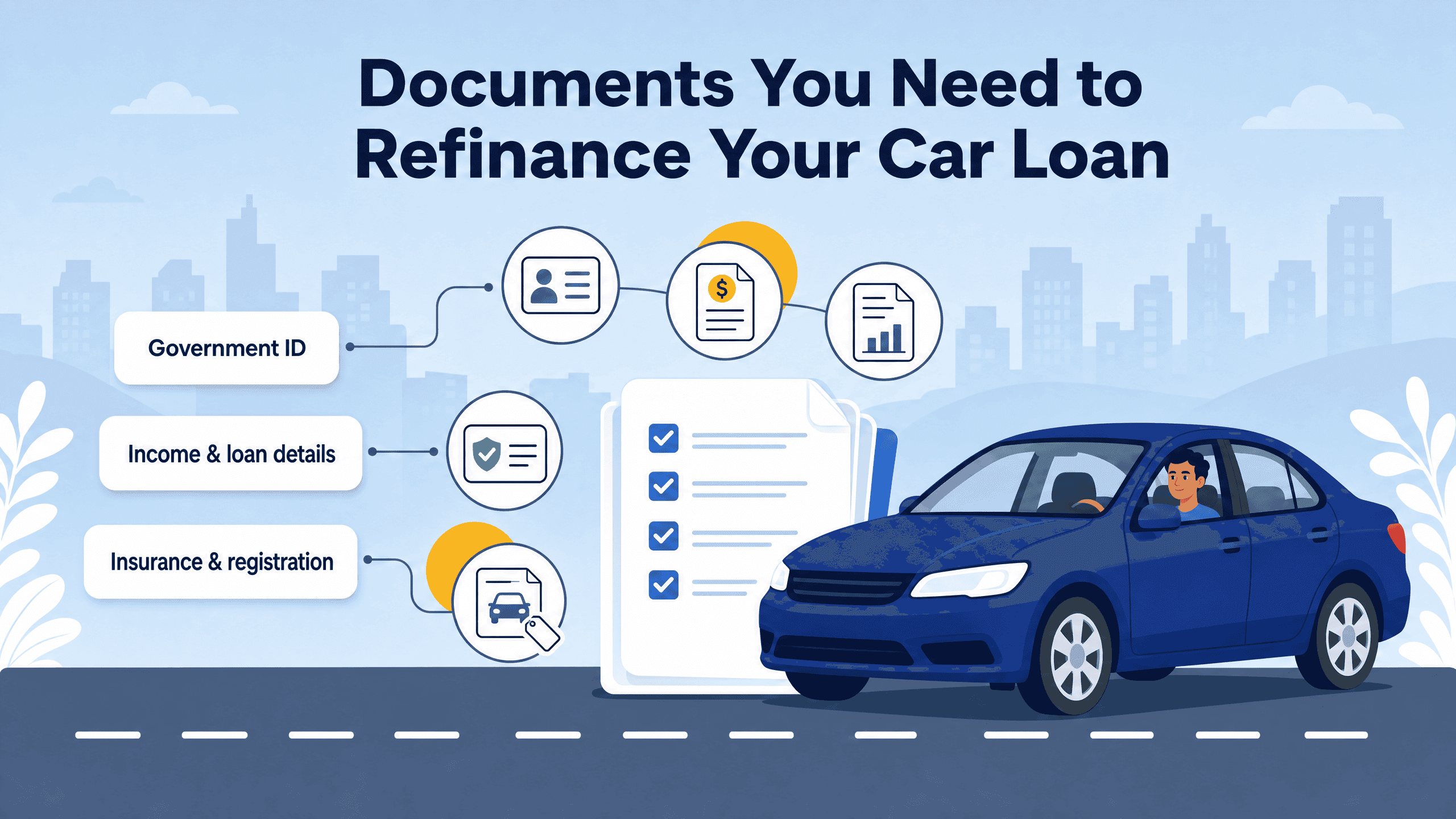
Gathering key documents like your ID, income proof, and vehicle details can help speed up your car loan refinancing process.
Have these ready before you apply to speed up the process:
- Government-issued ID
- Proof of income (pay stubs, tax returns, or bank statements)
- Current loan statement showing your balance and lender information
- Proof of auto insurance
- Vehicle registration and, in some cases, title information
How Much Does It Cost to Refinance a Car Loan?
Costs vary by lender and state, but here’s what to watch for:
- Title transfer fees: Charged by your state’s DMV to update the lien holder, typically $15–$100.
- Prepayment penalties: Some original loans charge a fee for paying off the balance early. Check your current loan agreement before you refinance.
- Origination or application fees: Many aggregators and online lenders, including RefiJet and several other major refinancing companies, don’t charge application fees, but some individual lenders in a network might. Confirm before signing.
If the total fees are low relative to your expected savings, refinancing is usually still worth it. Run the numbers with a car loan calculator before you commit.
Pros and Cons of Refinancing a Car Loan
Pros
Can lower your monthly payment
Can reduce total interest paid if you secure a lower rate or shorter term
Can remove a cosigner from the loan
Fast process — many lenders fund within 24 hours to a few days of approval
Cons
A hard credit inquiry can temporarily lower your score
Extending your loan term can increase total interest, even if your rate drops
Not worth it if you’re close to paying off your current loan
Some vehicles won’t qualify if they’re too old or have too many miles
How to Refinance a Car Loan With Bad Credit
A lower credit score doesn’t automatically disqualify you, but it does narrow your options and typically means a higher rate. To improve your odds:
- Add a cosigner with stronger credit to reduce the lender’s risk.
- Increase your down payment or pay down principal before applying, which lowers the loan-to-value ratio.
- Check credit unions, which sometimes offer more flexible underwriting than large online lenders.
- Watch for refinancing scams that target borrowers with credit challenges — see our guide on spotting auto loan refinancing scams before signing anything that seems off.
For a full rundown of lenders that work with lower credit tiers, see our list of the best auto loans for bad credit. We’ve also reviewed the cheapest car insurance with low credit.
Frequently Asked Questions
Most lenders can provide a decision within minutes to 24 hours after you apply, and funding — the point at which your new loan pays off your old one — typically happens within a few business days of approval.
Applying for a refinance loan usually triggers a hard credit inquiry, which can cause a small, temporary drop in your score. Rate-shopping with multiple lenders within a short window (typically 14–45 days, depending on the scoring model) is generally treated as a single inquiry rather than several.
Some lenders will refinance a loan they already hold, but many require you to switch to a different lender to get meaningfully better terms. It’s worth asking your current lender, but also comparing outside offers.
There’s no universal minimum, but most lenders look for a score in the mid-600s or higher for the best rates. Some lenders and aggregators, including RefiJet, work with borrowers with scores as low as 500, though rates will be higher.
It depends on the fees involved and how long you plan to keep the car. If refinancing costs little or nothing upfront and you’ll keep the vehicle for a year or more, even modest monthly savings can add up. Use a loan calculator to compare the total cost of your current loan against the new offer, not just the monthly payment.
Sources
State of the Automotive Finance Market. Experian. (2026).
https://www.experian.com/automotive/auto-credit-webinar-form
Related Articles


6 Ways to Tell If Your Auto Loan Refinancing Is a Scam
August 19, 2026
The Best Auto Loans for Refinancing of 2026
June 9, 2026