
 866-589-5339





Full Coverage Auto Insurance Guide
Do you really need full coverage?
Get quotes from providers in your area

Discover rates as low as $24 /month


Last updated: July 23, 2024
If you’re talking about auto insurance, you may hear the term “full coverage.” So what does that mean? The truth is that the minimum coverage required in 48 states is generally not sufficient to deal with the costs of at-fault accidents, including property damage, bodily injuries, deaths, and lost wages. If you can afford it, we recommend getting full coverage auto insurance, which we’ll explain in detail below.

Most people haven't compared rates in over a year.
Rates change constantly. A quick comparison takes 2 minutes and could put hundreds of dollars back in your pocket.
Full Coverage Car Insurance

“Full coverage” is not technically a type of auto insurance coverage. The term refers to a combination of liability, comprehensive and collision, medical, and uninsured motorist coverages that you can purchase to protect your vehicle.
Getting full coverage auto insurance typically means that you’re going above and beyond the legally required minimum coverage, which varies by state. See your state’s requirements in our auto insurance guide.
What It Covers
- Liability coverage: Full coverage includes both bodily injury liability and property damage liability. If you get into a car accident and it’s your fault, you’ll be responsible for the associated costs, unless you live in one of the no-fault states:
- Comprehensive and collision coverage: However, property damage and bodily injury coverage aren’t sufficient. You’ll also need collision coverage for things like pothole damage, as well as comprehensive coverage for auto theft, auto vandalism, and more damages from incidents other than collisions, such as fires. Learn more about the difference between collision vs. comprehensive coverage.
- Uninsured and underinsured motorist coverage: Although every state except New Hampshire and Virginia requires auto insurance, not everyone complies with the law. If you get into an accident that’s the fault of someone with no or insufficient auto insurance, you’ll need uninsured motorist coverage.
NOTE
Uninsured motorist coverage also covers hit-and-runs.
- Medical payments coverage / personal injury protection (PIP): If you get into an at-fault accident, medical coverage will pay for you and your passengers’ injuries and lost wages.
What It Doesn’t Cover
- Emergency roadside assistance and towing: If you get stuck on the side of the road, your insurance company won’t be able to send help using full coverage alone.
- Ridesharing: Personal auto insurance doesn’t cover commercial driving unless you add on ridesharing coverage for Uber or Lyft. Explore the best auto insurance for rideshares.
- Rental car reimbursement coverage: If your car is being repaired under a covered claim, rental car coverage would pay for a rental car.
- Gap coverage: While collision and comprehensive coverage will reimburse you for the market value of your car, if your car depreciates in value, you won’t get back what you actually paid for it. This will matter if your car is totaled or stolen. Gap insurance makes sure you’ll receive all the money you paid for your car, not its current value.
- Optional basic economic loss: OBEL adds $25,000 to $50,000 in basic economic loss. You can apply OBEL however you see fit, whether it’s reimbursement for physical therapy, rehab, or income loss.
- Glass coverage: You might be surprised to learn that comprehensive coverage doesn’t always include damage to windshields, sunroofs, or side and rear windows.
How Much It Costs
How much does auto insurance cost? Well, the average cost of full coverage auto insurance in 2020 was $1,202.
| Car type | Average yearly cost of full coverage auto insurance in 2020 (high to low) |
|---|---|
| Small sedan | $1,342 |
| Large sedan | $1,264 |
| Medium sedan | $1,245 |
| Half-ton/crew pickup (4WD) | $1,242 |
| Electric | $1,227 |
| Hybrid vehicle | $1,212 |
| Medium SUV (42D) | $1,118 |
| Minivan | $1,096 |
| Small SUV (FWD) | $1,0871 |
FYI
Car insurance rates depend on many factors, from the state you live in to your vehicle type and driving history. In other words, take annual averages with a grain of salt.
Who Needs It
We recommend full coverage insurance for everyone, as your state’s minimum requirements may not be sufficient to cover the costs of at-fault accidents.
How to Get Full Car Insurance Coverages
Getting full coverage insurance isn’t a hard process when you have AutoInsurance.com on your side.
- Compare car insurance quotes. Compare quotes from multiple providers to find the lowest rates. Select full coverage for each provider so you can compare apples to apples.
- Find a provider. Once you find a quote you like along with positive customer service ratings, contact the provider to be connected with an insurance agent or broker.
- Work with an agent or broker. Your agent or broker will ask you about your needs to find a policy that works for you.
- Pay your premium. Once you pay your premium, your policy will be active on its effective date.
Ways to Save

While full coverage might be more expensive than minimum coverage, there are a few ways you can keep premiums to a minimum:
- Raise your deductible. Raising your deductible will lower your premiums. But make sure that you could afford your deductible if you got into an at-fault accident tomorrow.
- Use discounts. Every auto insurance provider offers discounts. Find out how much you could save by disclosing your veteran status, adding multiple cars to your policy, or bundling your home and auto insurance together.
- Drop other optional coverages. You may not need supplemental coverages like rental car reimbursement or glass coverage. Determine what’s unnecessary and get rid of it to lower the cost of your auto insurance.
Full Coverage vs. Liability Insurance
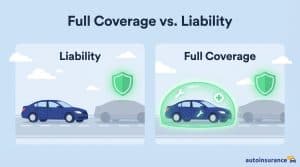
What’s the difference between full coverage and liability insurance? In a nutshell, full coverage includes liability insurance but adds on more coverage.
| Coverage type | Full coverage | Liability insurance |
|---|---|---|
| Bodily injury | Yes | Yes |
| Property damage | Yes | Yes |
| Damage to the other car | Yes | Yes |
| Collision | Yes | No |
| Comprehensive | Yes | No |
| Injury to passengers in the other car | Yes | Yes |
| Light poles | Yes | Yes |
| Damage to your car | Yes | No |
| Your injuries | Yes | No |
| Your passenger’s injuries | Yes | No |
| Best for vehicle owners | No | Yes |
| Best for financed vehicles | Yes | No |
| Best for new cars | Yes | No2 |
Recap
While paying more for full coverage auto insurance may not seem appealing initially, you’ll appreciate the expanded coverage and limits if you get into an at-fault accident. In the long run, full coverage insurance could actually save you money over minimum coverage insurance!
FAQ
Learn more about full coverage insurance below.
Having full coverage insurance means your insurance has all of these coverages:
- Bodily injury coverage
- Property damage coverage
- Comprehensive coverage
- Collision coverage
- Uninsured motorist coverage
- Medical payments coverage
Full coverage is better than minimum coverage because you’ll have more coverage and higher limits. For example, if you lack comprehensive coverage, which is part of full coverage but not minimum coverage policies, any auto thefts or vandalism won’t be covered.
You can know if you have full coverage if you have all the following:
- Bodily injury coverage
- Collision coverage
- Comprehensive coverage
- Medical payments coverage
- Property damage coverage
- Uninsured motorist coverage
Here are the differences between full coverage and liability insurance:
| Coverage type | Liability insurance | Full coverage |
|---|---|---|
| Collision | No | Yes |
| Comprehensive | No | Yes |
| Damage to your car | No | Yes |
| Your injuries | No | Yes |
| Your passenger’s injuries | No | Yes |
| Best for financed vehicles | No | Yes |
| Best for new cars | No | Yes |
| Best for vehicle owners | Yes | No |
Citations
YOUR DRIVING COSTS. AAA. (2020).
https://newsroom.aaa.com/wp-content/uploads/2020/12/2020-Your-Driving-Costs-Brochure-Interactive-FINAL-12-9-20.pdfWhat Is The Difference Between Liability vs. Full Coverage Insurance? UAI. (2022).
https://www.unitedautoinsurance.com/what-is-the-difference-between-liability-vs-full-coverage-insurance/
Related Articles

The Best Auto Insurance for Full Coverage of 2026
September 23, 2026
Leased Vehicles Coverage: Will I Pay More?
July 31, 2026
A Guide to Collision Auto Insurance Coverage
August 17, 2026