
 866-589-5339






What is Personal Injury Protection (PIP) Coverage?
If you live in one of the 12 states that require PIP, here’s what you need to know.
Get quotes from providers in your area

Discover rates as low as $24 /month

Last updated: September 11, 2026
Key Takeaways: PIP Insurance Coverage
PIP is mandatory car insurance in 12 states that covers your medical bills and lost wages, regardless of who caused the accident.
PIP is required in 12 states, mostly no-fault states, plus Delaware and Oregon.
Minimum PIP limits range from $3,000 in Utah to $250,000 in Michigan.
Unlike bodily injury liability, PIP covers your own medical bills, lost wages, and essential services.
If you get into a car accident, you might be left with whiplash, back pain, or other injuries. In the event that you or your passengers sustained severe injuries, you could be looking at significant medical bills. About one in four car crashes results in injuries serious enough to need medical attention.1
That’s where personal injury protection, or PIP, comes in. PIP is a type of car insurance coverage that pays for accident-related medical expenses for your own party, no matter who caused the crash. It also covers costs you may not expect, like lost wages if you can’t work and help around the house if you can’t manage on your own.
If you live in a no-fault state (or an at-fault state that requires PIP), PIP is mandatory, and for good reason — it ensures you can get back on your feet after a major accident.
What PIP Covers
PIP covers the medical expenses of your and your passengers. It also pays for:
- Lost wages
- Essential services, including childcare and household help
- Funeral costs (in some states)
Note that in no-fault states, your insurance pays for your own damages, regardless of who caused the accident.
How PIP Differs From Other Coverage
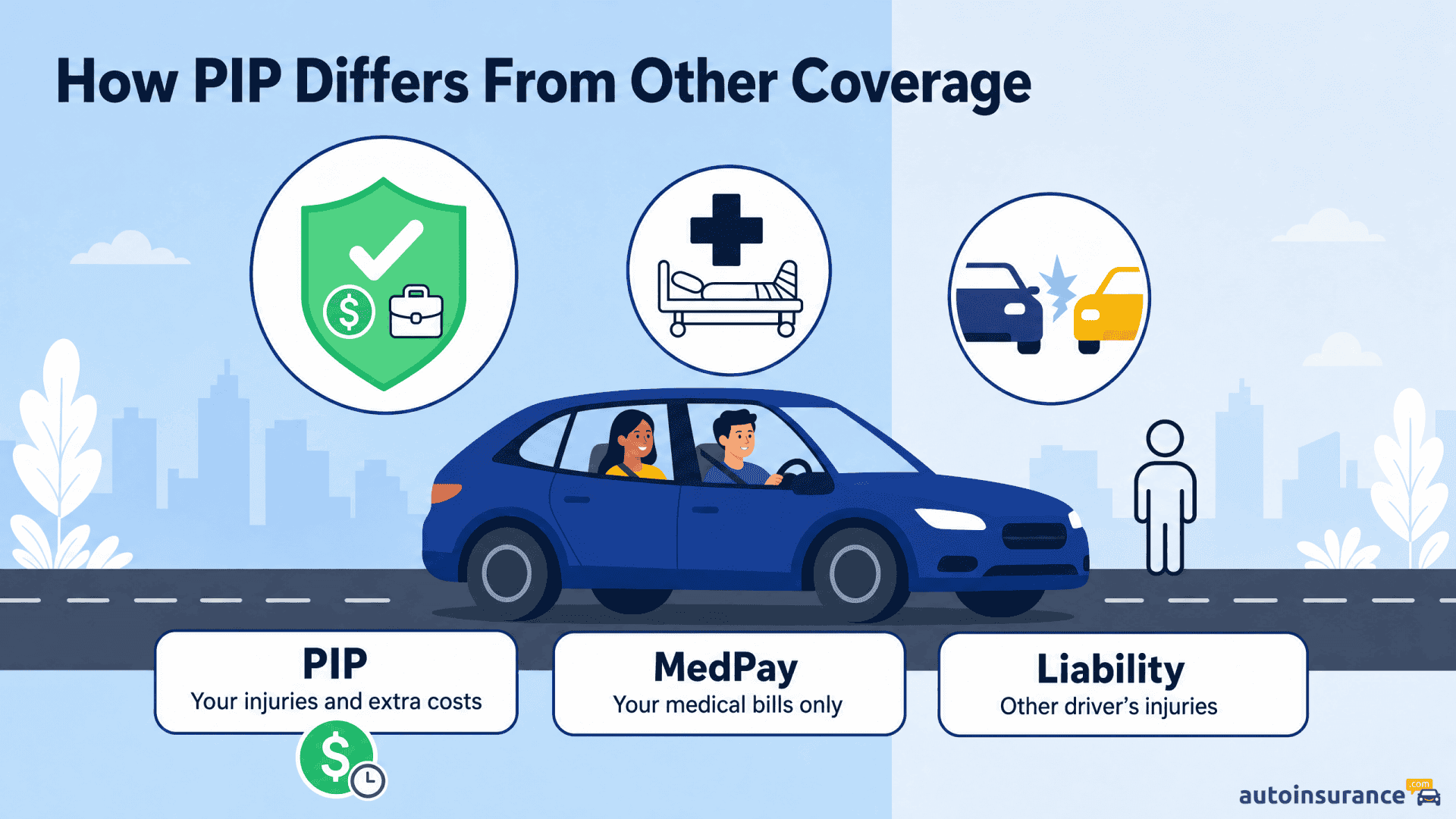
Personal injury protection provides broader coverage for your expenses than standard medical or liability insurance.
PIP vs. Bodily Injury Liability
PIP covers your party’s accident-related injuries, even if the other party was at fault. Meanwhile, bodily injury liability only covers the other party’s medical expenses from an accident you caused. Unlike PIP, which covers other non-medical expenses, bodily injury liability only pays for medical costs resulting from an accident.
All no-fault states require PIP — of all the states that require PIP, only Delaware and Oregon are at-fault states.
| Category | PIP | Bodily Injury Liability |
|---|---|---|
| Who it covers | Your own party | The other party |
| When it applies | In a car accident, regardless of fault | In a car accident you caused |
| What’s covered | Medical bills, lost wages, essential services (e.g., childcare and housework help), funeral costs | Medical expenses, lost wages, and potentially legal costs in the event of a lawsuit |
| Required states | Delaware, Florida, Hawaii, Kansas, Massachusetts, Michigan, Minnesota, New Jersey, New York, North Dakota, Oregon, and Utah | All excluding Florida, New Jersey (basic policies), and New Hampshire (if you choose to forego insurance) |
PIP vs. Medical Payments Coverage
Personal injury protection and medical payments coverage both cover your party’s injuries after an accident. However, PIP offers more extensive benefits since it pays for non-medical costs like childcare and lost wages. Additionally, PIP is mandatory in no-fault states, while MedPay is optional in many states except Maine and Pennsylvania, where it’s required.
| Category | PIP | Medical Payments Coverage |
|---|---|---|
| Covers lost wages and essential services? | Yes | No |
| Required states | Delaware, Florida, Hawaii, Kansas, Massachusetts, Michigan, Minnesota, New Jersey, New York, North Dakota, Oregon, and Utah | Maine and Pennsylvania |
Personal Injury Protection vs. Health Insurance
While personal injury protection and health insurance both cover medical bills, they differ in a few key ways. PIP claims are processed faster since you can use it for any provider, so you’ll get covered quickly.
For health insurance, you’ll usually need to find an in-network provider, and you may need pre-authorization to visit specialists, like a surgeon or cardiologist. In many cases, you must meet a deductible before your coverage kicks in. To illustrate, the average single-person deductible in 2025 was $1,886.2
While PIP cannot be used to pay for your health insurance deductible, it does cover other services that health insurance might not pay for, like an ambulance ride.
GOOD TO KNOW:
Consider other potential medical costs to decide whether it’s ideal to increase your PIP limits. In 2025, the average co-pay for an in-network doctor appointment is $27-$45, while an emergency room visit is $200-$300.3
Having both PIP and health insurance may be helpful. Once you reach your PIP limit, you can use your health insurance to cover the rest. Since PIP also provides non-medical benefits, like lost wage replacement, it can give you extra peace of mind after an accident.
| Category | PIP | Health Insurance |
|---|---|---|
| Network restrictions | No, can see any provider | Yes (in-network required for lowest co-pays) |
| Deductible | No | Yes |
How Much Coverage You Need
If you live in a place that requires PIP, the minimum limits depend on your state. For example, Utah has the lowest limits at $3,000. Michigan has the highest minimum PIP limits at $250,000, but drivers can lower that to $50,000 if they’re enrolled in Medicaid.
Whether you should choose a higher PIP limit depends on a few factors.
- If you have health insurance with affordable co-pays and a low deductible, you may not need to raise your PIP limits.
- However, if you have no health insurance or a policy with high co-pays and deductibles, it may be worth increasing your PIP coverage. You may also want to consider higher limits if you don’t have paid sick leave.
| State | Minimum Limits for PIP |
|---|---|
| Delaware | $15,000 |
| Florida | $10,000 |
| Hawaii | $10,000 |
| Kansas | $4,500 |
| Massachusetts | $8,000 |
| Michigan | $250,000 |
| Minnesota | $40,000 |
| New Jersey | $15,000 |
| New York | $50,000 |
| North Dakota | $30,000 |
| Oregon | $15,000 |
| Utah | $3,000 |
Factors Affecting PIP Premiums
How much PIP coverage contributes to your premium depends on many factors. For example, you’ll pay more if you live in a state with higher PIP requirements, or you choose a policy with higher PIP limits.
Providers also increase premiums for those who are statistically more likely to be in an accident, including young drivers, high-mileage drivers, and those who live in neighborhoods with higher claim rates.
For more affordable premiums, you can:
- Choose lower PIP limits
- Increase your PIP deductible (if you live in a state that requires it)
- Get quotes from multiple providers for better rates
- Coordinate PIP with your health insurance (if you live in Michigan, New Jersey, or Massachusetts)
FYI:
You can also find car insurance discounts to lower your premium, including good driver, multi-policy, and telematics discounts. Ask your insurance company about additional qualifying discounts to get the most affordable rate possible.
How to File a PIP Claim
If someone in your party has an accident-related injury, here’s what to do:
- Get medical treatment: Have your condition checked, even if your injuries appear negligible. To qualify for PIP benefits, you usually need to seek treatment within 14 days, and some injuries aren’t immediately apparent.
- Report the accident: File a claim online or call your provider as soon as possible so they know about the incident. They’ll need to know details including the date, time, location, and other parties involved.
- Submit documentation: Send in any medical bills, proof of lost wages, and receipts for essential services related to your injury. PIP usually pays in increments, until you reach your limit.
- Keep treatment records: Gather proof of missed work, health appointments, and injury-related symptoms. It will help justify ongoing payments as you continue receiving PIP benefits.
- Follow up with your provider: Regularly check with your provider about the remaining benefit limit, especially as they process your bills.
If you include lost wages in your PIP claim, you’ll need additional documents, including a doctor’s note showing that you’re unable to work, and pay stubs or a letter from your employer proving your annual income.
Common Misconceptions
Even though PIP covers injuries no matter who is at fault, the at-fault party can still face lawsuits in certain circumstances. No-fault systems restrict when someone can sue you after an accident, but if you cause damages beyond the other party’s PIP limits, they can file a lawsuit.
Additionally, PIP may not cover all medical expenses. For example, a no-fault state like Florida requires a minimum PIP limit of $10,000, which is only enough to cover a single ER visit and imaging. In the event of a severe accident, your medical expenses can surpass $100,000. Moreover, PIP follows the car, so it doesn’t cover you if you sustain injuries while driving someone else’s car.
Conclusion
Some states legally require personal injury protection, which covers medical bills, essential services, and lost wages. If you have PIP on your auto policy, consider increasing your limits if you don’t have health insurance or paid leave. Even though PIP protects you from lawsuits for minor injuries, it won’t protect you if you cause an accident that exceeds the other party’s PIP limits.
You can lower PIP premiums by lowering your limits or coordinating your PIP with your health insurance, if your state allows it. PIP costs vary based on your driving profile and your state’s required limits, so get quotes from multiple providers to find affordable rates.
FAQs
In some cases, PIP may be worth it. While it’s required in no-fault states, drivers should consider raising their limits if they lack health insurance or have a health insurance policy with a high deductible and co-pay. It can also be helpful if you have a job that doesn’t provide sick leave.
No. Since PIP coverage is usually mandatory in no-fault states, your provider can’t legally raise your rates if you file a claim under this type of coverage. However, your rates can increase for other reasons, like having multiple at-fault accidents on your driving record.
It depends. You can only remove PIP from your insurance policy in states where PIP is optional, including New Hampshire, Arkansas, South Dakota, Texas, Virginia, and Washington. In no-fault states, PIP is mandatory and cannot be removed.
PIP is required in the following states: Delaware, Florida, Hawaii, Kansas, Massachusetts, Michigan, Minnesota, New Jersey, New York, North Dakota, Oregon, and Utah.
Sources
Overview- Type of Crash. NSC. (2026).
https://injuryfacts.nsc.org/motor-vehicle/overview/type-of-crash/2025 Employer Health Benefits Survey. KFF. (2025, Oct 22).
https://www.kff.org/health-costs/2025-employer-health-benefits-survey/Health Insurance Premiums, Deductibles, Copays and Coinsurance. Debt.org. (2025, May 20).
https://www.debt.org/medical/health-insurance-premiums/
Related Articles

PIP Insurance in Texas
May 22, 2026
Medical Payments Coverage for Car Insurance
August 16, 2024
PIP Insurance in Arkansas
June 16, 2026