
 866-589-5339





What Are Auto Insurance Bundling Discounts?
Bundling your home and auto insurance with the same provider typically saves you 5–25% on your premiums, but you should still compare bundled rates against separate policies.
Get quotes from providers in your area

Discover rates as low as $24 /month

Last updated: June 18, 2026
Key Takeaways: Auto Insurance Bundling Discounts
Bundling home and auto insurance typically saves 5–25% on premiums.
Bundling discounts average 18–20%, with some insurers like American Family offering savings up to 40%.
Beyond price, bundling simplifies management with one login, one payment, and one renewal date.
Bundling isn’t always worth it — premium hikes, coverage gaps, or better separate-policy rates can offset savings.
Always compare bundled and separate quotes from at least three providers before combining policies.
Bundling means purchasing two or more insurance policies — usually auto and homeowners —from the same company. The provider rewards you with a multi-policy, or bundling, discount for one or both of your premiums.
How Much Can You Save?
For multiple policies, providers usually offer a bundling discount of 5 to 25 percent on auto insurance. Bundling discounts average between 18 and 20 percent, and with insurers like American Family, you can save up to 40 percent on your policy.
| Company | Discount |
|---|---|
| Progressive | 7% |
| Allstate | Up to 25% |
| Liberty Mutual | $950 per year in average savings |
| State Farm | Varies by state |
| American Family | Up to 40% |
| Nationwide | Up to 15% |
| Farmers | Not advertised |
| USAA | Up to 10% |
**Note that actual savings vary by state, coverage level, and individual profile
What Can You Bundle with Auto Insurance?
Most providers offer discounts for buying both auto and homeowners insurance, and often this extends to renters and condo policies. If you have existing homeowners coverage, it may be worth it to see how much you can save by pairing it with your car insurance policy.
Depending on the insurer, you can also get discounts for bundling these types of coverage:
- Auto and motorcycle, RV, or boat insurance
- Auto and umbrella insurance
- Auto and life insurance
- Auto and property insurance
- Multiple vehicles (Two or more vehicles on the same policy)
Keep in mind that your policies will stay separate. They’ll each have their own policy number and deductible, unless your provider allows you to combine deductibles. In any case, combining policies can make it easier to manage your coverage (which we’ll talk about in more detail below).
FYI:
Apply other car insurance discounts before purchasing to see whether a bundling discount is worth it. Some providers offer more savings, depending on your driver profile and state.
Benefits Beyond the Discount
Pros
One login, one payment, and one renewal date simplifies policy management
Single agent handles questions, changes, and claims across all policies
Some providers let you pay just one deductible when one event damages both home and car
Loyalty perks like priority claims service or waived fees can add value over time
Cons
Premium hikes on either policy can erode your discount over time
The best auto insurer in your state may not write competitive home policies — and vice versa
In high-risk states like Florida, Texas, and California, home insurance quality gaps are especially common
In addition to saving money, bundling insurance can make it easier to manage policies. Depending on the provider, combining policies may make it easier to manage payments, file claims, and access extra perks.
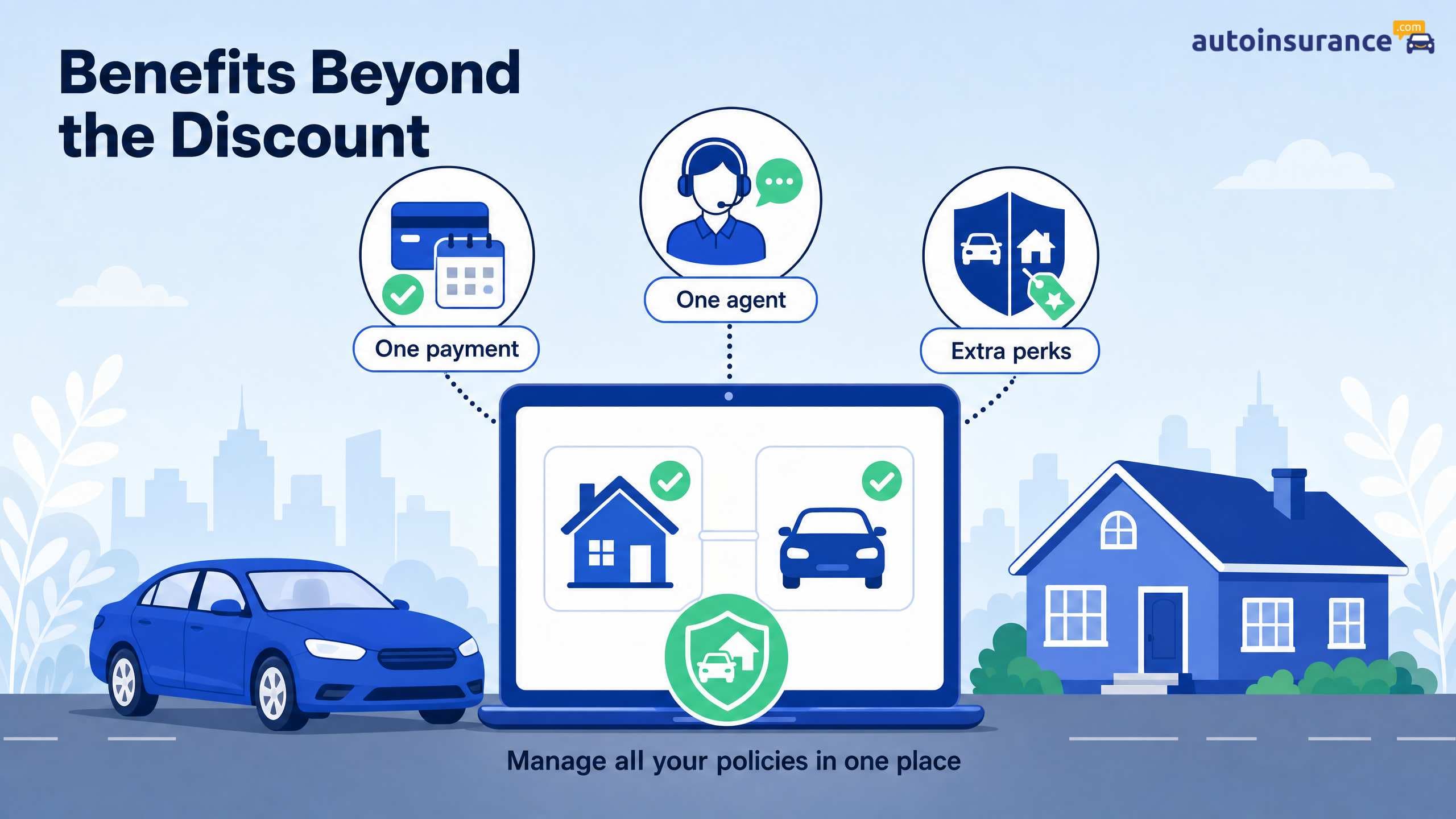
Bundling insurance policies offers convenience through unified payments and simplified account management.
Simpler Account Management
With bundled policies, you can manage everything with a single online account. That means one login, one monthly payment, and one renewal date instead of juggling separate accounts and billing cycles. You can also work with the same agent for questions, policy changes, and claims.
Combined Deductibles
Some providers offer a combined deductible benefit for bundled policies. If the same covered event damages both your home and vehicle, you may only pay for one deductible instead of two. For example, if a windstorm damages your roof and your car in the same incident, you’d normally owe two separate deductibles — one on your homeowners claim and one on your auto claim. With a combined deductible, you pay only the higher of the two, not both. Progressive and Amica are examples of companies that offer this benefit in certain states.
Loyalty Perks
If you bundle your insurance, you may also qualify for perks like priority claims service or waived fees. These benefits vary by insurer, but they can add up over time if you stay with the same provider for several years.
When Bundling Might Not Be Worth It
Bundling home and auto insurance can help you save, but it’s not always the best option. For example, a company that provides great auto coverage may be expensive for home insurance. In some cases, buying policies from different insurers may be better.
Premium Creep
In the beginning, a bundling discount may look great, but premium hikes on either policy can offset how much you save. For example, your homeowners premium could increase because of weather-related claims, even if your car insurance premium stays the same.
Coverage Quality
The auto insurance provider in your state with strong third-party ratings may not write competitive homeowners policies. This is common in high-risk states like Florida, Texas, and California, where home insurance has become more expensive.
That’s why the company with the cheapest price may not offer the best coverage for both home and auto policies. You could end up sacrificing important homeowners coverages or claims services just to keep the discount.
Forced Bundling
Some providers have required customers to buy home and auto coverage together to qualify for a policy. In Texas, regulators have pushed back against these practices.1 Before purchasing a bundle, see whether each policy can stand on its own, and how pricing changes if you separate them later.
You can decide whether bundling is worth it by comparing both bundled and separate-policy quotes. Getting quotes from multiple insurers can help balance price, coverage, and customer service.
How to Get a Bundling Discount
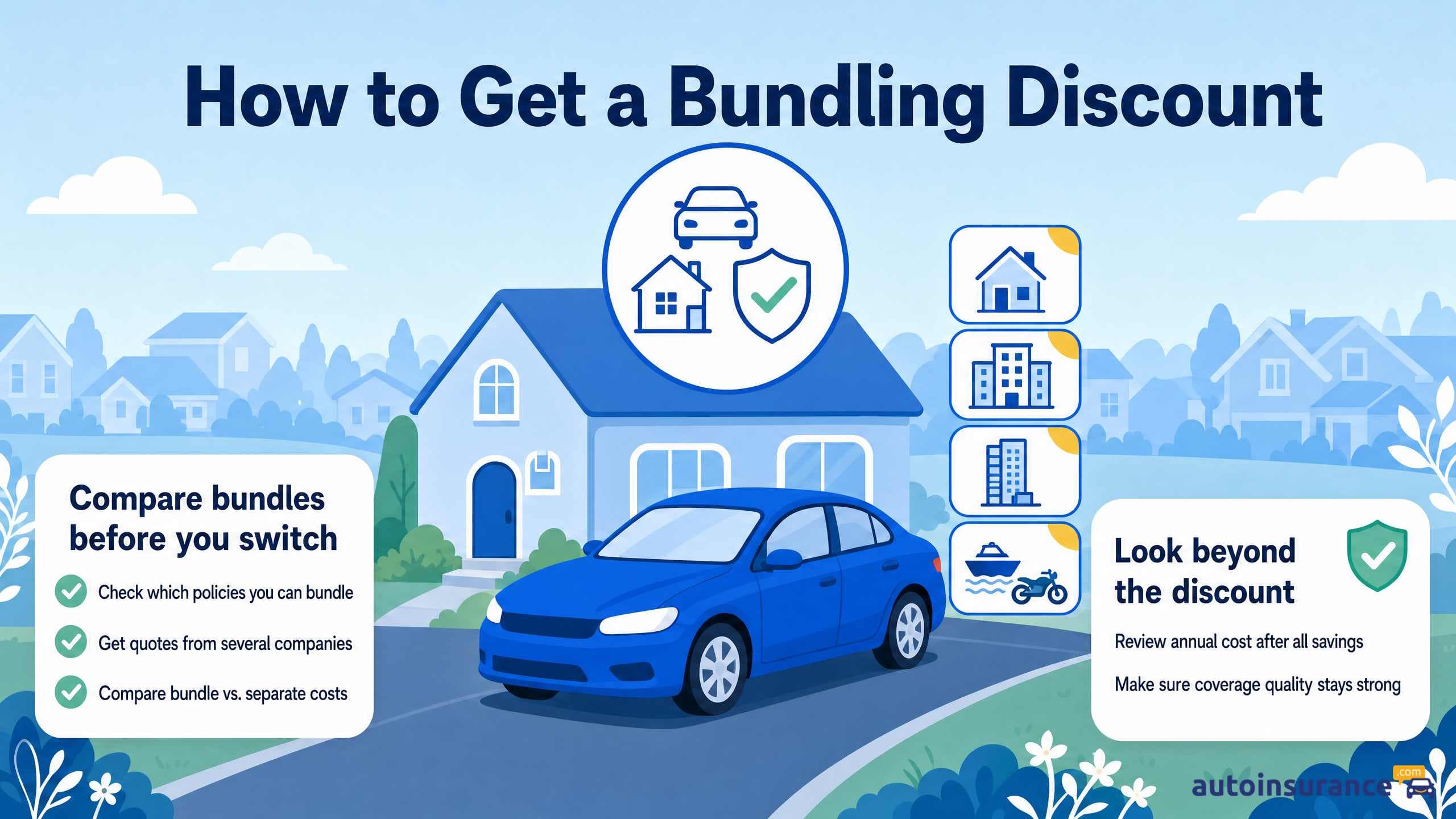
Compare multiple quotes and total annual costs to ensure your insurance bundle provides the best value.
Getting a bundling discount can take a bit of research to ensure you’re getting the best deal. Here’s what to do before combining your policies:
- Decide what you want to bundle. Start by figuring out which policies you need. Most providers have bundling discounts for combining auto insurance with homeowners, renters, or condo insurance. Some also extend discounts to motorcycle, boat, or life insurance policies.
- Get bundled quotes from multiple insurers. Request bundled quotes from at least three providers. Your rates and discounts can diff between companies, so get a better sense of what’s competitive by comparing several quotes.
- Compare the price of separate policies. Ask the same providers for separate auto and home insurance quotes so you can compare the total cost to bundled rates. Sometimes buying separate policies saves more money.
- Compare total annual cost after all discounts. A bundling discount doesn’t always produce the lowest premium. Add up the full annual cost of both policies before concluding the bundle is the better deal.
- Treat the bundle as a win only if it saves at least 5–10% versus your best separate-policy combination. If the gap is smaller, the coverage tradeoffs may not be worth it.
- Review coverage details carefully. While price is important, coverage quality also matters. Compare car insurance deductibles, limits, and customer satisfaction ratings before choosing a policy. It may not be worth it to choose a cheaper bundle with weak coverage or poor claims service.
TIP:
Ready to compare carriers that offer the best bundling deals? See our picks for the best home and auto insurance bundles.
Recap
Bundling home and auto insurance typically saves 5–25% on premiums, but it’s not always the best deal.
- Bundling discounts average 18–20%, with some insurers like American Family offering savings up to 40%.
- Beyond discounts, bundling simplifies account management with one login, payment, and renewal date.
- Bundling isn’t always worth it — premium hikes, coverage gaps, or better separate-policy rates can offset savings.
- Always compare bundled and separate quotes from at least three providers before combining policies.
Frequently Asked Questions
It depends. Many insurance companies offer discounts for bundling policies, but the amount you’ll save varies by provider, location, coverage levels, and claims history. In some cases, buying policies separately from different insurers may still cost less. That’s why it’s smart to compare bundled and separate quotes before purchasing coverage.
Not necessarily. If you file a home insurance claim, it won’t automatically raise your auto insurance premiums. However, you may see higher rates on both policies after a large claim since it affects your overall risk profile.
Yes, many providers offer a bundling discount for having car and renter’s insurance on the same policy. Renters insurance typically costs less than homeowners insurance, but you can still save on coverage.
Contact your provider and ask about adding another policy, such as homeowners, renters, condo, or life insurance. Once your additional policy is active, you’ll receive the multi-policy discount on both policies.
Yes. Insurers usually use “multi-policy discount” and “bundling discount” to refer to savings for buying more than one type of insurance policy from the same provider.
Sources
TDI: Companies shouldn’t force consumers to buy home and auto insurance together. Texas Department of Insurance. (2025, Feb 20).
https://www.tdi.texas.gov/news/2025/tdi02202025.html
Related Articles

Car Insurance and Discounts for Veterans
June 5, 2026
What Affects Car Insurance Rates?
November 25, 2025