
 866-589-5339






What J.D. Power’s 2026 U.S. Auto Insurance Study Means for You: Rates Stabilize While Customer Experience Lags
How new industry data is reshaping service, rates, and retention strategies for America’s auto insurance consumers.
Get quotes from providers in your area

Discover rates as low as $24 /month

Last updated: September 18, 2026
The J.D. Power 2026 U.S. Auto Insurance Study offers insights into customer frustrations with cross-channel interactions as well as the impact of AI on consumer behavior. The study asked over 52,000 auto insurance customers across 11 regions about customer satisfaction. Keep reading to find out about what you can do to get the most out of your car insurance.
Key Takeaways: 2026 J.D. Power Auto Insurance Study
The 2026 J.D. Power Auto Insurance Study reveals that customers now have more power in the auto insurance market and are turning to AI to compare coverage options.
Insurers that work to enhance cross-channel interactions, digital tools, and education about policy options will provide a better customer experience and are more likely to retain policyholders.
The market favors shoppers, so shop around, compare and don’t be afraid to switch.
Regional and usage-based insurers may offer better service than large national brands. Review satisfaction rankings for your area and consider switching to a regional or usage-based provider.
PRO TIP:
Get the most out of your car insurance by knowing which companies are better for you, depending on your driver profile. For example, GEICO tends to offer lower rates for drivers with minor traffic violations like speeding tickets — which is why it’s one of our top choices for best cheap car insurance.
Breaking Down the 2026 J.D. Power Auto Insurance Study
Study Methodology and Measurement
In its Auto Insurance Study, J.D. Power surveyed over 52,000 customers between April 2025 and April 2026. The company measured customer satisfaction across 11 U.S. regions and subcategories (including usage-based insurance).
J.D. Power assesses customer experience with providers across seven categories, using a “poor-to-perfect” 6-point scale for customer ratings:
- Level of trust
- Price for coverage
- People (staff and agent experience)
- Ease of doing business
- Product and coverage offerings
- Problem resolution
- Digital channels
Major Findings: Satisfaction, Switching, and AI Use
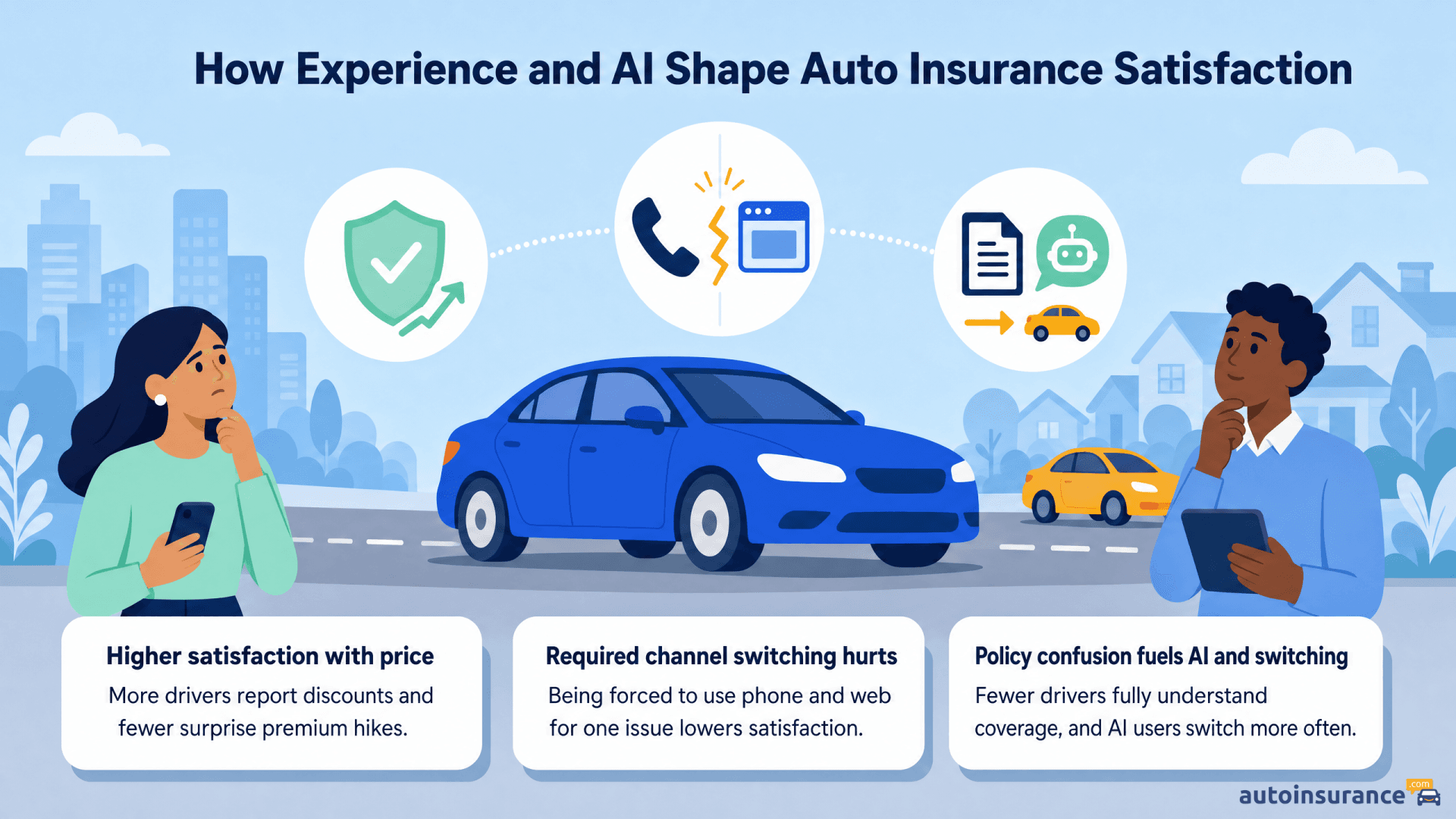
Insurance customer satisfaction is driven by pricing transparency, streamlined communication channels, and policy clarity.
Price Satisfaction Increases Slightly
J.D. Power found that overall customer satisfaction did not change from 2025 to 2026, but satisfaction with price for coverage increased three points. Fewer customers reported premium increases outside of their control, which is a major level in overall satisfaction. In addition, more customers noted that they received several discounts and avoided payment fees.
Cross-Channel Interactions Lower Customer Satisfaction
The latest data from J.D. Power indicates that customers become frustrated when forced into cross-channel interactions to resolve an inquiry (for example, having to interact with the insurer both on the phone and through its website). Twenty-one percent of customers reported needing to switch channels for an inquiry along with a drop in perceived seamlessness.
Using multiple interaction channels isn’t necessarily an issue, but it lowers customer satisfaction when it’s required to resolve a single inquiry. This is especially true if the inquiry doesn’t get resolved.
Lack of Understanding Leads Customers to AI and Policy Switching
The percentage of customers who indicated that they fully understand their auto insurance policy was only 58 percent, down from 62 percent in 2025. Those who understand their policy are more satisfied with their coverage, on average, and are more likely to renew their coverage.
In addition, J.D. Power found that 32 percent of auto insurance shoppers used AI to help with their auto insurance search, including for general questions and to compare policies. Those who use AI are more than 1.3 times as likely to switch insurers.
PRO TIP:
If you’re satisfied with your premiums and service, sticking with the same provider can earn you loyalty discounts that pay off in the long run. Some companies, like USAA and American Family, offer loyalty and generational discounts.
How Insurers Will Stand Out in 2026
Delivering Seamless Cross-Channel Interactions
According to J.D. Power’s 2026 report, customers hold more power in the auto insurance market as prices lower and competition between insurers increases. A major factor for lagging customer satisfaction ratings is insurance companies’ subpar cross-channel experience despite the fact that “a seamless cross-channel experience has become the single-most impactful driver of satisfaction in the study,” according to Stephen Crewdson, managing director at J.D. Power.1
Whether insurers invest in improving this experience for customers remains to be seen, but those who manage to provide an excellent cross-channel experience will stand out and be better positioned to retain policyholders.
Bridging Information Gaps
As discussed above, another major theme from this year’s study was the growing use of AI among car insurance customers. Moving forward, insurers will need to adapt to how customers prefer to engage and bridge the knowledge gap to ensure policyholders understand their coverage options and what they’re paying for. “In a soft market, that friction will separate insurers that earn long-term loyalty from those that struggle to keep pace with rising expectations,” says Crewdson.
“A seamless cross-channel experience has become the single-most impactful driver of satisfaction in the study.” – Stephen Crewdson, Managing Director, J.D. Power
Usage-Based Insurance and Regional Rankings
The study also includes the highest-ranking insurer for usage-based insurance, which considers factors like onboarding experience, app usability, and discounts for participation. Nationwide earned the top spot in this category for the third year in a row with a score of 711.. (The company offers two UBI programs: telematics program Nationwide SmartRide and pay-per-mile program Nationwide SmartMiles).
Smaller, regional insurers consistently rank highest in their regions. These include Wawanesa (California), Shelter (Central), Florida Farm Bureau (Florida), Amica (for New England), and Erie (for Mid-Atlantic, North Central, and Southeast). According to our research, regional insurers tend to offer lower-than-average premiums compared to the national average — especially if you have a clean record.
What This Means If You’re Shopping for Car Insurance
If you have multi-policy bundles, have been with your insurer for years, and pay higher premiums, you’re likely a high-value customer. This means you have the leverage to demand better service. Don’t hesitate to ask about car insurance discounts, priority support, and loyalty rewards.
If you’re dissatisfied, compare car insurance rates and switch providers. Online quotes make shopping quick and effective, and switching can result in savings of over $100 per year.
FYI
If you have a young driver in your family, shop around to find the best car insurance for teens. Although drivers under the age of 25 usually pay more for insurance, rates decrease over time as long as they demonstrate safe driving.
Comparing Top Insurers’ Retention Strategies
| Insurer | Customer Retention Strategy | Usage-Based Program | Digital Experience | Notable Features |
|---|---|---|---|---|
| Wawanesa | Keeps costs low by reducing marketing costs, commitment to customer service | No | Not rated | #1 in California |
| Florida Farm Bureau | Responsive claims service, supportive local agents | Yes | Not rated | #1 in Florida |
| Amica | Proactive claims, strong customer focus | Yes | High | Highest New England region score; highest digital experience score in service category |
| Erie | Loyalty outreach, competitive bundle offers | Yes | Moderate | Stellar customer/claims satisfaction nationally; #1 in Mid-Atlantic Southeast, and North Central regions |
| Shelter | Concierge service, retention outreach | No | Not rated | #1 in Central region for six years |
TIP
Review your policy regularly and compare at least three providers. Ask about incentives—insurers want to retain you now more than ever.
Frequently Asked Questions
It’s an annual survey of more than 52,000 U.S. auto insurance customers, measuring satisfaction, rates, and retention trends across regions and insurers. It’s widely used by consumers to evaluate their options and by insurers to develop better products and services.
Typically, high-value customers have high annual premiums, longer tenure, and multi-policy bundles. If you fit this profile, you can expect extra perks and better service. Ask your provider about loyalty programs and priority support.
Yes — 2026 is a buyer’s market for auto insurance. With more options and slow rate increases, switching is easier and often results in savings and improved service. Use online comparison tools for the best results.
Regional insurers like Amica, Florida Farm Bureau, Erie, and Shelter top satisfaction rankings in their areas, while Nationwide leads in usage-based insurance. Consult the full study and rankings for your state or region to find the best fit.
Sources
Auto Insurers Struggle to Maintain Seamless Interactions Across Channels, JD Power Finds. JD Power. (2026, Jun 09).
https://www.jdpower.com/business/press-releases/2026-us-auto-insurance-study
Related Articles
GEICO vs. Lemonade Car Insurance
May 26, 2026
Lemonade Insurance Review 2026
August 12, 2026
Best Car Insurance for Customer Service in 2026
September 3, 2026