
 866-589-5339






How to Choose a Car Insurance Company for Claims and Customer Service
Evaluating industry data and considering your priorities will help you find the best companies for customer service.
Get quotes from providers in your area

Discover rates as low as $24 /month

Last updated: September 18, 2026
Key Takeaways: Choosing a Car Insurance Company for Claims and Customer Service
J.D. Power's auto insurance studies and the NAIC complaint index are some of the most useful resources when comparing customer service ratings.
Customer satisfaction, claims handling, financial stability, and digital experience are all factors to consider when looking for the best customer service.
The availability of agents is another factor, but whether or not to work with one comes down to personal preference.
Some companies with high-quality service may be more expensive, but it is possible to find both great service and affordable rates.
While cost is often a priority for drivers looking for car insurance, good customer service can be just as important as finding a competitive rate. When you need to file a claim or have questions about your policy, responsive and reliable service can make the experience much easier. The best companies for customer service are not always the cheapest, but for some drivers, the extra cost can be worth it.
Here are some helpful tips and resources you can use to compare insurers’ customer service records and practices and find the company that best fits your needs.
What Makes a Company Good at Customer Service?
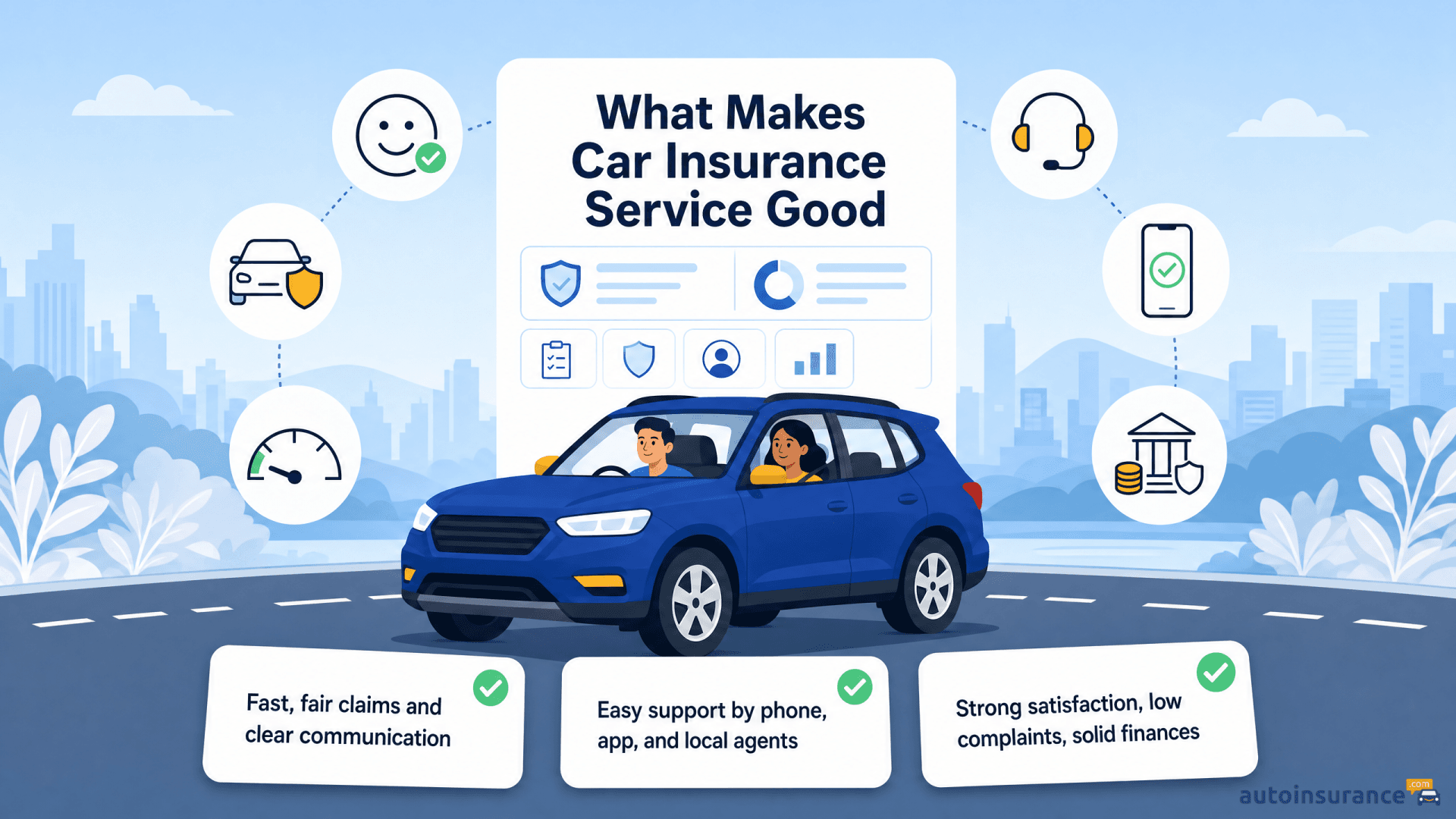
Quality car insurance is defined by efficient claims processing, accessible support, and overall financial stability.
Good customer service can make a significant difference when you need help with your policy or have to file a claim. The best insurers make it relatively simple to get help, understand your coverage, and resolve problems when you need to use your policy.
Here are some of the main factors to consider when evaluating car insurance companies on customer service:
Strong customer satisfaction
Ratings from policyholders can provide insight into an insurer’s overall service, including interactions with representatives and how well the company meets customer expectations. J.D. Power’s main customer satisfaction study surveys real customers and measures seven core factors: level of trust, price for coverage, people, ease of doing business, coverage offerings, problem resolution, and digital channels.
Resources to consult: J.D. Power U.S. Auto Insurance Study1
High claims satisfaction
Although claims will hopefully be few and far between, evaluating how an insurer handles them is particularly important. Look for insurers that perform well on communication, ease of filing, fairness of settlements, and time to resolve claims.
Resources to consult: J.D. Power U.S. Auto Claims Satisfaction Study2, CRASH Network Report Card3
Low complaint rates
Policyholders can log complaints with state departments of insurance for various issues, including unfair settlements, denials, or delays. Reviewing complaint rates can give you a sense of which insurers you may be more likely to run into problems with.
Resources to consult: NAIC Complaint Index4
Accessible support
Consider how many ways you can reach the company and when help is available. Phone, online chat, email, and local agents can all make it easier to get assistance when you need it. For claims specifically, most insurance companies now have 24/7 claims intake. However, you should consider whether the insurer’s app allows you to file claims (or only make payments) and whether the company has agents easily reachable by phone, or even local offices if you prefer to meet with a representative in person.
Resources to consult: Insurer’s official website
Strong digital experience
Most of the time, your interactions with your insurance company will be day-to-day policy management and payments; you may also need to file and track a claim. A user-friendly website and mobile app can make all of these tasks more convenient.
Resources to consult: J.D. Power U.S. Digital Experience Study5, App Store and Google Play Store ratings
Available local agents
Drivers who prefer personalized assistance may benefit from insurers with extensive networks of local agents who can answer questions and provide help with their policies. If this type of service is important to you, it makes sense to prioritize companies with local agents.
Resources to consult: Insurer’s official website
Solid financial strength
This is an additional metric to look at in conjunction with overall claims satisfaction — an insurer’s financial stability can affect the customer experience as it reflects its ability to pay covered claims after a major loss. Low financial stability ratings are a red flag and indicate that you might have a harder time resolving claims.
Resources to consult: AM Best6
The resources listed here are among the most reliable sources for evaluating companies’ customer service records, but they are largely quantitative. For more context on the types of issues that existing policyholders have experienced, it can be helpful to also consult sources like the BBB, mobile app store reviews, and even Reddit.
However, keep in mind that dissatisfied customers may be more likely to leave reviews, so ratings and individual experiences from these sources should be viewed in context rather than taken as definitive measures of customer service.
How Agent Models Impact Customer Service
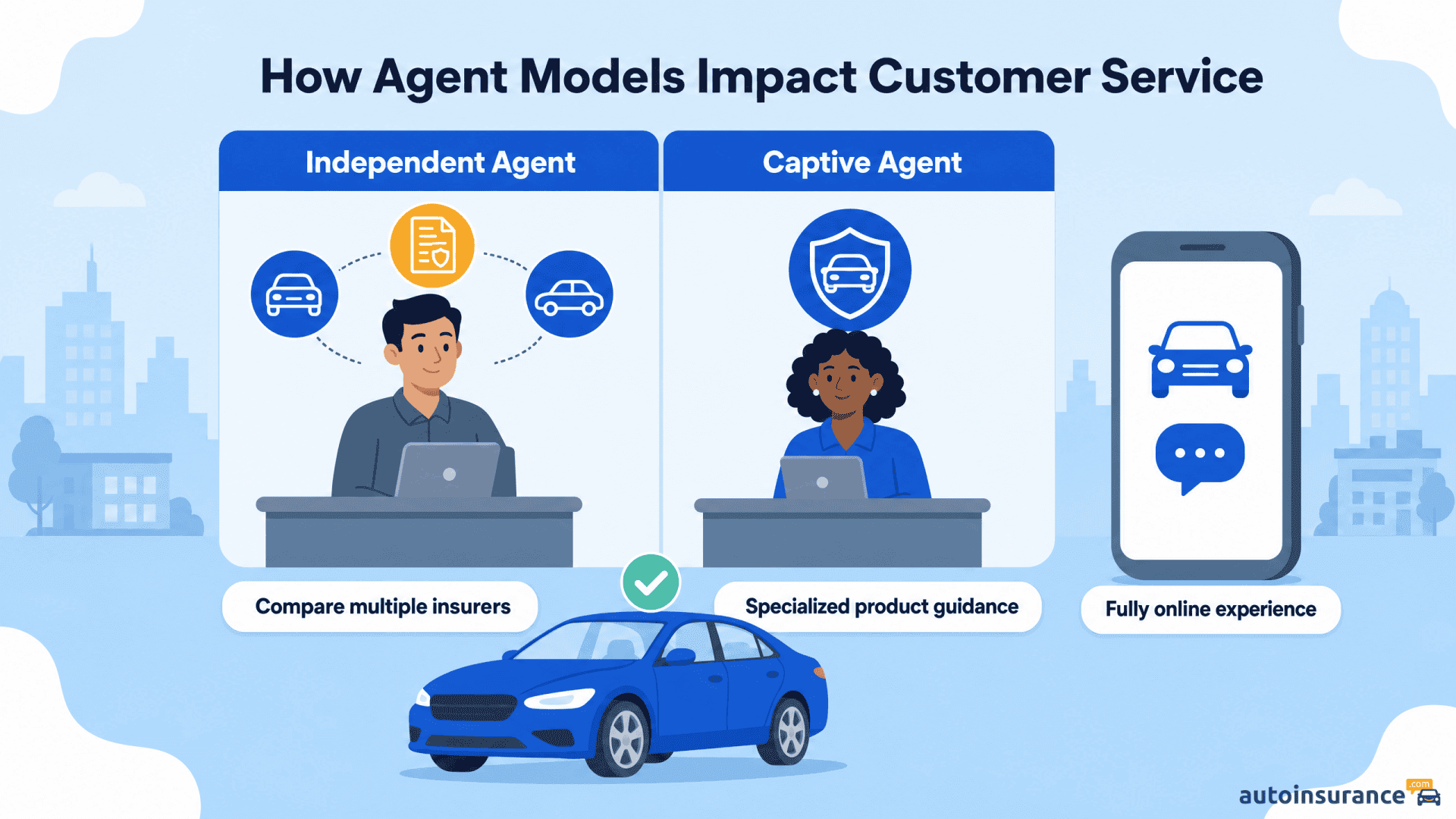
Choosing between an independent agent, a captive agent, or an online platform changes your insurance experience.
Insurance companies use different models when it comes to how they sell insurance and their reliance on agents, whether captive or independent. The type of agent an insurer uses can affect how you interact with the company and the type of service you’re provided.
GOOD TO KNOW
Independent agents sell policies from multiple insurance companies and can help you compare coverage and pricing. They usually work for local agencies and brokerages that represent many different insurers. Meanwhile, captive agents represent a single insurer and generally provide more specialized knowledge of their insurer’s products.
Of course, whether you prefer working with an agent also comes down to personal preference. Some drivers may prefer fully online interactions and consider that better service than having to call or meet with an agent. When evaluating an insurer’s customer service, consider its business model and how it aligns with the type of support and interaction you prefer.
| Captive agents | Independent agents | Direct-to-consumer | |
|---|---|---|---|
| Examples* | State Farm, Allstate, Farmers | Travelers, Nationwide, Erie | GEICO, Progressive Direct, USAA |
| Agent Support | You have a dedicated agent who can help with policy questions and advocate on your behalf | An independent agent can advocate on your behalf and may have more options if one insurer can’t meet your needs | You work directly with the insurer rather than through an agent |
| Price & shopping | Can provide rates from a single insurer and identify available discounts | Can compare prices from all of the insurers the agency represents | You compare prices yourself across insurers |
| Best fit | Drivers who value a personal relationship with one insurer and agent | Drivers who want personalized advice and the ability to compare multiple insurers | Drivers who prefer online or phone-based service and are comfortable managing their insurance themselves |
*Note that some companies have hybrid business models but have been included in a single category for the sake of simplicity. For example, Allstate also sells policies online direct-to-consumer.
Best Car Insurance Companies for Customer Service
Some companies stand out when evaluating various customer service metrics across industry reports. These are by no means the only companies with good customer service, but they are a good starting point.
Service can also vary by region, as many of the top companies in J.D. Power’s Auto Insurance Study are smaller regional providers. Be sure to prioritize regional ratings where possible, as they will provide a better indication of which companies are more likely to provide a positive experience based on where you live.
| Company | Best for | J.D. Power Customer Satisfaction | J.D. Power Claims Satisfaction | Average annual full coverage premium |
|---|---|---|---|---|
| State Farm | Broad nationwide availability | Above average in Central, Florida, Mid-Atlantic, New England, New York, North Central, Northwest, Southwest, Texas
Below average in California, Southeast | Above average | $2,030 |
| USAA | Military | Above average in all regions | Above average | $1,533 |
| Erie | Overall value | Above average in Mid-Atlantic, New York, North Central, and Southeast (all regions where available) | Above average | $1,833 |
| Nationwide | Low-mileage drivers | Above average in California, Central, North Central, Southeast, Texas
Below average in Mid-Atlantic, New York | Above average | $1,987 |
| Amica | Digital experience | Above average in New England | Above average | $2,274 |
You can read our full breakdowns of the best for customer service and the best for claims.
Does Good Customer Service Mean Higher Car Insurance Rates?
Finding a car insurance company with excellent service can mean you pay a higher premium in some cases, but it doesn’t necessarily. Smaller regional providers, in particular, — like Erie or Farm Bureau affiliates — tend to have competitive rates in the regions they serve while delivering top-notch service. In fact, all of the companies in our list above have average full coverage premiums below the national average.
There can sometimes be a trade-off, since insurers that invest heavily in local agents, 24/7 support, claims resources, and other customer-service features may have higher operating costs, which can sometimes be reflected in premiums. Insurers that serve high-net-worth individuals, like Chubb and AIG, tend to have very highly rated service and are more expensive on average.
Always get quotes from several providers and consider customer satisfaction, claims handling, and complaint data in addition to the premium you’re quoted.
Recap
Customer service is an important factor to consider in addition to price when comparing car insurance providers. Dealing with an insurance company is never fun, but an insurer with good customer service can make those interactions more seamless and less stressful. Various industry reports can be helpful to consult, including J.D. Power’s studies and the NAIC complaint index.
You should also consider whether you prefer to work with a captive or independent agent or manage your policy directly. Overall, the best company for you will be the one whose service, coverage, claims handling, and price best fit your needs.
Frequently Asked Questions
Whether it’s cheaper to buy insurance directly or through an agent depends on several factors — neither is always cheaper than the other. The price you pay for insurance depends on the company, your driving record, where you live, and more. Working with an independent agent can help you find the best rates because they can easily compare several options for you, but those quotes won’t necessarily be lower than what you’d find on your own.
Regional insurers tend to have the best customer satisfaction ratings, including Erie, Shelter, Wawanesa, and Farm Bureau. Amica, State Farm, and Travelers also have top ratings, depending on the region.
Car insurance companies with high complaint rates and low customer satisfaction and claims ratings should generally be a last resort. These are often companies that cater to high-risk drivers. Fred Loya, National General, Direct Auto, and The General all tend to rank very low on industry reports.
A good deductible amount depends on how much you can comfortably pay out of pocket after an accident. The most common deductible amounts are $500 or $1,000. Lower deductibles generally mean higher premiums but lower out-of-pocket costs for a covered claim.
Sources
Auto Insurers Struggle to Maintain Seamless Interactions Across Channels, JD Power Finds. JD Power. (2026, Jun 09).
https://www.jdpower.com/business/press-releases/2026-us-auto-insurance-studySatisfaction with Auto Insurance Claims Strained by Higher Deductibles, More Total Losses, JD Power Finds. JD Power. (2025, Oct 27).
https://www.jdpower.com/business/press-releases/2025-us-auto-claims-satisfaction-studyTop Rated U.S. Car Insurance Companies for 2026. Crash Network. (2026).
https://www.crashnetwork.com/irc/Consumer Insurance Search Results. NAIC. (2026).
https://content.naic.org/cis_refined_results.htmInsurance Websites and Apps Miss Opportunities to Build Customer Engagement, JD Power Finds. JD Power. (2026, May 13).
https://www.jdpower.com/business/press-releases/2026-us-insurance-digital-experience-study
Related Articles

Insurance Agent vs. Insurance Broker: What’s the Difference?
August 13, 2026
7 Signs It’s Time to Switch Car Insurance Companies (Beyond Price)
September 18, 2026
Best Car Insurance for Customer Service in 2026
September 3, 2026