
 866-589-5339






Do You Need to Have Insurance to Register a Car in Florida?
The laws surrounding car registration and insurance in the Sunshine State
Get quotes from providers in your area

Discover rates as low as $24 /month


Last updated: August 18, 2026
In Florida, whether you’re registering a car for the first time or renewing your registration, you’ll need car insurance beforehand. But knowing that you have to do something and knowing how to do it are two different things. We’ve scoured the state of Florida’s websites to show you exactly how to register your car so you don’t get penalized.

Find out if you’re overpaying for auto insurance.
See how much you could be saving! Let’s get started by entering your ZIP Code.
Do You Have to Have Insurance to Register a Car in Florida?
Yes, in the state of Florida, you have to have proof of insurance to register a car. These are the minimum auto insurance requirements in Florida:
- Property damage liability (PDL): $10,000 minimum limit
- Personal injury protection (PIP): $10,000 limits per person and per accident
Florida is a no-fault state, meaning that if you get into an accident and it’s your fault, each party will pay for their own injuries under PIP. You would only be financially responsible for the other party’s property damage.
For leased and loaned vehicles, you may be required to buy gap insurance in Florida, along with collision and comprehensive coverage. However, this is typically a stipulation of your lessor or loaner, not of the state of Florida itself.
Once you have the minimum insurance required, it’s time to register your car (or renew your registration if it’s run out). This process will look different for Florida residents versus non-residents. Let’s start with the Floridians.
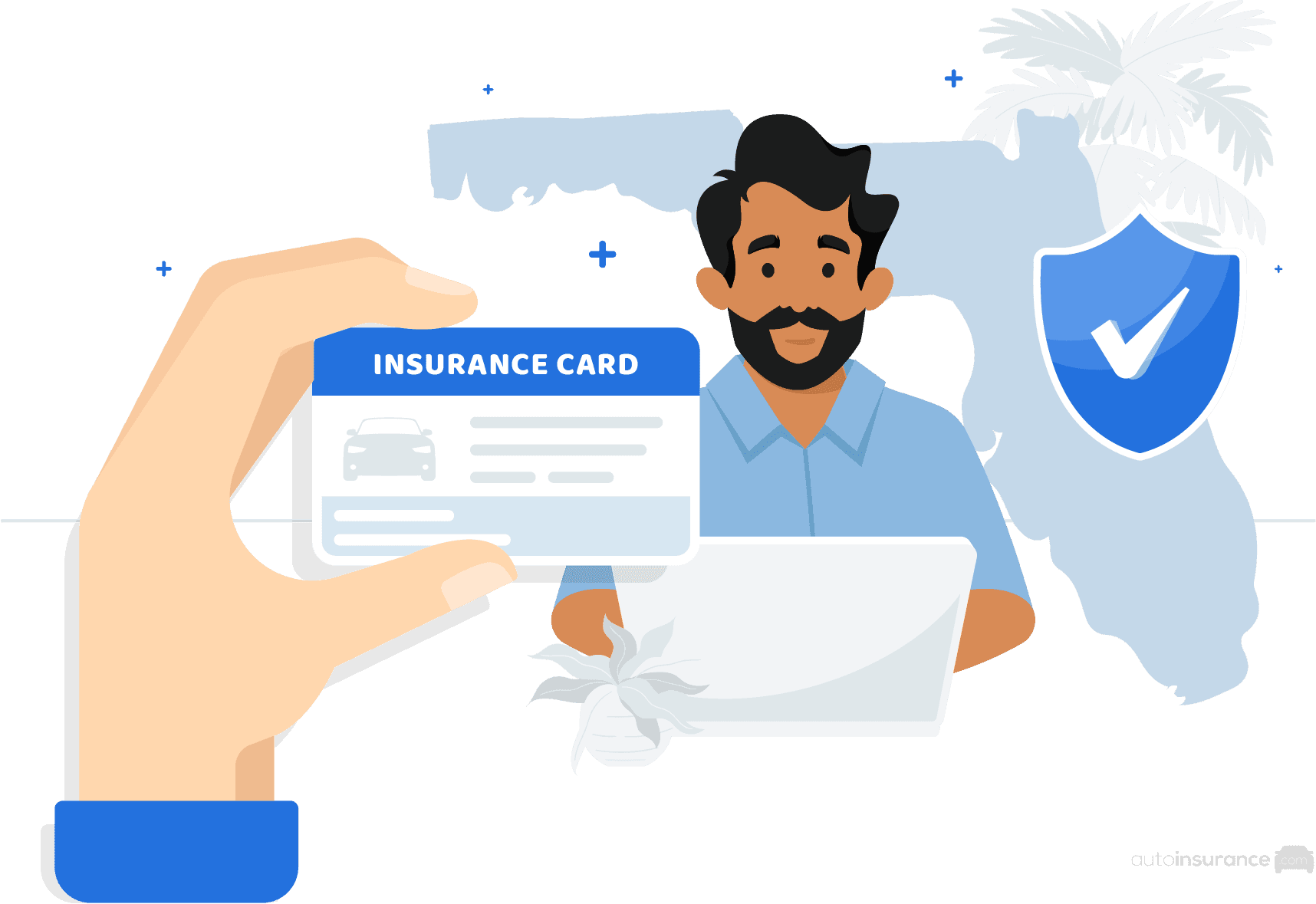
Residents
Who counts as a Florida resident? Obviously, there are permanent residents:
- Have begun employment or have engaged in a profession, occupation, or trade in Florida.
- Have children enrolled in Florida’s public schools.
- Have filed homestead tax exemption on Florida property.
- Have lived in Florida for more than six consecutive months.
- Have registered to vote in Florida.
If you’ve just become a Florida resident, you’ll need to get a Florida license within 30 days of establishing residency and Florida car insurance within 10 days of establishing residency. The next step is to transfer your title to Florida, which will look different based on whether your vehicle has a lien or not.
- A vehicle with a lien: Ask your lienholder to transfer your title to Florida. If they refuse to send it, ask them for a written refusal on letterhead. If they agree to send it, complete the Application for Certificate of Title With/Without Registration at the DMV. Either way, you’ll still be required to register your vehicle in Florida.
- A vehicle without a lien: Prepare a packet with your proof of identity, proof of Florida insurance, original out-of-state title, completed Application for Certificate of Title With/Without Registration, and verification of the physical inspection of your vehicle identification number (VIN).1 Remember, if you get stopped by police, you’ll need to show them proof of insurance, so make sure to have it in your vehicle at all times.
Non-Residents Registering Out-of-State Vehicles
Even if you’re not a resident of Florida, you will have to insure your vehicle with a Florida policy if:
- You accept employment or engage in an occupation, profession, or trade in Florida.
- You enroll your kids in a Florida public school.
You’ll need to obtain a registration certificate and license plate within 10 days of the start of your employment or your children’s enrollment. You’ll need a Florida certificate of title for your vehicle as well.
Non-Running Vehicles
Got a vehicle that doesn’t run? You won’t need to register it, as it’s not operated on Florida roads.2 That being said, you might still want to get insurance on a car that doesn’t run, as it’s still susceptible to auto theft, vandalism, and weather-related incidents. We recommend comprehensive coverage for these potential damages.
How to Register or Renew Registration for a Car in Florida
Here are step-by-step instructions on how to register or renew your registration in the Sunshine State.
Documentation You’ll Need
For initial registration, you’ll need these documents:
- Proof of identity (a birth certificate or passport will do)
- Proof of insurance
- Completed Application for Certification of Title With/Without Registration
You can renew your license either online or on a mobile app, but to start a new registration, you’ll need to register in person.
Online
- Visit https://mydmvportal.flhsmv.gov/Home/en/Account/Landing.
- Log in to MyDMV Portal or create an account.
- Complete the transaction by paying a $2 processing fee.
- You’ll receive your new registration in the mail in seven to 10 business days.
Mobile App
- Download the mobile app MyFlorida for the FLHSMV from the Apple or Google Play store.
- Provide your license plate number or VIN.
- Pay the $4 processing fee with a credit card, or the $3.75 processing fee with a checking account.
- You’ll receive your registration in the mail, but until then, you can use a digital document in the mobile app.
In Person
- Visit any Florida motor vehicle center with the correct documentation.
- Hand the documentation to a clerk to start the registration.
- If you have all the correct documentation, you can get your registration card on the same day.
From a Car Dealer
If you purchased your car from a dealer, they can handle the registration, applying for a tag or title within 30 days of the sale. In the meantime, you’ll drive home with a temporary paper tag.
Dealers handle the registration fees differently. Some will charge you separately for the tax, tag, and title transfer fees, along with a processing or handling fee.
Alternatively, if you sign a cash-on-delivery form, you’ll reimburse the dealer for the registration costs. If you don’t pay, the dealer could stop the registration until they receive payment. Either way, you’ll avoid a trip to the DMV, always a plus in our book.
Military
If you’re a member of the U.S. military, you’ll use special forms to title and register your motor vehicle, available on the Florida Department of Highway Safety and Motor Vehicles (FLHSMV) website (https://www.flhsmv.gov/military/).
Fees
The cost of registering your car depends on your vehicle type. See how much your registration fee will be below.
| Vehicle type | Registration fee |
|---|---|
| Motorcycle | $10 |
| Moped | $5 |
| Antique motorcycle | $7.50 |
| Antique automobile | $7.50 |
| Automobile (net weight up to 2,499 pounds) | $14.50 |
| Automobile (2,500-3,499 pounds) | $22.50 |
| Automobile (3,500 or more pounds) | $32.50 |
| Autocycle | $10 |
| Truck (net weight up to 1,999 pounds) | $14.50 |
| Truck — based on weight (2,000-3,000 pounds) | $22.50 |
| Truck — based on weight (3,001-5,000 pounds) | $32.50 |
| Goat truck | $7.50 |
| Antique truck | $7.50 |
| Heavy truck (5,001-5,999 pounds) | $60.75 |
| Heavy truck (6,000-7,999 pounds) | $87.75 |
| Heavy truck (8,000-9,999 pounds) | $103 |
| Heavy truck (10,000-14,999 pounds) | $118 |
| Heavy truck (15,000-19,999 pounds) | $177 |
| Heavy truck (20,000-26,000 pounds) | $251 |
| Heavy truck (26,001-34,999 pounds) | $324 |
| Heavy truck (35,000-43,999 pounds) | $405 |
| Heavy truck (44,000-54,999 pounds) | $773 |
| Heavy truck (55,000-61,999 pounds) | $916 |
| Heavy truck (62,000-71,999 pounds) | $1,080 |
| Heavy truck (72,000 or more pounds) | $1,322 |
| Heavy truck/tractor (150-mile radius) | $324 |
| Heavy truck/tractor (agriculture 150 miles) | $87.75 |
| Heavy truck/tractor | $324 |
| Semitrailer (per registration year) | $13.50 |
| Semitrailer (permanent registration) | $68 |
| Special-purpose vehicle | $44 |
| School bus | $41 |
| Wrecker | $41 |
| Other wrecker (10,000-14,999 pounds) | $118 |
| Other wrecker (15,000-19,999 pounds) | $177 |
| Other wrecker (20,000-25,999 pounds) | $251 |
| Other wrecker (26,000-34,999 pounds) | $324 |
| Other wrecker (35,000-43,999 pounds) | $405 |
| Other wrecker (44,000-54,999 pounds) | $772 |
| Other wrecker (55,000-61,999 pounds) | $915 |
| Other wrecker (62,000-71,999 pounds) | $1,080 |
| Other wrecker (72,000 or more pounds) | $1,322 |
| Hearse or ambulance | $40.50 |
| Motor vehicle for hire (under 9 passengers) | $17 |
| CWT (weight per 100 pounds) | $1.50 |
| Motor vehicle for hire (over 9 passengers) | $17 |
| CWT (weight per 100 pounds) | $2 |
| Trailer for private use (under 500 pounds) | $6.75 |
| Trailer for private use (over 500 pounds) | $3.50 |
| CWT (weight per 100 pounds) | $1 |
| Trailer for hire (under 2,000 pounds) | $3.50 |
| CWT (weight per 100 pounds) | $1.50 |
| Trailer for hire (over 2,000 pounds) | $13.50 |
| CWT (weight per 100 pounds) | $1.50 |
| Recreational vehicle (5th wheel) | $27 |
| Recreational vehicle (camping trailer) | $13.50 |
| Recreational vehicle (under 4,500 pounds) | $27 |
| Recreational vehicle (over 4,500 pounds) | $47.50 |
| Dealer and manufacturer license plate | $17 |
| Exempt/official license plate | $4 |
| Locally operated motor vehicle for hire | $17 |
| CWT (weight per 100 pounds) | $2 |
| Transporter | $101.25 |
| Commercial motor vehicle surcharge on vehicles 10,000 pounds or more | $10 |
| Original/replacement license plate | $28 |
| Initial registration | $225 |
Moving Out of State
If you’re moving out of state, make sure not to cancel your insurance in Florida until you’ve completed your vehicle registration in your new state and surrendered your license plate and registration to the DMV. Otherwise, you risk a lapse in coverage, which could put you at risk legally and lead to higher auto insurance rates down the line. See more information on driving without insurance below, or read our auto insurance FAQs for even more knowledge.
Self-Insurance
There is one loophole in Florida’s auto insurance requirements. Technically, according to Florida car insurance laws, you can get a self-insurance certificate, but to qualify, you’ll need to:
- Have an unencumbered net worth of at least $40,000 for the first car and $20,000 for each additional car.
- Maintain a sufficient net worth to be financially responsible for potential losses.3
NOTE
In finance, “unencumbered” means that the currency is free of liens, charges, mortgages, and anything else that could prevent immediate liquidation.4
Do you have at least $40,000 in cash? Probably not, which is why you’re better off paying for an auto insurance policy than self-insuring.
Florida License Plates
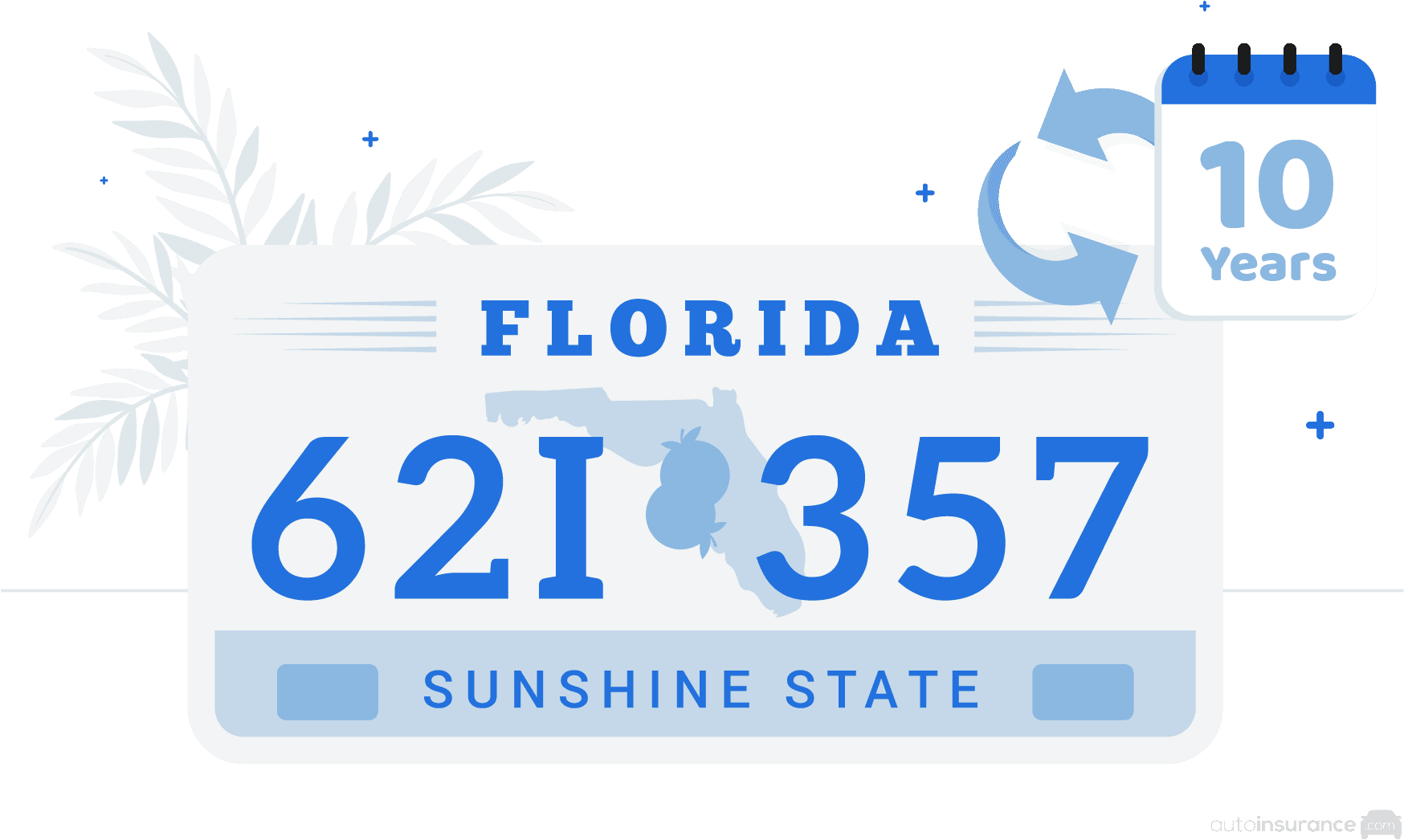
In Florida, you need to replace your license plate once a decade as part of the registration process.
Fees
Here’s what you’ll pay for a new license plate for automobiles and trucks.
| Classification of license plate | Net weight (in pounds) | Annual tax and other fees |
|---|---|---|
| Automobiles, private use | Up to 2,499 | $27.60 |
| Automobiles, private use | 2,500-2,499 | $35.60 |
| Automobiles, private use | 3,500 and up | $45.60 |
| Trucks, private and commercial use | Up to 1,999 | $27.60 |
| Trucks, private and commercial use | 2,000-3,000 | $35.60 |
| Trucks, private and commercial use | 3,001-5,000 | $45.60 |
FYI
The average cost of a new license plate in Florida is $36, while the average cost of car insurance in Florida is $1,431.56 according to the latest NAIC data—and has risen to near double that for full coverage, according to our most recent analysis—the fourth-highest state in the country.5
Options
You have two options for the design of the license plate itself, standard or specialty. Standard license plates can say one of these:
- Sunshine State
- Your county name
- In God We Trust (the state’s motto)
If you want to add a little more personality to your vehicle or identify yourself (e.g., as a disabled person, government employee, or Native American), get a specialty license plate. Here are your options:
- Authenticated
- Collegiate
- Commercial vehicle
- Diplomatic/legislative
- Disabled person
- Environmental/wildlife
- Front end for emergency personnel
- Governmental
- Historical vehicle
- Military
- Military services
- Miscellaneous
- Motorcycle
- Native American
- Special interest (agriculture, “choose life,” Challenger, etc.)
- Sports
Penalties for Driving Without Insurance in Florida
If you’re caught driving without insurance in Florida, you could face a suspended license for up to three years or registration plus a reinstatement fee of up to $500. If you’ve let your insurance lapse for whatever reason, you can reinstate your auto insurance with affordable Florida auto insurance.
Recap
Now you know everything there is to know about registering a car in Florida, which, again, requires auto insurance. To avoid license suspensions or worse, it’s best to follow the letter of the law with the best car insurance in Florida.
Citations
New Resident – Welcome to Florida!. FLHSMV. (2022).
https://www.flhsmv.gov/new-resident/2011 Florida Statutes. The Florida Senate. (2022).
https://www.flsenate.gov/laws/statutes/2011/320.02The 2021 Florida Statutes. Online Sunshine. (2022, Jan 11).
http://www.leg.state.fl.us/statutes/index.cfm?App_mode=Display_Statute&URL=0300-0399/0324/Sections/0324.171.htmlunencumbered value definition. Law Insider. (2022).
https://www.lawinsider.com/dictionary/unencumbered-value2020/2021 Auto Insurance Database Report. National Association Of Insurance Commissioners. (2024, Jan). https://content.naic.org/sites/default/files/publication-aut-pb-auto-insurance-database.pdf
Related Articles
Do You Need Insurance to Register a Car in California?
August 17, 2026
Guide to Car Insurance in Illinois
August 20, 2026