866-589-5339






Top Car Insurers in Pennsylvania
Discover Pennsylvania's most reliable car insurance options.

Drivers in the Keystone State pay an average of $2,473 per year for full coverage car insurance.
Get quotes from providers in your area

Discover rates as low as $24 /month


If you own one of the over 10 million cars registered in Pennsylvania, you’ll pay around 5 percent more than the national average for auto insurance. The average cost of full coverage auto insurance in the state is $2,473 per year, while minimum coverage costs an average of $603 per year.
Let’s take a closer look at how much car insurance would cost, on average, for a variety of demographics.
The more coverage you purchase, the more you’ll pay for auto insurance. In Pennsylvania, minimum coverage must include medical payments coverage.1
| Level of coverage | Annual average rate in Pennsylvania | Monthly average rate in Pennsylvania |
|---|---|---|
| Minimum coverage car insurance | $603 | $50 |
| Full coverage car insurance | $2,473 | $206 |
The cost of auto insurance varies widely depending on the insurance company. At $1,516 annually, Travelers has the lowest average annual full coverage premium in the Keystone State.
| Company | Annual average rate in Pennsylvania | Monthly average rate in Pennsylvania |
|---|---|---|
| Travelers | $1,516 | $126 |
| Erie | $1,882 | $157 |
| GEICO | $2,083 | $174 |
| Nationwide | $2,216 | $185 |
| USAA | $2,329 | $194 |
| State Farm | $2,352 | $196 |
| Allstate | $2,603 | $217 |
| Progressive | $2,611 | $218 |
| Pennsylvania average | $2,473 | $206 |
Like in all states, Pennsylvania auto insurance rates can vary depending on where you live. Insurance companies consider population density, the cost of living and medical care, theft and vandalism rates, and the likelihood and severity of auto accidents within your zip code, to rate policies. Here’s the average annual cost for full coverage for six of the largest cities in Pennsylvania.
| City | Annual average rate in Pennsylvania | Monthly average rate in Pennsylvania |
|---|---|---|
| Philadelphia | $4,315 | $360 |
| Pittsburgh | $2,426 | $202 |
| Allentown | $2,437 | $203 |
| Erie | $2,308 | $192 |
| Scranton | $2,330 | $194 |
| Harrisburg | $2,055 | $171 |
Many states, including Pennsylvania, allow age to be a contributing factor in car insurance premiums. That means young drivers under 20 generally pay the highest premiums due to their inexperience as drivers.
| Age | Annual average rate in Pennsylvania | Monthly average rate in Pennsylvania |
|---|---|---|
| 16 | $5,234 | $436 |
| 18 | $3,596 | $300 |
| 20s | $2,586 | $194 |
| 30s | $2,473 | $206 |
| 40s | $2,100 | $143 |
| 50s | $1,860 | $128 |
| 60s | $1,992 | $145 |
| 70s | $1,584 | $127 |
One of the best ways to lower your insurance premium, and keep it low, is to maintain a clean driving record. Having tickets, DUI convictions, or at-fault accidents on your record could catapult you into a high-risk driver category and increase your premium significantly.
| Violation record | Annual average rate in Pennsylvania | Monthly average rate in Pennsylvania |
|---|---|---|
| Clean driving record | $2,473 | $206 |
| Speeding ticket | $2,665 | $222 |
| Accident | $3,015 | $251 |
| DUI | $3,930 | $328 |
Pennsylvania allows auto insurance companies to take into account your credit score when calculating your premium. The better your credit score is, the less you’ll pay for car insurance.
| Credit score | Annual average rate in Pennsylvania | Monthly average rate in Pennsylvania |
|---|---|---|
| Poor | $3,424 | $285 |
| Fair | $2,154 | $179 |
| Good | $1,988 | $166 |
| Excellent | $1,551 | $129 |
Everyone wants to pay as little as possible for car insurance. Whether you have a clean driving record or prefer to purchase only the minimum coverage, Pennsylvania drivers will discover the lowest average annual premium with these insurance companies:
| Demographic | Cheapest company | Annual rate in Pennsylvania |
|---|---|---|
| Full coverage | Travelers | $1,516 |
| Minimum coverage | Erie | $398 |
| Military/veterans | USAA | $2,329 |
| Teens | Travelers | $4,044 |
| Seniors | Travelers | $1,428 |
| Speeding ticket | Erie | $1,884 |
| At-fault accident | Travelers | $1,515 |
| DUI | Travelers | $2,326 |
| Poor credit | Nationwide* | $2,791 |
*After USAA
Get quotes from more than one insurance company to be sure you’re getting the cheapest rate.
If you’re unsure about what discounts might be available to you, ask your auto insurance company to go over all the ways you can save on your premium.
Pennsylvania law mandates all residents who own a motor vehicle must have current vehicle liability insurance to cover property damage or injuries to others in a car crash as well as medical payments coverage for injuries to you and your passengers:
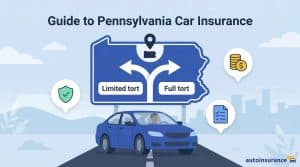
Pennsylvania is one of three states that gives drivers a choice between limited- or full-tort coverage. If you pick limited-tort coverage, your premium will be lower, but you will not be able to sue for pain and suffering after a car accident unless the injuries fall within the “serious injury” definition, which is defined by Pennsylvania law.4 If you opt for full-tort coverage, you will pay more but retain the right to sue for pain and suffering, even if there’s no serious bodily injury after a car accident.
The state also has modified comparative negligence laws, which means you would receive money only if your percentage of fault is less than the defendant’s. For instance, if you’re found 30 percent responsible for an accident and the other person involved is 70 percent responsible, your damages would be tied to your degree of fault.5
While some states mandate drivers with a DUI must obtain an SR-22 to prove minimum insurance coverage, Pennsylvania does not require this form.
It’s wise to purchase more than the minimum amount of auto insurance to provide better protection for you and your vehicles. Taking advantage of discounts and maintaining an excellent credit score will ensure you save on your premium. Compare quotes from at least three providers to find the cheapest policy.
We analyze average premiums in Pennsylvania for full and minimum coverage for good drivers with good credit as well as various driver profiles, including those with DUIs, at-fault accidents, speeding tickets, low credit and households with teenagers. Full coverage averages use the following limits:
Yes. According to the Pennsylvania Department of Transportation (PennDOT), vehicle owners must present proof of insurance prior to having their vehicle inspected at a vehicle inspection station. If an owner does not provide proof, the inspection official will not issue a certificate of inspection and also may report the lack of insurance to PennDOT.
In Pennsylvania, auto insurance follows the vehicle, not the driver. This means if you let someone else drive your vehicle and they are in an accident, your insurance company probably would be responsible for paying any claims, depending on your coverage.
According to the Pennsylvania Department of Motor Vehicles, state law provides a grace period of 31 days for someone without car insurance. You must submit an affidavit stating your vehicle was not operated during that coverage lapse to avoid having your vehicle registration suspended for three months.
No, you will not face jail time or be arrested for driving uninsured as a Pennsylvania resident. Those who drive without car insurance do face the following repercussions:
Auto Guide. Commonwealth of Pennsylvania. (2026).
https://www.insurance.pa.gov/Documents/auto_guide.pdf
View Consolidated Statute Title 18. Pennsylvania General Assembly. (2026).
https://www.palegis.us/statutes/consolidated/view-statute?txtType=HTM&ttl=18&div=0&chapter=23#:~:text
Older Driver. Pennsylvania Department of Transportation. (2026).
https://www.penndot.pa.gov/TravelInPA/Safety/TrafficSafetyAndDriverTopics/Pages/Older-Driver.aspx
Title 75. Pennsylvania General Assembly. (2026).
https://www.palegis.us/statutes/consolidated/view-statute?txtType=HTM&ttl=75&div=0&chapter=17§ion=5&subsctn=0
7102. Comparative negligence. Pennsylvania Legislature. (2026).
https://www.legis.state.pa.us/WU01/LI/LI/CT/HTM/42/00.071.002.000..HTM